Reference
Exact recorded citation of the original deed (book/page or instrument number) so the county recorder links the correction to the earlier record and title examiners can trace changes.
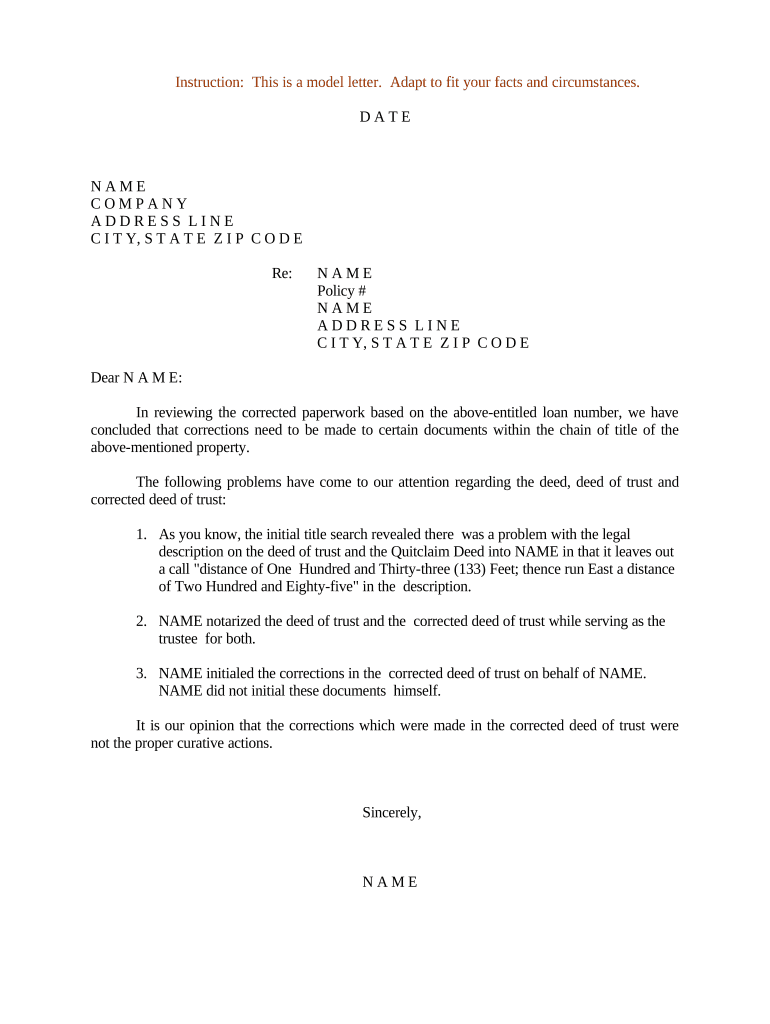
A Corrected Deed preserves an accurate chain of title, prevents future ownership disputes, and reduces risk for buyers, lenders, and insurers. Timely corrections avoid flagged title exceptions, potential mortgage defaults tied to documentation errors, and costly post-closing litigation over property description or identity.

Coordinate among all stakeholders—owner, lender, title insurer, and county recorder—to avoid rework and ensure acceptance.
Exact recorded citation of the original deed (book/page or instrument number) so the county recorder links the correction to the earlier record and title examiners can trace changes.
Full legal names of grantor(s) and grantee(s) matching the recorded deed and IDs to avoid ambiguous identity and ensure consistency in title records and insurance.
Complete metes and bounds or lot/block description copied verbatim from the recorded deed to identify the corrected parcel without introducing new ambiguities.
A clear clause describing the error and the corrected text (for example, correction of spelling, typographical error, or transposed numbers) limited to the specific items being changed.
Signature lines, printed names, date lines, and a notary acknowledgement formatted to state requirements so recorders accept the instrument.
Recorder cover sheet or stapled information listing documentary transfer tax, return address, and recording information to expedite county processing and delivery of recorded copies.
| Field | Configuration |
|---|---|
| Document Upload | PDF/A preferred; include original deed copy |
| Signature Type | Typed or drawn with audit trail |
| Authentication | Email + SMS or KBA for higher assurance |
| Notary Process | Enable RON where state permits |
Verify county recorder acceptance of electronically-signed or remotely-notarized deeds in advance and retain the full audit trail and notary recording for submission.
Begin correction as soon as error is discovered to avoid chain-of-title issues.
Allow time for in-person or RON session; some states require specific identity proofing steps.
Many recorders process same day to several business days depending on workload and county.
Title underwriters may require recorded correction before issuing clearance for sale or refinance.
Lenders occasionally require corrected deed recorded before funding or final lien release.
| signNow | DocuSign | Adobe Sign | PandaDoc | HelloSign | |
|---|---|---|---|---|---|
| Starting Price | $8/user/mo | $15/user/mo | $14/user/mo | $19/user/mo | $15/user/mo |
| Free Trial | 7-day trial | Verify with vendor | Verify with vendor | Verify with vendor | Verify with vendor |
| Bulk Send | Yes | Yes | Yes | Yes | No |
| Audit Trail | Yes | Yes | Yes | Yes | Yes |
| HIPAA Compliant | Yes | Yes | Yes | No | No |
| Envelope Cap | No cap | 100 envelopes/user/year | Varies | Varies | Varies |
A buyer discovers a misspelled grantee name in a recorded deed which clouds title.
A parcel’s lot number was transposed in the legal description causing a title exception during refinance review.