Establishing secure connection…Loading editor…Preparing document…

Dispute Letter for Fraudulent Account

This template is fully customizable. Edit the text, fill out the fields, and send it for signature. Give it a try!
Dispute Letter for Fraudulent Account

What a Dispute Letter for Fraudulent Account Is and When to Use It

A Dispute Letter for Fraudulent Account is a written notice you send to a creditor, merchant, or consumer reporting agency to contest charges or an account opened without your authorization. It explains why an account or transaction is fraudulent, requests investigation or removal, and lists supporting facts and documentation. Use this letter when you discover identity theft, unauthorized charges, or accounts opened in your name; it complements criminal identity-theft reports and formal notifications to credit bureaus and creditors under the Fair Credit Reporting Act.

Why a Clear Dispute Letter Matters

A concise, well-documented dispute letter speeds investigation, creates a written record, and preserves legal protections under the FCRA and other consumer-protection laws. It clarifies your request and the evidence you rely on, which helps credit bureaus and creditors meet their legal obligations.

Why a Clear Dispute Letter Matters

Who Typically Prepares and Sends This Letter

Individuals who discover unauthorized accounts, identity-theft victims, and authorized representatives commonly prepare dispute letters to correct credit files or stop collection activity.

  • Consumers: Victims identifying fraudulent charges or accounts in their credit reports.
  • Authorized agents: Attorneys, credit-repair professionals, or identity-theft advocates acting with written authorization.
  • Financial institutions: Loss mitigation or fraud teams submitting on behalf of customers in documented cases.

Step-by-Step: Drafting and Sending Your Dispute Letter

Follow these core steps to prepare a complete dispute letter and submit it to the correct party.

  • 01
    Gather Evidence: Collect statements, police report, FTC Identity Theft Report, and government ID copies.
  • 02
    Write Letter: State the fraud facts, include dates, account IDs, and the remedy you want.
  • 03
    Attach Proof: Scan and attach supporting documents; redact unrelated personal data.
  • 04
    Send & Track: Send certified mail or e-submit with delivery receipt; keep copies for records.

How the Dispute Process Typically Proceeds

Understanding the typical flow helps set expectations for responses from creditors and bureaus.

  • Submit Dispute: You send the letter to the creditor or credit bureau with evidence.
  • Acknowledgement: Entity confirms receipt and begins investigation per applicable rules.
  • Investigation: Creditor or bureau verifies records, contacts furnisher, and reviews evidence.
  • Resolution: Result recorded; corrections or removals are posted and you receive notice.

Digital Workflow Settings for eSubmission

When submitting electronically, configure authentication, field requirements, and delivery receipts to strengthen the record.

Field Configuration
Authentication Email + SMS code or identity verification for higher assurance
Signature Type Typed name or drawn signature, with audit trail
Attachments PDF or image uploads allowed, require required documents
Delivery Receipt Enable read receipt and download certificate of completion

Technical Considerations for eSubmission and eSignatures

Use a secure eSignature and document platform that provides tamper-evident records, an audit trail, and secure file storage.

  • Document Formats: PDF, DOCX supported
  • Authentication Options: Email, SMS, KBA, SSO
  • Integrations: CRM and cloud storage connectors

Essential Elements to Include in a Professional Dispute Letter

A complete dispute letter both documents the fraud and gives the recipient the facts needed to act. Include these elements to reduce follow-up requests.

Identification

Full legal name, current address, and contact details so the investigator can verify identity and send responses.
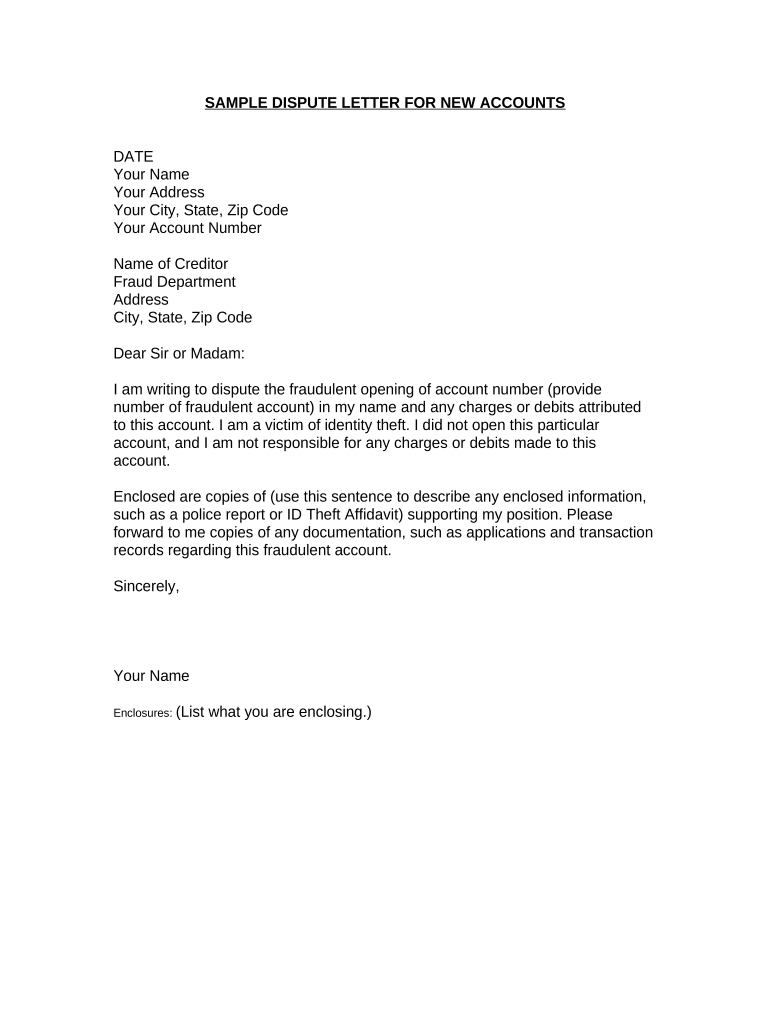
Account Details

Exact account numbers, creditor names, dates, and transaction amounts that identify the disputed item without ambiguity.

Concise Narrative

Numbered, factual description of why the account or charges are fraudulent, avoiding opinion and including specific dates.

Supporting Evidence

Attach police report, FTC Identity Theft Report, billing statements, ID copies, and any correspondence that corroborates the claim.

Requested Correction

Specify whether you want removal, reversal of charges, or a notation of fraud on the account and credit report.

Signature and Date

Sign and date the letter; include a statement that the information is true to the best of your knowledge.

Privacy and Security Items to Protect

Redact Nonessential: Mask unrelated SSN digits
Secure Attachments: Use encrypted PDFs
Limit Distribution: Send only to necessary parties
Audit Trail: Preserve delivery and access logs
BAA if PHI: Use BAA for healthcare data
Retain Originals: Keep signed copies securely

Common Pitfalls That Slow or Undermine Disputes

  • Submitting incomplete account identifiers or vague descriptions that force the investigator to request clarification and delay resolution.
  • Failing to include a police report or FTC Identity Theft Report when requested, which reduces the likelihood that a furnisher will remove accounts.
  • Using informal language or omitting a clear requested remedy, causing the receiving party to interpret rather than act on your intent.
  • Sending to the wrong recipient (creditor versus credit bureau) or failing to use trackable delivery, which complicates proof of timely submission.

Consequences of an Incorrect or Misleading Dispute Letter

Delayed Resolution: Missing information causes additional review time
Denial of Claim: Insufficient evidence can result in rejection
Credit Reporting Impact: Unresolved accounts may continue to affect score
Potential Liability: False statements may expose legal risk
Collection Actions: Unaddressed fraud may lead to collections
Legal Costs: Attorney involvement increases expenses

Timing Expectations for Investigations and Responses

Typical federal timelines and practical deadlines help set expectations after you submit a dispute letter.

Credit Bureau Response:

Investigations typically conclude within 30 days of receipt.

Furnisher Review:

Furnishers usually have 30 days to investigate and respond.

Document Retention:

Keep copies for at least three years or longer if litigation is possible.

Notary/RON Sessions:

If notarized, expect scheduling and fee variations by provider.

Follow-Up Window:

Send follow-up 30–45 days if no satisfactory response.

Vendor Pricing and Feature Snapshot for eSignature Support

Comparison of starting prices and a few common capabilities relevant when sending and signing dispute letters; signNow is listed first as the baseline.

signNow DocuSign Adobe Sign PandaDoc HelloSign
Starting Price $8/user/mo $15/user/mo $14/user/mo $19/user/mo $15/user/mo
Free Trial 7-day free trial Verify Verify Verify Verify
Bulk Send Yes Yes Yes Yes Verify
Audit Trail Yes Yes Yes Yes Yes
HIPAA Compliant Yes Yes Yes No No
Envelope Cap No cap 100 envelopes/user/year Verify Verify Verify

Frequently Asked Questions About Disputing a Fraudulent Account

Answers to common questions about evidence, timelines, e-signatures, and next steps to help you avoid delays.


Need help? Contact support

be ready to get more
Join over 28 million airSlate SignNow users