Caption
Identify the document as an Affidavit to Prove Date of Birth and Parentage and include the jurisdiction or purpose (e.g., for passport or USCIS support). Use a clear title line to help reviewers locate the document in a case file.
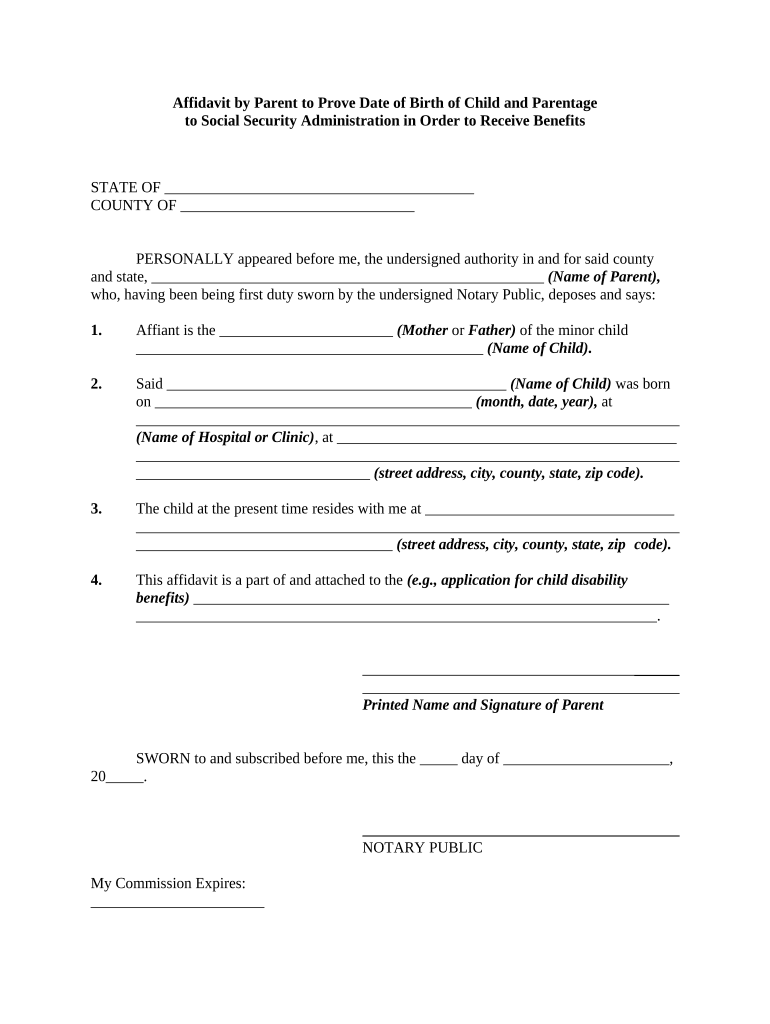
This affidavit provides a practical alternative when certified birth records are unavailable, offering a sworn record that agencies and courts frequently accept to establish identity, age, and parentage. It reduces delays in benefits, travel, and enrollment where a primary document cannot be produced.

Proper execution, supporting evidence, and notarization increase the affidavit's acceptance across administrative agencies and courts.
The affiant signs the affidavit and declares the facts under oath. This is usually the person whose birth or parentage is at issue or a close relative with firsthand knowledge; accuracy is critical because false statements can carry criminal penalties.
Witnesses or secondary declarants sign to corroborate specific facts when the affiant lacks direct knowledge. Agencies may require one or more witness affidavits or professional attestations (e.g., clergy or medical personnel) to strengthen the evidentiary record.
Identify the document as an Affidavit to Prove Date of Birth and Parentage and include the jurisdiction or purpose (e.g., for passport or USCIS support). Use a clear title line to help reviewers locate the document in a case file.
A first-person statement from the affiant describing how they know the birth date and parentage facts, including specific dates, places, and relationships to the person named; avoid hearsay language where possible.
A numbered exhibit list referencing attached documents such as hospital records, baptismal certificates, school records, or witness affidavits; each exhibit should be labeled and cross-referenced in the body text.
Optional sworn witness statements from individuals with direct knowledge. Witnesses should include contact information and explain the basis of their knowledge in plain terms to strengthen credibility.
A notary block that includes notary signature, printed name, commission number, expiration date, and official seal. For RON, include session details consistent with state RON rules and retention requirements.
The affiant’s handwritten signature with a printed name and signing date. If multiple affiants or witnesses sign, provide separate signature blocks and dates for each party.
Submit the affidavit when an agency requests secondary evidence
Processing times vary; attach affidavit with supporting documents
Follow USCIS instructions for supporting evidence with petitions
Notarization occurs at signing; RON sessions may be scheduled immediately
RON audio/video may be retained 5–10 years per state rules
Prepare clear factual statements and exhibit list.
Obtain copies of hospital, school, or religious records.
Sign before a notary or complete a RON session.
File with the agency and respond to requests.
Ensure any eSignature provider you use meets ESIGN/UETA and the receiving agency’s notarization or RON requirements before electronic submission.
| Criteria | Electronic Affidavit | Notarized Paper |
|---|---|---|
| Enforceability | yes (esign/ueta) | yes (traditional) |
| Notary method | remote or in-person | in-person only |
| Processing speed | faster | slower |
| Agency preference | varies by agency | widely accepted |
| signNow | DocuSign | Adobe Sign | PandaDoc | HelloSign | |
|---|---|---|---|---|---|
| Starting Price | $8/user/mo | $15/user/mo | $14/user/mo | $19/user/mo | $15/user/mo |
| Free Trial | 7-day free trial | Yes | Yes | Yes | Yes |
| Bulk Send | Yes | Yes | Yes | Yes | No |
| Audit Trail | Yes | Yes | Yes | Yes | Yes |
| HIPAA Compliant | Yes | Yes | Yes | No | No |
| Envelope Cap | No cap | 100 env/user/yr | Varies | Varies | Varies |