Establishing secure connection…Loading editor…Preparing document…

Debt Letter Notice

This template is fully customizable. Edit the text, fill out the fields, and send it for signature. Give it a try!
Debt Letter Notice

What a Debt Letter Notice Is and when it’s used

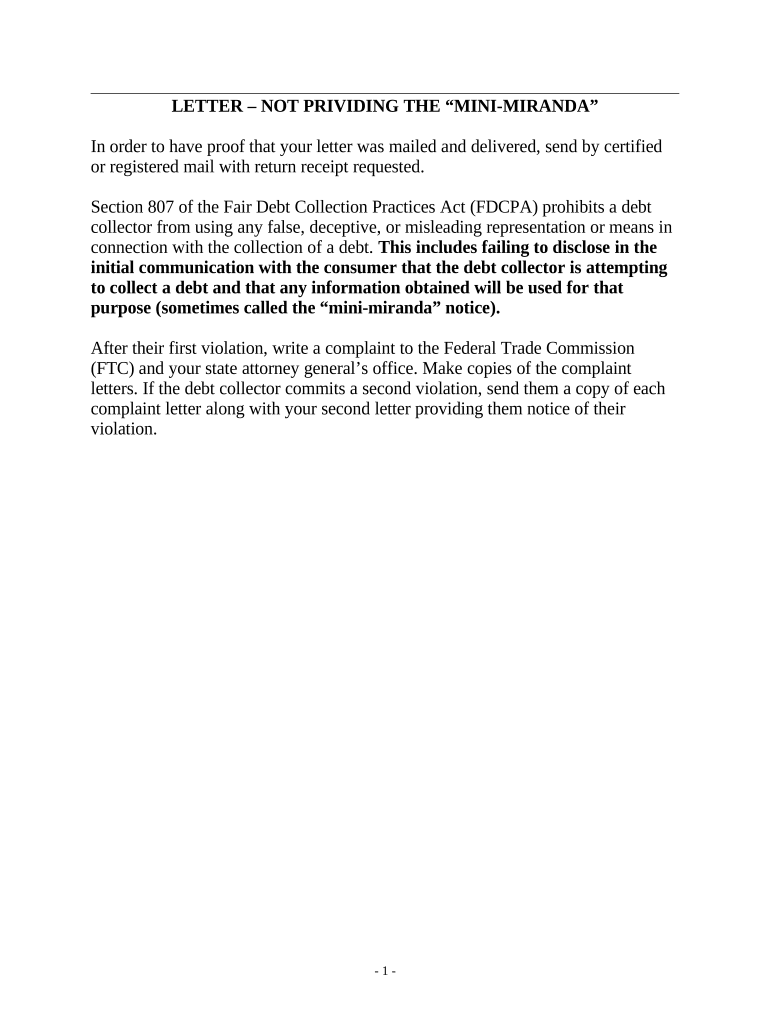
A Debt Letter Notice is a formal written communication from a creditor, collection agency, or attorney notifying a debtor of an outstanding obligation and requesting payment, dispute, or validation. It typically states the amount owed, account details, how to pay, and instructions to dispute or request verification. Debt Letter Notices are used for account collections, pre-litigation demand, and as evidence of notice in subsequent legal proceedings. Properly prepared notices reduce disputes, clarify rights, and create a documented record for both parties while meeting applicable consumer-protection requirements.
Why a clear Debt Letter Notice matters

A precise Debt Letter Notice creates a dated record, informs the debtor of rights and remedies, and can speed resolution without court action. Clear notices reduce compliance risk, limit consumer disputes, and help organizations demonstrate good-faith collection efforts under federal and state rules.

Why a clear Debt Letter Notice matters

Who prepares and receives Debt Letter Notices

Accurate routing and role-based review reduces legal exposure and ensures the notice meets consumer-protection and company policy requirements.

  • Creditor accounts teams issue initial demands and track responses, often coordinating billing and customer-service records.
  • Collection agencies send validation and demand notices when accounts are past due and manage dispute responses.
  • Legal departments or counsel draft pre-litigation demands or notices intended for court-admissible record keeping.

Who can sign or approve a Debt Letter Notice

Authorized Signer

An authorized officer, collections manager, or licensed attorney may sign formal demand letters; the signer should have delegated authority and be able to attest to account accuracy and mailing records in case of dispute.

Legal Counsel

When a notice is a pre‑litigation demand or contains specific legal warnings, in-house or external counsel often reviews and signs to ensure compliance with consumer‑protection laws and to preserve litigation strategy.

Essential sections every professional Debt Letter Notice should include

A complete notice balances clarity, required disclosures, and supporting detail. Include identification, statement of debt, dispute rights, payment options, deadlines, and contact instructions to reduce later challenge.

Account Identification

Provide the original creditor name, account or invoice number, and any reference numbers so the debtor and their representatives can immediately verify which obligation the notice concerns without ambiguity or unnecessary back-and-forth.

Amount and Breakdown

State the outstanding principal, accrued interest, fees, and any payments applied, with dates. A clear itemized total reduces disputes over calculation and supports collection or settlement discussions.

Payment Instructions

List acceptable payment methods, payee name, mailing or electronic payment address, and any reference that must accompany payment. Include deadlines and effective dates for partial payments or offers.

Dispute and Validation Rights

Explain the recipient’s right to dispute the debt and request verification, including the timeframe for doing so and the procedure for submitting disputes or requests for documents.

Consequences of Nonpayment

Describe potential outcomes such as reporting to credit bureaus, referral to collections, or legal action. Use neutral language and avoid threatening or misleading statements that could violate consumer‑protection rules.

Contact and Record Details

Include sender name, address, phone, email, representative ID, and a clear statement of record retention procedures to help both parties maintain a verifiable audit trail for any follow-up or legal matters.

Step-by-step: preparing and sending a Debt Letter Notice

Follow a consistent sequence: verify account data, prepare the notice, obtain approvals, deliver by chosen method, and retain proof of delivery in records.

  • 01
    Verify Account Data: Confirm balances, dates, and debtor contact details in the billing system.
  • 02
    Draft Notice: Populate template fields, include dispute language, and itemize charges.
  • 03
    Review and Approve: Obtain manager or legal sign-off if required before sending.
  • 04
    Deliver and Log: Send via chosen channel and record proof of delivery or transmission.

Configuring an online workflow for Debt Letter Notices

Set up a template-driven workflow that automates field population, approvals, and delivery while preserving an audit trail for compliance and dispute response.

Field Configuration
Template Pre-fill standard text and required fields for consistency
Approval Add one or two approvers based on dollar threshold
Delivery Choose email, certified mail, or eDelivery with read receipt
Retention Enable automatic storage and retention policies after sending

Typical end-to-end flow for sending and managing notices

A standard lifecycle includes creation, authorization, delivery, recipient response, and record retention. Automate steps to minimize manual errors.

  • Create: Load template and populate account fields automatically.
  • Authorize: Route to manager or legal for sign-off when required.
  • Deliver: Send via chosen channel and capture delivery proof.
  • Record: Store signed copy and audit log for compliance and disputes.

Digital delivery and eSubmission considerations

Match delivery method and signer authentication to the notice’s legal sensitivity and the recipient’s preferences to ensure admissibility and traceability.

  • Authentication: Email link, SMS code, or stronger KBA as required
  • Proof of Delivery: Read receipts, certified mail, or signed PDF with audit trail
  • Integrations: CRM and document storage integrations reduce manual reconciliation

Key timing rules and recipient response windows to observe

Several consumer‑protection and internal timelines govern notices; track notice date, dispute windows, and internal follow-up dates to remain compliant and efficient.

Initial Validation Period:

Allow 30 days for the recipient to dispute or request verification

Immediate Notice Timing:

Deliver validation information within five days of first communication when required

Payment Deadline:

State the date by which payment must be received to avoid escalations

Internal Follow-up:

Set a 7–14 day internal reminder for unanswered notices

Escalation Window:

Allow a reasonable period before referral to collections or legal action

Milestones from notice creation to final resolution

Track major stages so teams can monitor progress and evidence compliance at each milestone.

01

Prepare Notice

Verify account data and prepare the populated template.

02

Send Notice

Deliver via chosen channel and capture proof of transmission.

03

Receive Response

Log disputes, payments, or verification requests received.

04

Resolve or Escalate

Accept payment, set up arrangement, or refer to collections or counsel.

Common mistakes that lead to disputes or noncompliance

  • Using vague language about amounts or creditor identity that leaves recipients unsure which account is referenced and increases dispute volume.
  • Sending notices without verifying the current balance or applying recent payments, which can result in inaccurate demands and damaged customer relations.
  • Failing to include clear dispute or validation instructions, which may violate consumer‑protection requirements and extend resolution time.
  • Not retaining proof of delivery or audit logs, limiting the ability to defend collection steps in litigation or regulatory inquiries.

Potential legal and operational consequences of incorrect notices

Regulatory Risk: Regulators may find violations of consumer‑protection rules
Civil Liability: Recipient may sue for inaccurate or misleading communications
Credit Reporting Harm: Incorrect reporting can trigger correction obligations
Reputational Damage: Poor handling damages customer trust and retention
Increased Costs: More disputes raise administrative and legal expenses
Evidence Gaps: Missing delivery proof weakens enforcement or defense

Common eSignature vendor pricing and capability snapshot

Compare starting price, free trial, bulk send availability, audit trail, and HIPAA support across leading providers; signNow is listed first per vendor ordering rules.

signNow DocuSign Adobe Sign PandaDoc HelloSign
Starting Price $8/user/mo $15/user/mo $14/user/mo $19/user/mo $15/user/mo
Free Trial 7-day trial Varies Varies Varies Varies
Bulk Send Yes Yes Yes Yes No
Audit Trail Yes Yes Yes Yes Yes
HIPAA Compliant Yes Yes Yes No No

Illustrative scenarios for Debt Letter Notices

Examples show how notices vary by use: account collections, pre‑litigation demands, and reconciliations where documentation supports the claim.

Past-Due Account Collection

A creditor sends an itemized demand for an unpaid invoice to a business client, including payment instructions and a 30‑day dispute window

  • The client requests verification within 30 days
  • The file includes invoice copies and audit logs to support further collection steps if unresolved.

Pre-Litigation Demand

Legal counsel drafts a formal demand outlining outstanding principal and legal consequences, with a deadline for cure

  • The recipient receives the notice by certified mail and e‑delivery
  • The preserved delivery receipts and signed PDF support counsel’s decision to negotiate or file suit if the deadline lapses.

Best practices to reduce disputes and preserve enforceability

Follow consistent procedures and documentation standards to lower risk and accelerate resolution while maintaining consumer-protection compliance.

Use a standardized template
Create an approved template that includes required disclosures, itemized amounts, dispute instructions, and signature blocks to ensure each notice contains the same compliant language and reduces review time.
Validate data before sending
Cross-check balances, recent payments, and account holder details against source systems to avoid sending incorrect or outdated demands that can lead to disputes and regulatory exposure.
Capture delivery proof
Retain evidence of delivery such as read receipts, certified-mail tracking, or a signed PDF with an audit trail to support collection efforts and defend procedures in audits or litigation.
Document dispute handling
Log disputes and verification requests promptly, communicate timelines clearly to the recipient, and maintain a paper or electronic trail of all follow-up communications until resolution.

Required data elements to include for clarity and verification

Debtor Name: Full legal name
Creditor Identity: Company or agency name
Account Number: Unique reference ID
Amount Due: Currency with decimals
Effective Date: MM/DD/YYYY format
Contact Info: Phone, email, mailing address

Frequently asked questions about Debt Letter Notices

Answers to common questions about formatting, delivery, disputes, and digital signing to help teams avoid errors and respond to recipient inquiries.


Need help? Contact support

be ready to get more
Join over 28 million airSlate SignNow users