Establishing secure connection…Loading editor…Preparing document…

Debtor Examination

This template is fully customizable. Edit the text, fill out the fields, and send it for signature. Give it a try!
Debtor Examination

What a Debtor Examination Is and When It's Used

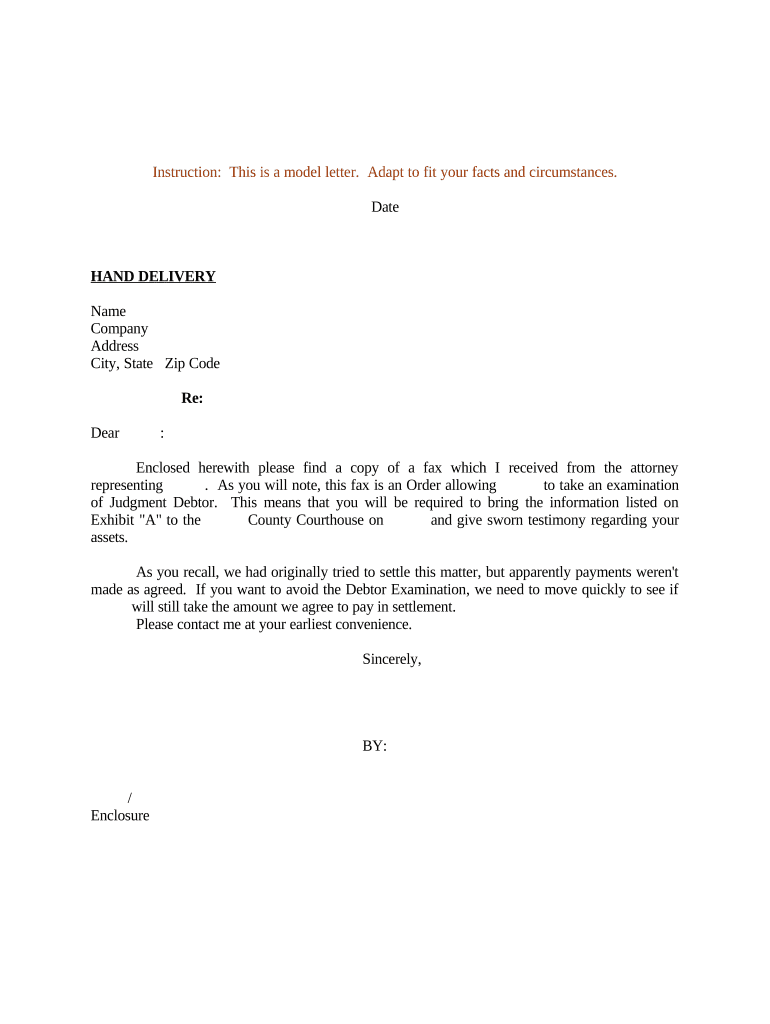
A Debtor Examination is a court-ordered procedure that allows a judgment creditor to examine a judgment debtor about assets, income, and financial affairs to aid collection. Typically conducted after a money judgment is entered, it can require the debtor to appear under oath, produce documents, and answer questions about bank accounts, real property, payors, and transfers. The session may occur in court, at counsel offices, or remotely if the jurisdiction permits remote testimony or notarization; procedures and available remedies vary by state and by local court rules.

Why a Debtor Examination Matters for Judgment Enforcement

A Debtor Examination provides formal discovery focused on collectable assets and third-party obligations, often revealing bank accounts, employer information, and transferable property. It supports post-judgment remedies such as garnishment, turnover orders, or contempt motions when a debtor refuses to cooperate.

Why a Debtor Examination Matters for Judgment Enforcement

Who Typically Requests or Participates in a Debtor Examination

Courts, collection professionals, and third parties identified by subpoena are all potential participants depending on local practice and the scope of the examination.

  • Judgment creditor or creditor counsel — Pursues examination to locate assets, validate solvency, and support collection motions.
  • Judgment debtor — Required to attend, produce requested documents, and answer under oath; may have counsel present.
  • Court personnel or special masters — Manage logistics, rule on objections, and issue subpoenas or enforcement orders.

Key Roles Authorized to Conduct or Administer the Examination

Collection Attorney

A licensed attorney representing the judgment creditor commonly prepares the motion, serves subpoenas, conducts the examination under court supervision, and files follow-up motions to enforce compliance or pursue garnishment.

Court Official

A judge or clerk enforces procedure, rules on objections, and may order sanctions or contempt if a debtor fails to appear, provide truthful testimony, or turn over ordered assets.

Core Elements to Include in a Professional Debtor Examination Form

A well-constructed Debtor Examination form organizes the court order, scope of inquiry, document list, oath language, logistics, and signature blocks so parties and the court can administer the session efficiently.

Case Caption

Full court caption and case number at the top so the order links directly to the judgment and is enforceable by the issuing court.
Order Language

Clear directive from the court stating the debtor must appear, the scope of questions, time and place, and consequences for noncompliance.

Scope & Documents

A precise list of required records (bank statements, tax returns, asset ledgers) and categories of financial information to be produced.

Oath and Verification

Standard oath or affirmation text and space for a notary or court officer to record sworn testimony and signature.

Logistics & Authentication

Fields for date, time, location, remote access details, authentication method used, and a record of service or subpoena.

Signatures

Signature blocks for the debtor, examining attorney, court officer, and notary with dates and printed names for clear attribution.

Step-by-Step: Preparing and Serving a Debtor Examination

Follow these sequential steps to prepare the motion, serve the debtor, gather documents, and conduct the examination with evidentiary integrity.

  • 01
    File Motion: File a motion or present the judgment order to obtain court authorization.
  • 02
    Issue Subpoena: Prepare and serve subpoenas for the debtor and any third parties for document production.
  • 03
    Assemble Records: Collect and index supporting requests and exhibits for efficient review during the examination.
  • 04
    Conduct Examination: Hold the session, record testimony, and obtain any ordered turnovers or admissions under oath.

How Electronic Completion and eSubmission Works for This Form

Digital workflows let counsel prepare the order, attach exhibits, and route the subpoena or order for authorized signatures while preserving an audit trail for court review.

  • Upload Document: Upload PDF or DOCX version of the order and exhibits to the e-signature platform.
  • Place Fields: Add signature, date, and checkbox fields for produced documents and authentication steps.
  • Authenticate Signer: Choose signer authentication (email link, SMS code, or stronger methods) consistent with court acceptance.
  • Capture Audit Trail: Record IP, timestamp, and action log for court-grade evidence of execution.

Recommended Digital Workflow Settings for Debtor Examinations

Configure the e-signature workflow to match court authentication expectations and to preserve evidentiary metadata.

Field Configuration
Signer Authentication Email + SMS code for identity verification; upgrade to KBA if required by local rules
Document Format Use PDF/A for retention and archival consistency with court exhibits
Audit Trail Enable full audit trail capture including IP, timestamps, and downloads
Retention Settings Retain original signed file and audit log for the statutory retention period

Technical Considerations for eSubmission and Remote Sessions

Use a platform that preserves cryptographic integrity and provides exportable audit reports so the court can verify signatures and execution history.

  • File formats: PDF, DOCX, and PDF/A accepted
  • Integrations: Supports systems like NetSuite and Google Workspace
  • Authentication: Email/SMS, KBA, or advanced signer verification

How a Debtor Examination Differs from Other Post-Judgment Discovery

Compare common discovery tools to clarify when a Debtor Examination is the appropriate remedy versus depositions or written interrogatories.

Criteria Debtor Examination Deposition
Primary Purpose enforce judgment testimony/discovery
Typical Scope financial assets focus broader fact-finding
Court Order Required often yes often yes
Produces Documents yes, targeted yes, broader

Typical eSignature Vendor Pricing and Feature Snapshot

A concise feature and pricing comparison with signNow listed first. Use vendor data to evaluate which plan aligns with your authentication and volume needs.

signNow DocuSign Adobe Sign PandaDoc HelloSign
Starting Price $8/user/mo $15/user/mo $14/user/mo $19/user/mo $15/user/mo
Free Trial 7-day trial Varies Varies Varies Varies
Bulk Send Yes Yes Yes Yes No
Audit Trail Yes Yes Yes Yes Yes
HIPAA Compliant Yes Yes Yes No No

Security and Compliance Elements to Include with Electronic Submissions

Encryption: AES-256 at rest; TLS 1.2/1.3 in transit
Audit Trail: Immutable timestamp and IP records
Access Controls: Role-based access and SSO options
Authentication: Email, SMS, KBA, or advanced options
HIPAA BAA: Business Associate Agreement available
ESIGN / UETA: Compliant with federal and state e-sign laws

Legal Risks and Consequences of Incomplete or Incorrect Examinations

Contempt: Court may impose contempt sanctions
Perjury Exposure: False statements may trigger criminal liability
Sanctions: Court-awarded sanctions and fees possible
Evidence Excluded: Improper procedure can render evidence inadmissible
Collection Delay: Errors prolong enforcement and increase costs
Civil Penalties: Monetary penalties or fee shifts

Common Preparation Errors to Avoid

  • Overbroad or vague document requests invite objections and may be narrowed by the court, delaying collection efforts and increasing litigation costs.
  • Failing to serve the subpoena or order properly can void the examination, requiring repeated service and additional filing fees.
  • Not matching the debtor's legal name or neglecting to include aliases or business names results in service and enforcement complications.
  • Relying on weak signer authentication or a missing audit trail risks evidentiary challenges to electronic execution in court.

Supporting Documents and Export Options

Include these companion materials and use standard export formats to facilitate court filings, among counsel, and for archival records.

Supporting Exhibits

Attach bank statements, pay stubs, deeds, and third-party subpoenas as labeled exhibits for the examination record.

Transcript

Create a verbatim transcript of the examination session and store as a signed PDF for the court record.

Certificate of Service

Complete and retain a signed certificate showing how and when subpoenas and orders were served.

Export Formats

Save final documents as PDF/A for archival use and as native DOCX for editing when permitted by court rules.

Frequently Asked Questions About Debtor Examinations

Answers to common operational and legal questions about conducting, serving, and documenting a Debtor Examination in U.S. practice.


Need help? Contact support

be ready to get more
Join over 28 million airSlate SignNow users