Establishing secure connection…Loading editor…Preparing document…

Homestead Declaration Form

This template is fully customizable. Edit the text, fill out the fields, and send it for signature. Give it a try!
Homestead Declaration Form

What a Homestead Declaration Form Is and when it applies

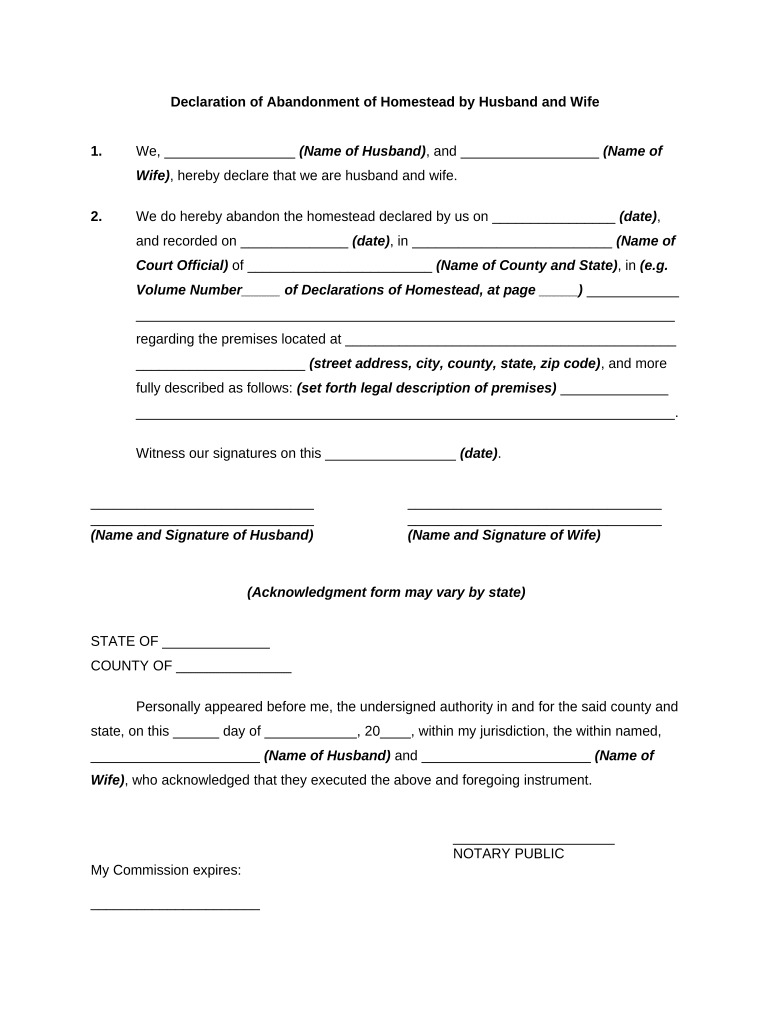
A Homestead Declaration Form is a sworn statement filed with a county recorder or assessor that identifies property as a primary residence for homestead protection or tax-exemption purposes. The form typically names the owner, the property legal description or parcel number, and the date the property became the principal residence. Recording the declaration can create statutory protections against certain creditors, establish eligibility for state homestead exemptions, and update tax-assessment records. Requirements, wording, and effects vary by state and county; confirm local filing rules before submitting a recorded declaration.

Why filing a Homestead Declaration matters

Filing reserves statutory protections and potential property tax benefits tied to primary residence status, clarifies ownership for public records, and helps ensure accurate assessment and exemption handling.

Why filing a Homestead Declaration matters

Who commonly completes a Homestead Declaration Form

The form is most commonly completed by property owners who occupy their home as their primary residence and want legal protections or tax exemptions.

  • Individual homeowners establishing homestead protection and tax exemption eligibility in their county.
  • Spouses or co-owners confirming a shared primary residence for exemption or creditor-protection purposes.
  • Estate attorneys and real estate professionals preparing recorded documents during transactions or post-closing updates.

If you represent a trust, LLC, or out-of-state owner, verify whether a homestead declaration is permitted and which supporting documents the county requires.

Step-by-step: filling and recording your Homestead Declaration

Follow these four practical steps to complete, authenticate, and record the declaration with minimal delays.

  • 01
    Prepare: Collect deed, parcel number, and ID for all owners.
  • 02
    Complete: Enter names, address, legal description, and claim date precisely.
  • 03
    Authenticate: Sign before a notary or required witness per state rules.
  • 04
    Record: Submit to county recorder and retain a certified copy.

How the filing and recording process typically flows

A recorded homestead declaration moves from preparation to public record; understanding each step reduces rejections and clarifies timelines.

  • Document Preparation: Draft or obtain the declaration template with accurate property details.
  • Authentication: Signers appear before a notary or meet witness rules as required.
  • County Submission: Deliver the signed declaration and pay recording fees to the county recorder.
  • Recording Confirmation: Obtain a recorded copy and update tax/assessor records if applicable.

Digital workflow settings to streamline completion and recording

Configure these settings when using an electronic signing workflow to match legal and county requirements.

Field Configuration
Authentication method Email link or SMS code; use stronger ID verification if required by state.
Notarization option Enable remote online notary (RON) only where state permits it.
Template locking Lock legal-description fields to prevent accidental edits.
Retention policy Store recorded PDF and audit trail for statutory retention period.

Platform and file-format considerations for e-filing

Use a platform that creates PDF/A or standard PDF output and preserves a complete audit trail for the signing session.

  • File types: PDF, DOCX compatible with county upload portals.
  • Integrations: Works with cloud storage and case management systems.
  • Authentication: Supports email, SMS, KBA, or advanced signer authentication.

Ensure the chosen platform preserves timestamps, signer metadata, and a downloadable certificate of completion to attach to recorded documents.

Essential elements to include in a professional Homestead Declaration Form

A complete declaration is concise but must include statutory language, accurate identification, and an authentication block that meets recorder and state requirements.

Title

Clear heading stating 'Homestead Declaration' so county staff can classify and route the document correctly during intake and recording.
Owner Identification

Full legal names for all owners, contact information, and ownership capacity (individual, trust, LLC) to establish who claims the homestead.

Property Description

Street address, parcel number, and legal description copied from the recorded deed to eliminate ambiguity about which parcel is claimed.

Claim Statement

A short sworn statement that the property is the signer's primary residence and is claimed under the applicable state homestead statute.

Notary / Witness Block

A notary acknowledgement and any witness lines required by state law; include space for notary seal and document recording number.

Recording Instructions

Instructions for county recorder: payment enclosed, number of copies, return address, and any required indexing information.

Data and security items to protect when handling the form

Encryption: TLS 1.2/1.3 and AES-256 at rest
Audit Trail: Timestamps, IP, and action log
Access Controls: Role-based signer permissions
HIPAA Consideration: BAA required for PHI handling
Standards: SOC 2 Type II and ISO 27001
Long-term Storage: Secure archival with tamper evidence

Common preparation errors to avoid

  • Using a P.O. box instead of the physical address causes rejection
  • Mismatched owner names between deed and declaration triggers corrections
  • Signing outside presence of required notary or witnesses voids acceptance
  • Failing to include parcel or legal description delays recorder indexing

Consequences of incorrect or incomplete declarations

Recording Rejection: Return or rejection by county
Loss of Exemption: Delayed tax benefit eligibility
Creditor Exposure: Limited homestead protection
1099/Tax Impact: Incorrect tax treatment risk
I-9 / Employment: Not applicable to employment verification
Legal Challenge: Potential disputes over ownership

Timing considerations and expected processing actions

Record the declaration promptly after completing the form to ensure timely indexing and recognition for tax-year or exemption deadlines.

When to File:

File once the property is your primary residence.

County Processing:

Recording may take days to weeks depending on volume.

Tax-Year Effect:

File before local exemption deadlines for same-year effect.

Notary Availability:

Schedule a notary in advance if required.

Record Retention:

Obtain certified copy for proof and appeals.

Comparison: common eSignature platform attributes relevant to this form

Platforms vary on price, compliance add-ons, and enterprise usage models; select a provider that supports notarization and long-term record retention.

signNow DocuSign Adobe Sign PandaDoc HelloSign
Starting Price $8/user/mo $15/user/mo $14/user/mo $19/user/mo $15/user/mo
Free Trial 7-day free trial Varies Varies Varies Varies
Bulk Send Yes Yes Yes Yes Yes
Audit Trail Yes Yes Yes Yes Yes
HIPAA Compliant Yes Yes Yes No No
Envelope Cap No envelope cap 100 envelopes/user/year Varies Varies Varies

Real-world examples of recorded homestead declarations

These summaries illustrate how property owners and firms used recorded declarations during transactions and record updates.

Martin Properties — Closing Update

A small broker prepared a declaration after closing to assert primary-residence status

  • Tim Martin used a standard county form to ensure consistent indexing
  • The recorded declaration helped the company correct assessor records and establish exemption eligibility without a separate court filing.

Optica Ventures — Title Cleanup

An investor recorded declarations to clear public title inconsistencies

  • The team matched legal descriptions to recorded deeds for each parcel
  • Recording the declarations produced certified copies that simplified subsequent closings and lender reviews.

Frequently asked questions about Homestead Declarations and electronic filing

Answers to common questions about acceptability, authentication, correction, and recording when preparing a Homestead Declaration Form.


Need help? Contact support

be ready to get more
Join over 28 million airSlate SignNow users