Establishing secure connection…Loading editor…Preparing document…

Demotion Letter

This template is fully customizable. Edit the text, fill out the fields, and send it for signature. Give it a try!
Demotion Letter

What a Demotion Letter Is and When It's Used

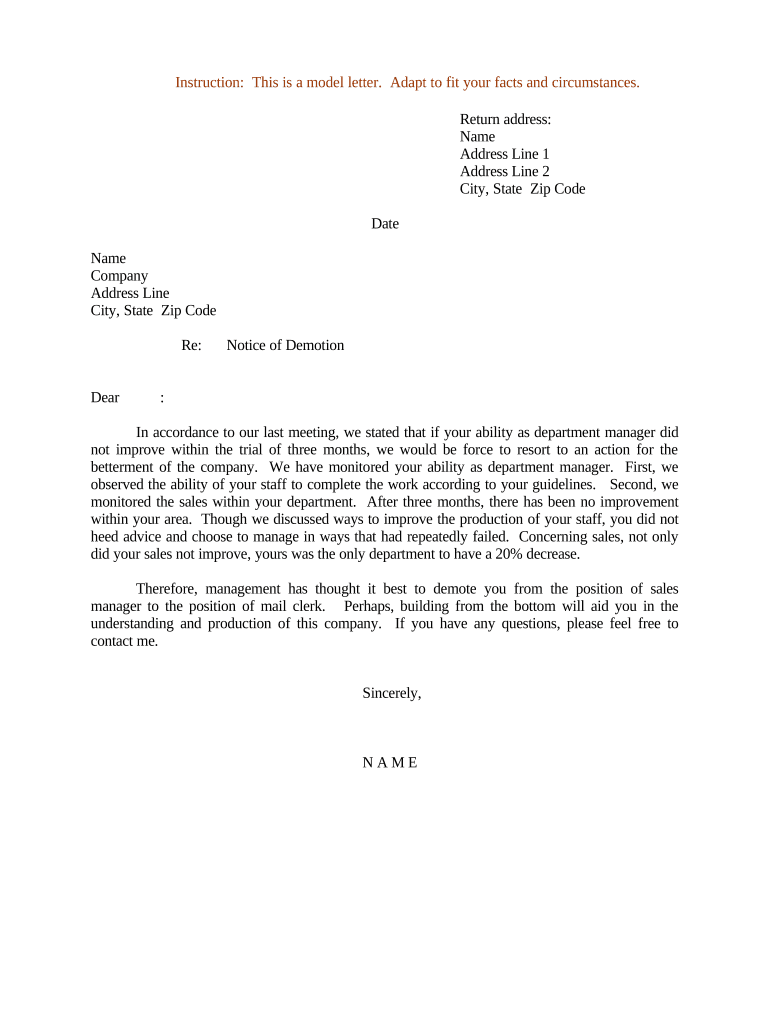
A Demotion Letter is a formal written notice that documents a change in an employee's job title, responsibilities, or pay grade that results in a lower-ranked position. It creates a clear record of the employer's decision, the effective date, the business reason and any changes to compensation or benefits. Employers use it to communicate expectations, preserve personnel records, and reduce dispute risk. The letter typically accompanies an in-person meeting and becomes part of the employee's personnel file for retention and compliance purposes.

Why Documenting a Demotion Matters

A written Demotion Letter provides clarity, protects legal compliance, and preserves an auditable record of the decision, mitigating misunderstandings and reducing litigation risk when properly executed and retained.

Why Documenting a Demotion Matters

Who Typically Prepares or Receives a Demotion Letter

Typical creators and recipients include HR, direct managers, and affected employees in employers of all sizes.

  • HR managers and personnel teams responsible for policy, documentation, and recordkeeping.
  • Direct supervisors or department heads who communicate performance-based or organizational reasons for the change.
  • Employees or their representatives who receive the notice and acknowledge understanding or disagreement in writing.

Core Elements to Include in Every Professional Demotion Letter

A complete Demotion Letter combines factual details, explanation, and next steps so both employer and employee clearly understand the change and its practical implications.

Header

Company name, employee legal name, job title, employee ID and contact details so records and payroll systems match personnel files and benefits records.
Effective Date

Clear effective date in MM/DD/YYYY format and any phased transition schedule so payroll and benefits teams apply adjustments on time.

Reason for Action

Concise, factual reason (performance, restructure, redundancy) avoiding speculative language; tie to prior warnings or organizational changes when appropriate.

New Role and Duties

New title and a brief duties summary describing substantive differences and reporting lines so job expectations are explicit.

Compensation and Benefits

Specify salary, hourly rate, bonus eligibility, benefits changes or preserved accruals and whether any pay reductions comply with state wage laws.

Appeal and Acknowledgment

Explain the process for employee questions, internal appeals, required signature or acknowledgment, and the contact person for follow-up.

Step-by-Step: How to Prepare and Issue a Demotion Letter

Follow a consistent sequence to minimize procedural risk, preserve documentation, and ensure payroll and benefits are adjusted correctly.

  • 01
    Document Decision: Confirm business justification and approvals.
  • 02
    Notify HR and Payroll: Coordinate timing and system updates.
  • 03
    Meet With Employee: Communicate changes and provide letter.
  • 04
    Obtain Acknowledgment: Collect signature and file record.

Typical Routing and Approval for a Demotion Letter

A standard routing workflow links decision-makers, HR, payroll, and the employee so actions are coordinated and auditable.

  • Manager Approval: Initiates the action and documents reason.
  • HR Review: Checks policy compliance and drafts letter.
  • Payroll Update: Applies compensation and benefits changes.
  • Employee Receipt: Employee signs and acknowledges.

Configuring an Electronic Demotion Letter Workflow

Set clear field mappings and authentication to ensure e-signed letters are legally defensible and integrate with HR systems.

Field Configuration
eSignature Type Email link with audit trail or stronger MFA when required
Recipient Order Manager → HR → Employee, sequential or parallel routing
Authentication Email+SMS code or SSO for higher assurance
Retention Policy Automatic archival to HRIS and secure document store

Technical Considerations for eSigning and Storing Demotion Letters

Ensure the chosen platform supports secure signatures, audit trails, and integration with HR or document management systems.

  • File Formats: PDF and DOCX supported
  • Integrations: Salesforce, NetSuite, Google Workspace
  • Security: TLS in transit; AES-256 at rest

Confirm BAA availability if healthcare data is present, verify 21 CFR Part 11 or other regulated requirements for your industry, and retain a defensible audit trail for each signed record.

Timing Considerations and Internal Deadlines

Track key internal deadlines from notification to payroll changes to ensure legal and operational consistency.

Notification Timing:

Deliver letter at or immediately after in-person meeting

Effective Date:

Set date to align with payroll cycles

Payroll Update Window:

Submit change before payroll cutoff

Appeal Period:

Provide internal timeline for grievances

File Entry:

Place signed letter in personnel record promptly

Common Pitfalls to Avoid When Preparing a Demotion Letter

  • Using vague language about reasons or expectations that invites misunderstanding or legal challenge.
  • Failing to coordinate with payroll, causing incorrect pay or benefit deductions and regulatory exposure.
  • Not documenting prior warnings or performance plans where relevant, weakening the employer’s justification.
  • Delivering the letter without a private in-person discussion, which can escalate employee relations issues.

Legal and Operational Risks of an Improper Demotion Letter

Wrongful Demotion: Potential discrimination or retaliation claim
Wage Violations: Improper pay deductions or overtime exposure
Contract Breach: Violation of employment agreement terms
Collective Bargaining: Union contract grievances may arise
Recordkeeping Failures: Lost evidence for defense
Operational Disruption: Degraded morale and retention

Comparison: eSignature Options for Executing Demotion Letters

Select an eSignature provider that supports audit trails, retention, and industry compliance; pricing and features vary by plan and vendor.

signNow DocuSign Adobe Sign PandaDoc HelloSign
Starting Price $8/user/mo $15/user/mo $14/user/mo $19/user/mo $15/user/mo
Free Trial 7-day trial Varies Varies Varies Varies
Bulk Send Yes Yes Yes Yes No
Audit Trail Yes Yes Yes Yes Yes
HIPAA Compliant Yes Yes Yes No No
Envelope Cap No envelope cap 100 envelopes/user/year Varies Varies Varies

Practical Tips for Accurate and Efficient Demotion Letters

Follow consistent wording and internal approval steps to reduce disputes and ensure correct administrative handling.

Use Plain, Factual Language
Avoid inflammatory or subjective terms. Stick to objective performance data or documented organizational reasons to reduce ambiguity and limit legal exposure.
Coordinate With Payroll
Verify effective date aligns with pay cycle and benefits changes so deductions, final pay calculations, and accruals are accurate.
Document Prior Steps
Attach performance reviews, corrective action plans, or reorganization memos where relevant; this preserves context for internal review or defense.
Preserve an Audit Trail
Use an eSignature solution that records timestamps, IP addresses, and signer authentication to support record reliability and retention policies.

Real-World Perspectives on Using eSignatures for Personnel Documents

Organizations report using eSignature platforms to streamline HR paperwork and maintain secure records across devices and locations.

Optica Ventures — COO

Optica simplified paperwork for remote transactions and internal records.

  • The team needed an easy interface for employees.
  • "The interface is simple and easy-to-use for our team; more importantly, it is just as easy for our customers."

Martin Properties — Founder

A small property firm moved personnel and lease documents online to speed processing.

  • Mobile signing was essential during site visits.
  • "I can process and execute all of these documents online with 100% compliance and built-in security."

Frequently Asked Questions About Demotion Letters and eSigning

Answers to common questions about enforceability, signatures, and recordkeeping for Demotion Letters, with plain-language guidance for employers and HR teams.


Need help? Contact support

be ready to get more
Join over 28 million airSlate SignNow users