Establishing secure connection…Loading editor…Preparing document…

Vermont Renunciation and Disclaimer of Property

This template is fully customizable. Edit the text, fill out the fields, and send it for signature. Give it a try!
Vermont Renunciation and Disclaimer of Property

What the Vermont Renunciation and Disclaimer of Property Is

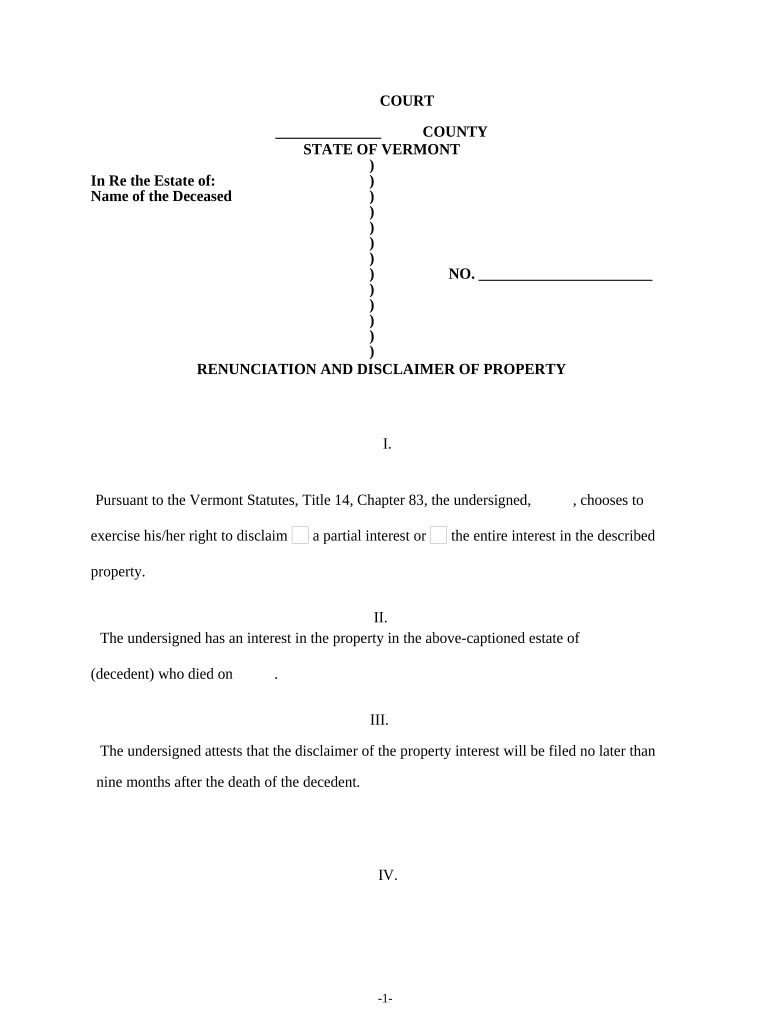
The Vermont Renunciation and Disclaimer of Property is a legal instrument used when a person formally refuses or disclaims an interest in real property, an inheritance, or other property rights under Vermont law. It documents that the named party declines all rights, title, and interest, and it can affect how property passes to other heirs or beneficiaries. When structured as a qualified disclaimer under federal tax rules, it can preserve favorable tax treatment (see IRC §2518). Because practical and statutory requirements vary, the document is often notarized and may require filing with a probate court or recording with a county land records office.

Why a Formal Renunciation or Disclaimer Matters

A written renunciation clarifies title, prevents accidental acceptance, and helps probate administration while preserving certain federal tax benefits when timed correctly.

Why a Formal Renunciation or Disclaimer Matters

Who Commonly Uses This Form

Parties use this form to decline property interests and to document the intended distribution path.

  • Heirs and beneficiaries who decline an inheritance to allow alternate distribution.
  • Personal representatives and executors resolving competing claims or simplifying estate administration.
  • Co-owners or tenants in common who reject an interest to preserve other parties' rights.

Typical Signatories and Their Roles

Heir / Beneficiary

An individual named by will or intestacy who elects to refuse the property. The heir must knowingly and unambiguously disclaim the interest and meet timing and formality requirements to avoid being treated as having accepted the property.

Executor / Administrator

A court-appointed fiduciary or estate representative who receives, files, or records the disclaimer to facilitate distribution, clear title, and close the estate in accordance with the decedent's estate plan or state intestacy rules.

Core Elements of a Professional Renunciation and Disclaimer

A complete Vermont Renunciation and Disclaimer of Property contains specific sections and language to ensure clarity, legal effect, and compatibility with tax and probate requirements.

Parties

Full legal names of the disclaimant and the decedent or original owner, including relationship and contact details to confirm identity and capacity.
Property description

A precise legal description or parcel ID for real property, or a clear description of personal property or equitable interests being disclaimed.

Statement of renunciation

Unambiguous language stating the disclaimant irrevocably refuses and renounces all rights, interests, and claims in the described property.

Effective date

The date the disclaimer is executed; this date can affect qualification under federal rules and probate timetables.

Notarization

Notary acknowledgement or remote online notarization details if required to establish authenticity and acceptability for recording or probate.

Tax and probate clauses

Optional language referencing IRC §2518 for qualified disclaimers and instructions about distribution to alternate beneficiaries or remainder interests.

Step-by-Step: Completing and Recording a Disclaimer

Follow these steps to ensure the disclaimer is effective and usable in probate or land records.

  • 01
    Prepare form: Draft complete legal description and disclaimer language.
  • 02
    Verify identity: Confirm signer name and ID before execution.
  • 03
    Notarize: Obtain in-person or remote notarization if needed.
  • 04
    File or record: Submit to probate or county recorder as required.

How to Configure an Online Disclaimer Workflow

Set up a digital workflow that secures identity, collects notarization evidence, and delivers the executed record where required.

Field Configuration
Authentication method Email link or SMS code; use stronger ID verification for high-risk estates.
Attachments required Attach death certificate, deed copy, and ID for the disclaimant.
Notary request Enable remote online notarization or schedule in-person notary steps.
Delivery method Email signed PDF to executor and record with county office.

Where the Completed Document Typically Goes

After execution, distribute the disclaimer to the parties who need notice, and file where the law or title practice requires.

  • Deliver to executor: Executor receives the signed disclaimer for estate administration.
  • Record with county: Record only when the county requires disclaimers to clear title.
  • Provide to beneficiaries: Send copies to alternate beneficiaries and affected co-owners.
  • Retain original: Keep original or certified copy for probate and tax records.

Technical Considerations for Digital Completion and eSubmission

Electronic completion is possible when the platform supports secure signatures, evidence capture, and required notarization workflows.

  • File formats: PDF and DOCX supported
  • Integrations: Salesforce, NetSuite, Google Workspace
  • Authentication: Email, SMS, KBA, SSO

Key Timing Rules to Watch

Certain timing rules affect tax qualification and probate administration; missed windows can change legal and tax outcomes.

Qualified disclaimer period:

9 months from decedent's death (IRC §2518)

Probate filing window:

Varies by county; start as soon as administration begins

Recording after execution:

Record promptly if county practice requires title notice

RON record retention:

Audio/video commonly retained 5–10 years per state rules

Statute of limitations:

Varies by claim; consult counsel for potential challenges

Common Mistakes to Avoid

  • Using informal language that fails to unambiguously renounce the interest, which can lead to disputes or courts finding acceptance.
  • Missing the qualified disclaimer window under IRC §2518, unintentionally creating taxable events or ownership transfers.
  • Failing to provide precise property descriptions or parcel identifiers, making recording or title clearance difficult.
  • Overlooking state-specific notarization or witness rules, which can render the instrument unacceptable for recording or probate.

Potential Risks and Consequences

Tax disqualification: May forfeit qualified disclaimer benefits
Probate contest: Disputed renunciations can trigger litigation
Unintended acceptance: Actions may be treated as acceptance
Timing failure: Missed windows change distribution results
Notary defects: Invalid notarization can block recording
Incomplete description: Title issues and recording rejections

Security and Compliance Considerations

Encryption: TLS 1.2/1.3 in transit
Data at rest: AES-256 encryption
Audit trail: Timestamps, IP, action history
ESIGN / UETA: Legal e-sign compliance
HIPAA BAA: Available when PHI involved
21 CFR Part 11: Available on specific plans

Practical Tips for Accurate and Efficient Completion

Adopt these practices to reduce rejection risk and speed estate settlement.

Confirm legal names and IDs
Verify government-issued identification and match names exactly to deeds and probate filings to avoid notarization or record rejections and reduce challenges to validity.
Use precise legal descriptions
Copy the exact deed language or parcel number for real property; vague descriptions invite title defects and additional administrative work.
Document intent clearly
Include explicit, irrevocable language of renunciation and any tax-oriented clauses to prevent courts from interpreting the action as partial acceptance.
Retain execution evidence
Keep notarization certificates, RON session logs, and delivery receipts to support authenticity during probate or title disputes.

Two Typical Use Scenarios

Realistic examples illustrate how a vacation property or an unwanted interest is renounced to streamline transfer and avoid tax consequences.

Probate Renunciation

An heir declines a lakeside parcel to allow siblings to inherit instead, avoiding fractional ownership disputes.

  • Quick effect on title distribution.
  • The disclaimer included the precise deed description and was notarized, enabling the executor to update the estate inventory and transfer the parcel cleanly to alternate beneficiaries.

Co-Owner Disclaimer

A tenant in common disclaims an unwanted share after relocation, simplifying sale.

  • Avoids protracted partition actions.
  • The signed, recorded disclaimer clarified ownership, allowed the co-owner to sell without consent hurdles, and reduced potential litigation and expense for all parties.

Sample eSignature Pricing and Capability Comparison

Cost and feature needs vary; the table below shows starting price and common feature differences among major vendors with signNow listed first.

signNow DocuSign Adobe Sign PandaDoc HelloSign
Starting Price $8/user/mo $15/user/mo $14/user/mo $19/user/mo $15/user/mo
Free Trial 7-day free trial Varies Varies Yes Yes
Bulk Send Yes Yes Yes Yes No
Audit Trail Yes Yes Yes Yes Yes
HIPAA Compliant Yes Yes Yes No No

Frequently Asked Questions About Disclaimers in Vermont

Answers to common practical and legal questions about executing, recording, and challenging a renunciation or disclaimer of property.


Need help? Contact support

be ready to get more
Join over 28 million airSlate SignNow users