Establishing secure connection…Loading editor…Preparing document…

Partial Reconveyance Form

This template is fully customizable. Edit the text, fill out the fields, and send it for signature. Give it a try!
Partial Reconveyance Form

What the Partial Reconveyance Form Is and When it Applies

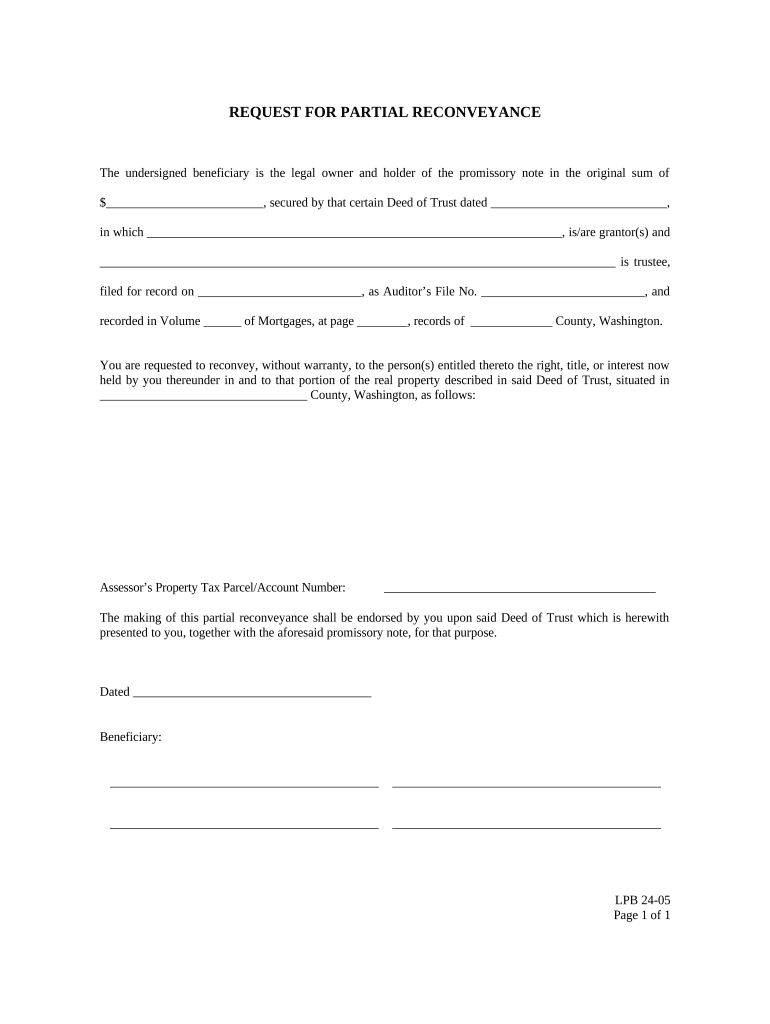
A Partial Reconveyance Form documents the release of a portion of property from a mortgage or deed of trust lien after the secured debt or a portion of it has been satisfied. It is commonly used when a borrower pays down part of a loan or when parcels are subdivided and only part of the original collateral is released. The form records the specific legal description being released, references the original deed or trust instrument, and is recorded with the county recorder to clear clouded title for the affected parcel and maintain an accurate chain of title.

Why a Careful Partial Reconveyance Matters

A correctly prepared partial reconveyance preserves clear title, avoids recording errors that can delay sales or refinance, and ensures mortgage records accurately reflect the remaining lien.

Why a Careful Partial Reconveyance Matters

Who Typically Prepares and Signs This Form

The form is used by lenders, title companies, closing agents, subdividers, and property owners when part of a secured interest is released.

  • Lenders and servicers: Prepare reconveyance after contractual obligations are met; coordinate recording and title updates.
  • Title and escrow agents: Confirm legal descriptions, ensure recording compliance, and update chain-of-title records.
  • Borrowers and developers: Request partial release when parcels are sold or loan principal is reduced.

Proper role assignment and signature authority prevents recording mistakes and subsequent title disputes.

Core Elements of a Professional Partial Reconveyance Form

A robust partial reconveyance includes precise identification, chain-of-title references, an accurate legal description of the released portion, and clear execution language for recording.

Document ID

Reference original deed of trust or mortgage book and page or instrument number to tie the release to the correct lien instrument.
Released Parcel

Provide the full legal description for only the portion released, using metes and bounds or lot-block references as recorded.

Remaining Lien

State the extent and terms of the lien that remain, including any encumbrance on the residual property.

Execution Block

Include signature lines for the trustee or authorized lender representative, printed names, titles, and a dated notary acknowledgement.

Recording Instructions

Specify county recorder to accept the instrument, recording fees advanced, and any required recording format or attachments.

Effective Date

State the effective date of reconveyance and any conditions precedent to the release becoming operative.

Step-by-step: Complete and Record a Partial Reconveyance

Follow these steps in order to prepare, execute, and record a legally effective partial reconveyance.

  • 01
    Confirm payoff or condition: Verify terms triggering partial release with loan documents.
  • 02
    Prepare instrument: Draft the reconveyance using the recorded legal description for the released parcel.
  • 03
    Obtain signatures: Get authorized lender/trustee signature and notary acknowledgment.
  • 04
    Record and notify: File with county recorder and send certified copies to title insurer and borrower.

How to Configure an Online Reconveyance Workflow

Set up a digital workflow to place fields, require authentication, and route the form for signature and recording.

Field Configuration
Document Upload Upload PDF/A with original instrument references for accurate OCR and archiving.
Signature Fields Place lender/trustee, borrower (if required), and notary fields with date stamps.
Authentication Require signer email plus SMS or KBA for higher-assurance workflows.
Recording Package Attach a cover sheet with recording instructions and pay fees if permitted.

Typical Online Processing Flow for Partial Reconveyance

Digital workflows compress manual steps while preserving the audit trail required for enforceability and recorder acceptance.

  • Upload source documents: Add original deed reference and legal description.
  • Place required fields: Add signature, date, and notary acknowledgement fields.
  • Assign signers: Set role order for lender/trustee and notary.
  • Record and archive: Save recorded copy and distribute results to stakeholders.

Digital and Integration Considerations

Verify integrations and file formats before starting a digital reconveyance workflow to avoid format rejections at recording.

  • Integrations: Salesforce, NetSuite, Microsoft 365 integrations streamline document delivery.
  • File formats: Use PDF or PDF/A for reliable recorder acceptance.
  • Authentication: Support SMS, email, or KBA for signer identity verification.

Confirm county recorder technical requirements and keep an auditable trail of signer authentication and document versions.

Security and Compliance Summary for Digital Reconveyance

Encryption: TLS 1.2/1.3 in transit
At-rest encryption: AES-256 storage
Audit Trail: Complete signer action history
HIPAA: BAA required for PHI workflows
ESIGN / UETA: Compliant with U.S. e-signature laws
Certifications: SOC 2 Type II and ISO 27001

Key Risks and Consequences of Errors

Clouded Title: Recording errors can create title defects
Re-recording Costs: Corrections require fees and delay
Liability Exposure: Incorrect releases may trigger lender liability
Insurance Issues: Title insurers may deny coverage until cleared
Recording Rejection: Noncompliant format may be refused
Statutory Noncompliance: Failure to meet state rules risks invalidation

Common Preparation Errors to Watch For

  • Using an imprecise legal description that fails to match the recorder's index
  • Listing the wrong instrument reference or recording details for the original lien
  • Missing the required notarization or witness signatures for certain counties
  • Failing to update title insurer and stakeholders after recording

Practical Tips for Accurate and Efficient Completion

Follow standard procedures to reduce re-recording, ensure acceptance by county recorders, and protect chain of title.

Verify original instrument
Compare the reconveyance draft against the recorded deed of trust or mortgage before execution; confirm book/page or instrument number.
Use exact legal descriptions
Copy the parcel description verbatim from the recorded instrument or survey; do not abbreviate or paraphrase.
Confirm signer authority
Check corporate resolutions, trustee certificates, or power of attorney documentation to confirm the signer has authority.
Plan for recording
Confirm county format, page limits, and required cover sheets to avoid rejections and delays.

Real-world Examples of Partial Reconveyance Use

These examples show how partial reconveyance is applied in typical lender and real estate workflows.

Optica Ventures LLC — Brian Fitzgibbons

A small portfolio lender needing remote execution for subdivision releases

  • The interface made parcel-by-parcel releases manageable
  • The outcome was fewer recording errors and faster title clearances, enabling quicker lot sales without multiple in-person signings.

Martin Properties — Tim Martin

A regional developer splitting a parcel during a refinance

  • Needed precise legal descriptions and quick recorder filing
  • Processing reconveyances online reduced holding time, simplified coordination with title insurers, and eliminated multiple courier trips to county recorders.

Comparison: Typical eSignature Pricing and Features

Pricing and feature availability vary; the table below compares starting price, trial options, bulk send, audit trail, HIPAA support, and envelope caps across vendors.

signNow DocuSign Adobe Sign PandaDoc HelloSign
Starting Price $8/user/mo $15/user/mo $14/user/mo $19/user/mo $15/user/mo
Free Trial 7-day free trial Varies by plan Varies by plan Varies by plan Varies by plan
Bulk Send Yes (Premium) Yes Yes Yes Yes
Audit Trail Yes Yes Yes Yes Yes
Envelope Cap No cap 100 envelopes/user/year Varies Varies Varies

Typical Signatories and Their Authority

Lender Representative

A loan servicer or trustee signs reconveyances on the lender's behalf under documented corporate authorization; confirm board resolutions, servicing agreements, or trustee certificates to establish authority and avoid later challenges.

Borrower or Agent

The borrower or an authorized agent may need to sign acknowledgements or consent clauses; ensure a valid power of attorney if signing is delegated to avoid acceptance issues at the recorder.

Timing Expectations and Recording Steps

Understand local recorder processing times and statutory requirements to ensure timely reconveyance and minimize title issues.

Request Timing:

Submit reconveyance immediately after payoff or condition is met

County Processing:

County recorders often process within 1–10 business days

RON Retention:

Audio-video for RON retained 5–10 years under many state rules

Title Update:

Notify title insurer within days of recording for policy correction

Correction Window:

Expect additional time for corrective instruments if errors are found

Frequently Asked Questions About Partial Reconveyance

Answers to common questions about completing, signing, and recording partial reconveyances.


Need help? Contact support

be ready to get more
Join over 28 million airSlate SignNow users