Establishing secure connection…Loading editor…Preparing document…

Discovery Interrogatories from Plaintiff to Defendant with Production Requests

This template is fully customizable. Edit the text, fill out the fields, and send it for signature. Give it a try!
Discovery Interrogatories from Plaintiff to Defendant with Production Requests

Overview of this combined discovery document

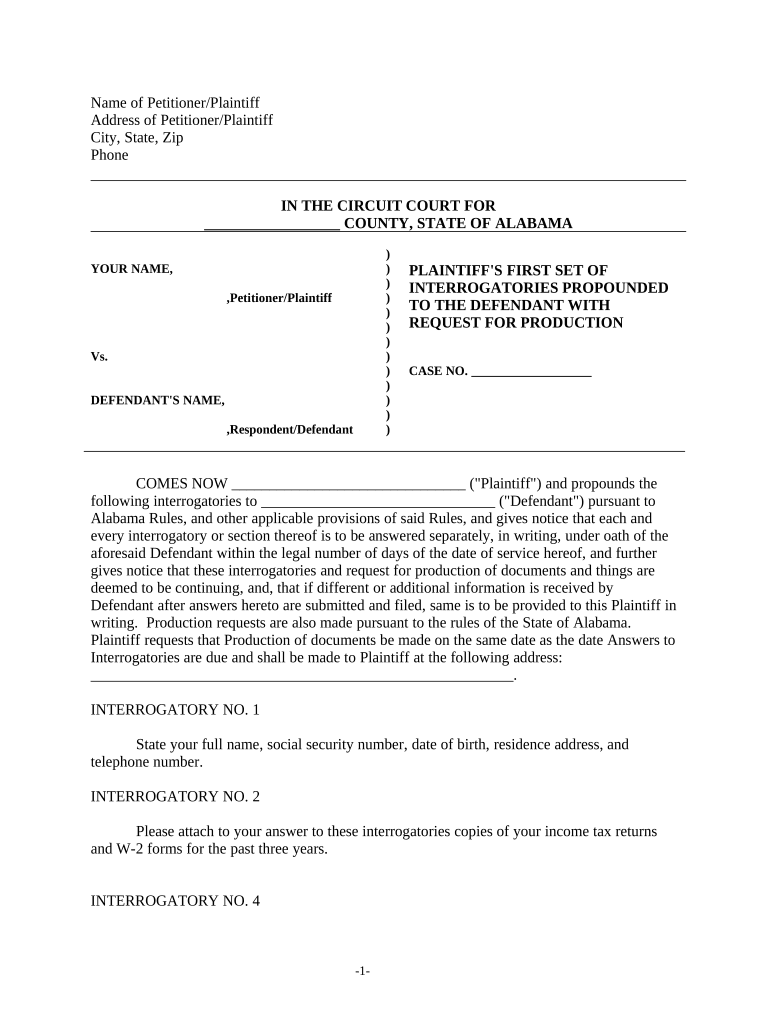
Discovery Interrogatories from Plaintiff to Defendant with Production Requests is a combined discovery document used in U.S. civil litigation to obtain written answers and relevant documents from a defendant. Typically served under the Federal Rules of Civil Procedure, it pairs interrogatories (written questions requiring verified responses) with requests for production of documents or electronically stored information. The form specifies deadlines, objections, and instructions for preserving responsive evidence. Plaintiffs use it to develop factual records, narrow issues, and support motions; defendants must answer, object, or produce documents within the applicable rule-based timeframe.

Why this combined interrogatory and production approach matters

Use this combined interrogatories and production request to efficiently gather admissions, identify witnesses, and obtain documents tied to claims or defenses. It focuses discovery, reduces surprises at trial, and creates a written record for motion practice while preserving procedural protections such as objections.

Why this combined interrogatory and production approach matters

Who prepares and responds to these discovery requests

Typical users include plaintiffs' counsel, litigants representing themselves, and legal support staff preparing discovery packages.

  • Plaintiff attorneys preparing targeted interrogatories and document requests for initial fact development.
  • In-house counsel coordinating document preservation and custodian interviews during early discovery.
  • Pro se litigants served with interrogatories who must understand formality and deadline rules.

Essential sections included in the combined form

Core parts of the document explain interrogatories, production lists, verification, instructions to the responding party, definitions, and confidentiality or protective order references.

Interrogatories

Numbered written questions seeking facts, identification of witnesses, and contentions; responses must be signed under oath or verified per state rule and may include specific limits on scope or form of answer.
Requests for Production

Detailed itemization of documents, ESI, and tangible things sought; commonly includes date ranges, custodians, file types, and instructions for electronic metadata and preferred delivery format.

Definitions

A definitions section narrows ambiguous terms (e.g., 'document', 'communication') and sets temporal or geographic bounds to reduce objections and facilitate consistent responses for all requests.

Verification

A verification clause requires responses to be sworn or verified by the responding party under penalty of perjury, establishing admissibility weight and discouraging false answers.

Instructions

Instructions prescribe how to answer, whether to produce in native format, how to handle privileged materials, and how to assert or log objections and any redaction rules.

Confidentiality

Reference to protective orders or confidentiality designations informs production methods, limits disclosure, and preserves privilege while allowing necessary review by counsel during litigation and settlement discussions.

Required case and document identifiers

Case Caption: Plaintiff v. Defendant on caption.
Court and Docket: Court name and docket number.
Propounder Contact: Attorney name, firm, email, phone.
Response Deadline: Date by which answers are due.
Verification Statement: Signature block and sworn affirmation.
Production Formats: Native files, PDFs, metadata instructions.

Step-by-step process for issuing and responding

Follow a structured process to draft, serve, respond, and meet preservation and production obligations under discovery rules.

  • 01
    Drafting: Identify claims, tailor questions to issues, set date ranges.
  • 02
    Service: Serve per local rules and certify service method.
  • 03
    Response: Answer each interrogatory separately; state objections clearly.
  • 04
    Production: Produce documents with metadata logs and privilege log.

How to configure a digital workflow for discovery

Configure an electronic workflow for serving and collecting verified responses, including field mapping, authentication, and audit logging.

Field Configuration
Authentication Use email verification or SMS codes; KBA when required.
Field Mapping Map interrogatory numbers to specific response fields.
Conditional Logic Show production requests if a related answer indicates responsive materials.
Audit Trail Capture IP, timestamp, and signer identity for every action.
Export Options Export responses to PDF, CSV, and native file bundles.

Where to send, serve, and file discovery materials

This section outlines where to file, how to serve the request, options for electronic delivery, and retention of the resulting materials.

  • Prepare: Finalize interrogatories and production list; attach definitions.
  • Serve: Serve by hand, mail, email if local rules permit.
  • Track: Record service date and method; update docket.
  • Produce: Deliver responsive documents with privilege log and format notes.

Delivery and eSignature platform considerations

Use of an e-signature platform can streamline delivery, collection, and preservation of interrogatory responses and ESI production.

  • Formats Supported: PDF, DOCX, native files.
  • Integrations: CMS, e-discovery, cloud storage.
  • Authentication Options: Email, SMS, SSO, KBA.

Typical timing rules and response windows

Key timing rules affect service, response deadlines, and deadlines for producing ESI; local rules may shorten or extend federal defaults.

Service Deadline:

Depends on local rules; typically within 30 days.

Response Time:

Federal baseline: 30 days to answer or object.

Production Time:

Often coincides with response deadline unless agreed.

Extension Requests:

Parties may seek agreed extensions in writing.

Preservation:

Issue litigation hold immediately upon notice of claim.

Common mistakes to avoid when preparing discovery

  • Overbroad or vague interrogatories that invite objections and do not elicit usable responses; tailor questions to specific facts and timeframes.
  • Failing to include precise definitions and date ranges, which causes confusion about scope and leads to motion practice over relevance.
  • Producing documents without metadata or native files, losing searchable context and risking spoliation claims when ESI format requirements were stated.
  • Ignoring privilege rules by overproducing sensitive communications without redaction or a sufficiently detailed privilege log.

Consequences of deficient or noncompliant responses

Sanctions: Court may impose monetary sanctions.
Motion to Compel: Opponent can seek court order to compel.
Adverse Inference: Evidence spoliation can yield negative inference.
Privilege Waiver: Improper disclosures may waive privilege.
Discovery Costs: Losing party may pay opposing costs.
Contempt: Persistent refusal risks contempt proceedings.

Answers to common questions about drafting and responding

Answers to frequent questions about drafting, serving, responding, objections, e-signature, and preservation for discovery interrogatories and production requests.


Need help? Contact support

Baseline eSignature pricing and capability comparison

Baseline pricing and feature differences for common eSignature vendors useful when selecting a platform to manage served discovery and document production workflows.

signNow DocuSign Adobe Sign PandaDoc HelloSign
Starting Price $8/user/mo $15/user/mo $14/user/mo $19/user/mo $15/user/mo
Free Trial 7-day free trial Yes Yes Yes Yes
Bulk Send Yes Yes Yes Yes No
Audit Trail Yes Yes Yes Yes Yes
HIPAA Compliant Yes Yes Yes No No
be ready to get more
Join over 28 million airSlate SignNow users