Establishing secure connection…Loading editor…Preparing document…

Domain Name License Agreement

This template is fully customizable. Edit the text, fill out the fields, and send it for signature. Give it a try!
Domain Name License Agreement

What a Domain Name License Agreement Is and When It Applies

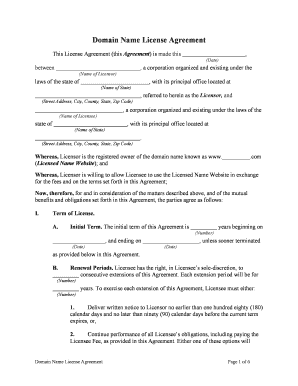
A Domain Name License Agreement is a legal contract where the domain registrant (the licensor) grants another party (the licensee) defined rights to use a domain name without transferring ownership. It sets the permitted uses, term, payment or royalties, assignment limits, technical control, and dispute resolution. Typical situations include franchisors permitting local franchisees to use a branded domain, an owner monetizing a premium domain via an exclusive license, or software vendors licensing subdomains. The agreement complements registrar records but does not substitute for ICANN or registry transfer procedures.

Why a Clear License Agreement Benefits Both Sides

A written license clarifies rights and limits, protects trademark and brand integrity, allocates technical responsibilities, and reduces the risk of disputes over ownership or control. It preserves the registrant’s title while enabling commercial use under defined conditions and payment terms.

Why a Clear License Agreement Benefits Both Sides

Who Typically Prepares and Signs Domain Name Licenses

Common parties include domain owners, brand licensees, marketing agencies, franchisors, and investors involved in domain monetization.

  • Domain owners and investors licensing premium names for revenue or strategic partnerships.
  • Brands and franchisees licensing subdomains or localized domain use for marketing and sales.
  • Agencies and platform operators obtaining limited use rights to manage DNS and content.

Each party’s role and decision authority should be documented in the agreement to avoid later operational or legal disputes.

Essential provisions to include in a professional agreement

A robust Domain Name License Agreement reduces ambiguity and protects rights. Include clear sections that cover control, payment, technical duties, intellectual property, termination, and dispute resolution.

Grant and Scope

Define exclusive or non‑exclusive rights, geographic or channel limits, permitted DNS changes, and any sub‑licensing permissions to prevent overbroad use.
Term and Renewal

Specify the start date, term length, renewal process, notice periods for nonrenewal, and survival clauses for post‑termination obligations.

Consideration

State fees, royalty rates, payment schedule, invoicing responsibility, and remedies for late payment, including interest or suspension rights.

Technical Control

Allocate DNS administration, registrar account access, who executes transfers, and procedures for planned changes to avoid service disruption.

IP and Brand Controls

Reserve trademark usage standards, approval rights for content, takedown procedures for infringing content, and indemnity for trademark claims.

Termination and Remedies

Detail events of default, cure periods, rights on termination (reversion of control, transfer lock), and dispute resolution (jurisdiction, arbitration).

Key information items to collect and verify

Registrant ID: Registrar account ID
WHOIS Contact: Registered administrative contact
Authorization Code: Transfer auth/EPP code
DNS Provider: Current DNS host
Trademark Basis: Registered TM number
Payment Terms: Fee schedule

Step-by-step: How to complete the agreement

Follow these sequential steps to prepare, review, and execute a Domain Name License Agreement with clarity and compliance.

  • 01
    Drafting: Enter parties, domain, grant language, term, and payment.
  • 02
    Technical Plan: Agree DNS roles, transfer triggers, and registrar access.
  • 03
    Legal Review: Have counsel review IP clauses, indemnities, and export controls.
  • 04
    Execute: Sign, date, and capture signatures via eSignature with audit trail.

How to configure an online signing workflow

Set up fields and routing to match the agreement’s approval flow and technical handoffs.

Field Configuration
Signature Blocks Assign to parties; include date and title fields
Authentication Email + SMS code or advanced ID verification
Conditional Fields Reveal renewal or payment fields based on choices
Notifications Automated reminders and copy to legal

Where to send, file, and who should receive executed copies

After execution, route copies to parties, registrar contacts, and legal or technical teams to ensure operational continuity.

  • Licensor: Keep original signed copy and registrar records
  • Licensee: Store signed copy and technical instructions
  • Registrar: Update billing/administrative contact if required
  • Legal/IT: Archive for compliance and DNS change records

Digital signing, file formats, and integration considerations

Choose an eSignature platform that supports PDF/DOCX, audit trails, and required authentication for your risk profile.

  • Formats: PDF and DOCX supported
  • Integrations: CRM and cloud storage
  • Authentication: Email, SMS, or KBA

Ensure the selected platform can produce a tamper-evident audit trail, export archival copies, and integrate with registrar or ticketing workflows for transfer events.

Key dates and notice periods to include

Build explicit timelines into the agreement so both parties know when payments, renewals, transfers, and cure periods occur.

Effective Date:

Start date in MM/DD/YYYY

Renewal Notice:

Commonly 30–90 days prior

Payment Due:

Net 30 after invoice

Transfer Window:

Agree timeframe for EPP transfer

Cure Period:

Often 10–30 days for defaults

Common mistakes to avoid

  • Failing to specify who controls registrar account and EPP code, leading to access disputes.
  • Using vague grant language that permits unintended commercial or sublicensing rights.
  • Omitting IP or brand controls, which can expose the registrant to trademark misuse.
  • Neglecting to document technical handoff timing, causing DNS downtime or transfer delays.

Risks and legal consequences of a deficient agreement

Breach Damages: Monetary liability
Injunctions: Court-ordered use restrictions
Trademark Claims: Infringement exposure
Loss of Control: Registrar access disputes
Operational Downtime: Service interruptions
Enforcement Costs: Legal fees and litigation

Practical examples of how license agreements are used

Two representative scenarios illustrate common structures and operational checks to include.

Brand Localization

A franchisor grants nonexclusive use of localized subdomains to franchisees, subject to brand guidelines and approval

  • Grant limits use to marketing and resale within territory
  • The agreement requires prior content approval, automated monitoring, and a 30‑day cure period for violations to protect trademark integrity and brand consistency.

Premium Domain Monetization

An investor licenses a premium domain exclusively for a technology product launch, in exchange for upfront fee plus revenue share

  • Includes defined KPIs and transfer triggers
  • The license defines DNS control, escrow for authorization codes, and milestone payments tied to agreed launch dates to ensure operational handoff and payment security.

Supporting documents and export formats to bundle with the agreement

Include technical and legal attachments to ensure the license can be executed and operationalized without follow‑up confusion.

Registrar Evidence

Screenshot or export of current WHOIS and registrar account details showing ownership and administrative contacts to prove authority to license.

Technical Instructions

Document DNS change procedures, EPP transfer steps, and emergency contact info so licensee can implement changes safely and consistently.

Brand Guidelines

Attach approved logos, content standards, and sample pages to limit disputes over permitted branding and design.

Payment Schedule

Detailed invoice template and payment routing instructions (bank details, tax IDs) to avoid delays and misdirected funds.

How to update or amend the agreement after execution

Use a structured amendment process to change scope, term, or technical controls to preserve enforceability and chain of title.

01

Propose Amendment:

Draft a concise amendment stating changes and effective date
02

Technical Review:

Confirm DNS and registrar implications before approval
03

Legal Approval:

Obtain counsel sign-off on IP and indemnity changes
04

Execution:

Have both parties sign the amendment with dates
05

Record Update:

Share executed amendment with registrar and technical teams
06

Archive:

Store amendment with original agreement and audit trail

Typical eSignature vendor pricing and capability snapshot

Compare starting prices and essential capabilities across common eSignature providers. signNow appears first in the header per vendor ordering rules.

signNow DocuSign Adobe Sign PandaDoc HelloSign
Starting Price $8/user/mo $15/user/mo $14/user/mo $19/user/mo $15/user/mo
Free Trial 7-day free trial, no credit card required Varies by vendor Varies by vendor Varies by vendor Varies by vendor
Bulk Send Yes Yes Yes Yes No
Audit Trail Yes Yes Yes Yes Yes
HIPAA Compliant Yes Yes Yes No No
Envelope Cap No cap 100 envelopes/user/year Varies Varies Varies

Frequently asked questions about Domain Name License Agreements

Answers to common practical and legal questions about licensing a domain, electronic execution, and recordkeeping.


Need help? Contact support

be ready to get more
Join over 28 million airSlate SignNow users