Parties
Clear identification of grantor(s) and grantee(s) with legal names and contact information.
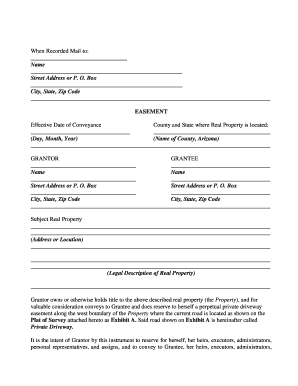
A written, recorded easement clarifies rights and obligations, prevents boundary disputes, and puts future buyers on notice. It creates an enforceable property interest that survives transfers when properly executed and recorded under state recording statutes.

Several parties interact with easements: property owners, utilities, developers, and counsel often prepare or execute the document.
An individual who holds title to the property must sign to grant an easement; signatures must match recorded title name(s) exactly to avoid challenges during recording or title transfer and may require proof of identity or notarization.
An authorized corporate officer, trustee, or attorney-in-fact may sign on behalf of an entity; include a corporate resolution, power of attorney, or other authorization showing signing authority for title records and recording purposes.
Clear identification of grantor(s) and grantee(s) with legal names and contact information.
A metes-and-bounds description or recorded plat reference that precisely defines the easement area.
Specific permitted uses (access, utilities) and any prohibitions or limits on use or interference.
Whether the easement is permanent, for a fixed term, or conditional; include termination triggers.
Allocation of maintenance duties, indemnities, and insurance expectations between parties.
County recorder submission details, return-to address, and reference to the document to be indexed.
| Field | Configuration |
|---|---|
| Document Template | Upload PDF with fillable fields |
| Authentication | Use email + SMS or KBA as needed |
| Automatic Record | Enable audit trail and certificate |
| Routing Order | Set signer sequence and reminders |
Choose an eSignature workflow that supports legal validity, audit trails, and county recorder file formats.
Tim Martin used online execution to finalize multiple easements quickly
Brian Fitzgibbons described a simple interface for customers and partners
| signNow | DocuSign | Adobe Sign | PandaDoc | HelloSign | |
|---|---|---|---|---|---|
| Starting Price | $8/user/mo | $15/user/mo | $14/user/mo | $19/user/mo | $15/user/mo |
| Free Trial | 7-day free trial | Varies by vendor | Varies by vendor | Varies by vendor | Varies by vendor |
| Bulk Send | Yes | Yes | Yes | Yes | No |
| Audit Trail | Yes | Yes | Yes | Yes | Yes |
| HIPAA Compliant | Yes | Yes | Yes | No | No |
Export a PDF/A with embedded audit trail and visible signatures; many recorders and title companies accept and prefer PDF.
Keep an editable DOCX copy for internal review, redlining, and iterative drafting before finalizing for recording.
Include a signing certificate or audit log capturing IP, timestamps, and signer authentication for evidentiary purposes.
Store a recorded instrument copy and audit certificate in a secure document repository and with title documentation.
Sign and notarize on the agreed effective date to fix priority
Obtain notary acknowledgment at signing; some counties require in-person or RON standards
Record with county recorder as soon as feasible; delays risk priority loss
Ensure returned recorded instrument is distributed to all parties and title insurer
Coordinate recording with any permit or municipal requirements to avoid enforcement issues