Establishing secure connection…Loading editor…Preparing document…

Customer Follow Up Letter – Auto Mechanic

This template is fully customizable. Edit the text, fill out the fields, and send it for signature. Give it a try!
Customer Follow Up Letter – Auto Mechanic

What a Customer Follow Up Letter – Auto Mechanic Is

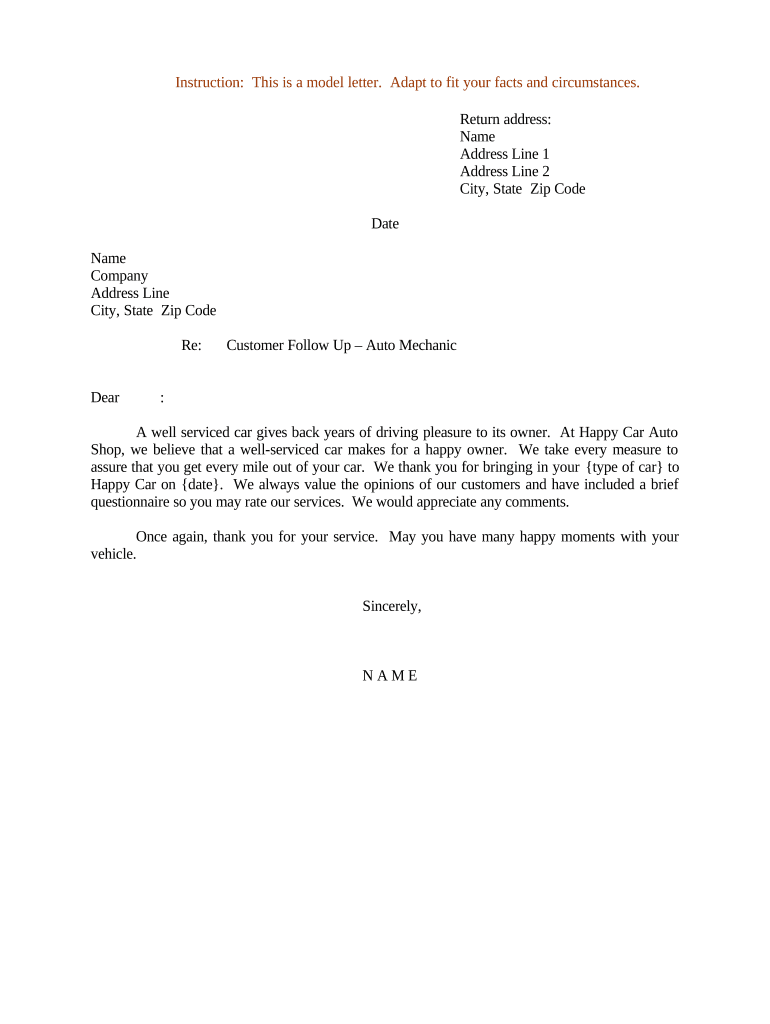
A Customer Follow Up Letter – Auto Mechanic documents post-service communication with a vehicle owner, summarizing work performed, charges, warranty or recall notices, and suggested next steps. It serves as a written confirmation of service, a record for billing and warranty purposes, and a communication tool to confirm customer satisfaction and collect outstanding payment or authorization for additional repairs.

Why a Follow Up Letter Matters for Repair Shops

A clear follow up letter reduces disputes, documents customer consent, and supports billing and warranty claims. When executed electronically it can satisfy ESIGN (15 U.S.C. ch. 96) and UETA requirements for enforceability, provided intent, consent, attribution, and retention are present.

Why a Follow Up Letter Matters for Repair Shops

Who Typically Prepares and Receives These Letters

Repair shops and service departments use follow up letters to confirm completed work, next steps, or unresolved items with customers.

  • Independent repair shops confirming completed repairs and payment status.
  • Dealer service departments documenting warranty work and manufacturer authorizations.
  • Fleet managers coordinating multi-vehicle maintenance and billing reconciliation.

The letter is addressed to vehicle owners, authorized drivers, or billing contacts and should be retained in the service file for the recommended retention period.

Who Can Sign and Authorize the Letter

Shop Owner

The shop owner or designated principal has authority to approve charges, warranty commitments, and settlement terms. Their signature confirms the shop’s obligations and typically binds the business for warranty or corrective actions.

Service Advisor

A service advisor or manager may sign on the shop’s behalf when expressly authorized; ensure a delegation record is retained so signature attribution is clear if disputes arise.

What a Professional Follow Up Letter Should Include

A follow up letter is most useful when it is concise, factual, and structured so customers can quickly confirm work details, costs, and next steps.

Customer Info

Full name, billing and service address, phone and email so the recipient is unambiguous and contact methods are clear for follow-up communication.
Vehicle Details

Year, make, model, VIN, license plate, and mileage at service to precisely identify the vehicle associated with the work performed.

Service Summary

Concise list of services performed, parts used, labor hours, and any diagnostic findings to document what work was completed and why.

Charges & Payments

Itemized parts and labor charges, taxes, applied payments, balance due, and acceptable payment methods with any late or collection terms clearly stated.

Warranty & Next Steps

Warranty coverage, claim window, recommended follow-up maintenance, and any conditional repairs requiring customer authorization before proceeding.

Signature & Date

Customer acknowledgement or signature block with date, and shop signatory line to confirm acceptance, payment, or authorization of further work.

Required Fields to Make the Letter Actionable

Customer Name: Exact legal name
Vehicle VIN: 17-character VIN
Service Date: MM/DD/YYYY
Work Performed: Brief description
Amount Due: Currency format
Signature Block: Signer and date

Step-by-Step: Create and Issue a Follow Up Letter

Follow these steps to produce a clear, compliant follow up letter that documents service, confirms customer choices, and preserves evidence for records.

  • 01
    Prepare template: Use a consistent format with required fields prefilled where possible.
  • 02
    Complete details: Enter vehicle, service, and pricing information accurately.
  • 03
    Send to customer: Deliver by email, text link, or printed copy per customer preference.
  • 04
    Retain proof: Store signed copy and audit trail in the service file.

Where and How to Send the Letter

Select the delivery channel that matches customer preference and preserves evidence of receipt and consent; the method affects the proof available in disputes.

  • Email: Attach PDF or send secure signing link with audit trail.
  • Text link: Short signing URL sent via SMS for mobile execution.
  • Printed copy: Hand or mail a hard copy for in-person acknowledgement.
  • Customer portal: Post letter to an authenticated account for retrieval.

Technical Formats and Integration Notes

Use common file formats and integrate with shop systems to minimize manual entry and preserve audit trails.

  • File Formats: PDF, DOCX supported
  • Integrations: Salesforce, NetSuite, Microsoft 365
  • Authentication: Email, SMS, or SSO

Choose a platform that preserves signed PDFs, stores an audit trail (IP, timestamp), and supports integrations with your shop management or accounting systems for seamless recordkeeping.

Timelines and Expected Response Windows

Define clear response and payment windows in the letter to set customer expectations and trigger timely follow-up actions.

Initial Follow-Up:

Send within 24–72 hours after work completion.

Payment Due Date:

Specify payment terms, commonly due on receipt or net 30 days.

Warranty Claim Window:

State any manufacturer or shop warranty period and claim instructions.

Authorization Timeout:

Specify how long repair authorizations remain valid, often 7–30 days.

Retention Reminder:

Note when records will be archived and how long they will be retained.

Common Mistakes to Avoid

  • Sending incomplete vehicle identifiers (missing VIN) which complicates warranty or recall processing.
  • Failing to state clear payment terms, leaving open disputes about fees and late charges.
  • Not obtaining explicit customer authorization for additional repairs, which can lead to consumer complaints.
  • Using ambiguous language about warranty coverage that creates uncertainty in claim disputes.

Risks of an Incorrect or Missing Follow Up Letter

Customer Dispute: Refunds or chargebacks
Warranty Denial: Claim rejection risk
Regulatory Complaint: State consumer agency action
Collection Difficulty: Harder to recover unpaid balances
Reputational Harm: Negative reviews or referrals
Legal Costs: Attorney fees and court expenses

Practical Examples of Follow Up Letters in Use

Two short scenarios illustrate how follow up letters resolve issues and preserve evidence after service completion.

Independent Repair Shop

A suburban independent shop confirmed brake repairs and attached photos of worn pads

  • Customer signed electronically on mobile
  • The signed letter prevented a disputed charge and supported a warranty exchange without further inspection, saving time and preserving customer trust.

Fleet Maintenance Provider

A fleet manager received a consolidated follow up listing work on five vehicles

  • Billing breakdown per vehicle was included
  • Electronic signatures from both vendor and fleet billing contact accelerated invoice processing and reduced month-end reconciliation effort.

Supporting Documents and Export Options

Attach or retain supporting materials that corroborate the letter: invoices, work orders, parts receipts, and before/after photos improve clarity and evidentiary value.

Invoice

Itemized invoice showing parts, labor, taxes, payments and remaining balance; store as PDF for long-term retention and audit.

Work Order

Original work order or repair authorization showing requested and approved repairs; include technician notes for traceability.

Photos

High-resolution before-and-after photos embedded or attached to the signed record to document condition and completed work.

Warranty Sheet

Written warranty terms and claim instructions appended to the letter to make coverage clear to the customer.

eSignature Pricing Comparison for Sending Follow Up Letters

Common vendor pricing and feature differences for eSignature platforms useful when selecting a solution to send and retain signed follow up letters.

signNow DocuSign Adobe Sign PandaDoc HelloSign
Starting Price $8/user/mo $15/user/mo $14/user/mo $19/user/mo $15/user/mo
Free Trial Yes, 7-day Varies Varies Varies Varies
Bulk Send Yes Varies Varies Varies Varies
Audit Trail Yes Yes Yes Yes Yes
HIPAA Compliant Yes Yes Yes No No
Envelope Cap No cap 100 envelopes/user/yr Varies Varies Varies

Frequently Asked Questions About Follow Up Letters

Answers to common questions about signing, enforceability, storage, and what to do when a customer does not respond.


Need help? Contact support

be ready to get more
Join over 28 million airSlate SignNow users