Establishing secure connection… Loading editor… Preparing document…
Navigation

Fill and Sign the Small Amount Affidavit Sample Form

Fill and Sign the Small Amount Affidavit Sample Form

How it works

Select the statement affidavit example and open it.
Fill out the form and add an eSignature.
Save the statement sample affidavit of true statement, print, or email it.

Rate template

4.5
65 votes
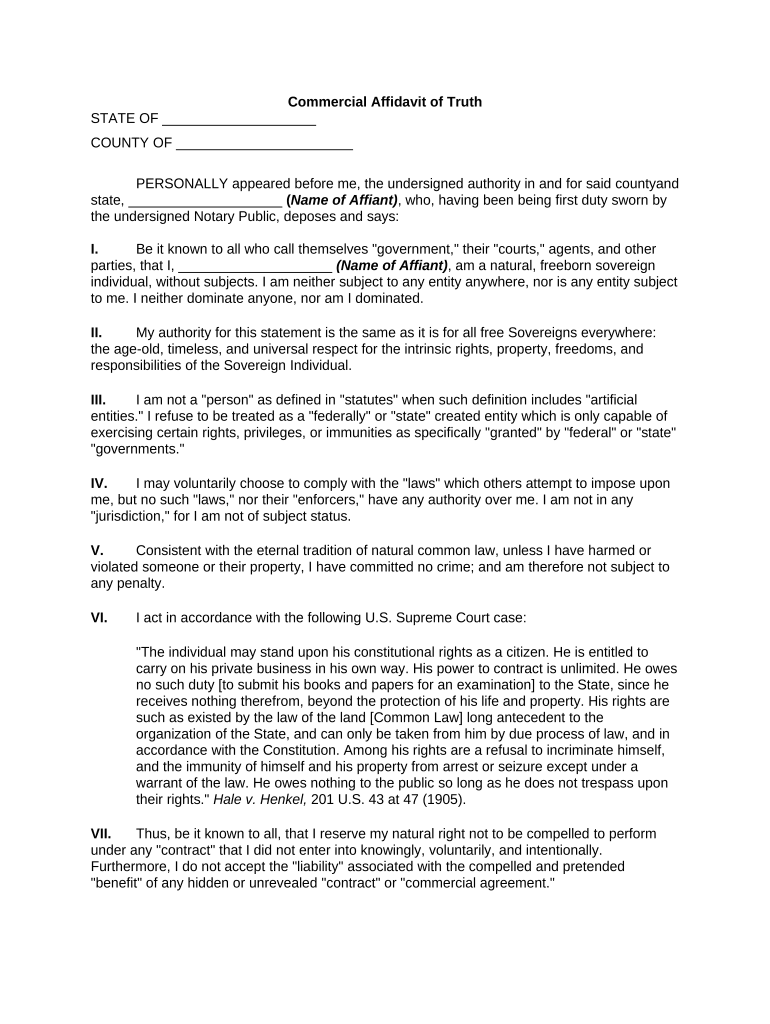
Commercial Affidavit of Truth STATE OF ____________________ COUNTY OF _______________________ PERSONALLY appeared before me, the undersigned authority in and for said countyand state, ____________________ ( Name of Affiant) , who, having been being first duty sworn by the undersigned Notary Public, deposes and says: I. Be it known to all who call themselves "government," their "courts," agents, and other parties, that I, ____________________ (Name of Affiant) , am a natural, freeborn sovereign individual, without subjects. I am neither subject to any entity anywhere, nor is any entity subject to me. I neither dominate anyone, nor am I dominated. II. My authority for this statement is the same as it is for all free Sovereigns everywhere: the age-old, timeless, and universal respect for the intrinsic rights, property, freedoms, and responsibilities of the Sovereign Individual. III. I am not a "person" as defined in "statutes" when such definition includes "artificial entities." I refuse to be treated as a "federally" or "state" created entity which is only capable of exercising certain rights, privileges, or immunities as specifically "granted" by "federal" or "state" "governments." IV. I may voluntarily choose to comply with the "laws" which others attempt to impose upon me, but no such "laws," nor their "enforcers," have any authority over me. I am not in any "jurisdiction," for I am not of subject status. V. Consistent with the eternal tradition of natural common law, unless I have harmed or violated someone or their property, I have committed no crime; and am therefore not subject to any penalty. VI. I act in accordance with the following U.S. Supreme Court case: "The individual may stand upon his constitutional rights as a citizen. He is entitled to carry on his private business in his own way. His power to contract is unlimited. He owes no such duty [to submit his books and papers for an examination] to the State, since he receives nothing therefrom, beyond the protection of his life and property. His rights are such as existed by the law of the land [Common Law] long antecedent to the organization of the State, and can only be taken from him by due process of law, and in accordance with the Constitution. Among his rights are a refusal to incriminate himself, and the immunity of himself and his property from arrest or seizure except under a warrant of the law. He owes nothing to the public so long as he does not trespass upon their rights." Hale v. Henkel , 201 U.S. 43 at 47 (1905). VII. Thus, be it known to all, that I reserve my natural right not to be compelled to perform under any "contract" that I did not enter into knowingly, voluntarily, and intentionally. Furthermore, I do not accept the "liability" associated with the compelled and pretended "benefit" of any hidden or unrevealed "contract" or "commercial agreement." VIII. As such, the hidden or unrevealed "contracts" that supposedly create "obligations" to perform, for persons of subject status, are inapplicable to me, and are null and void. If I have participated in any of the supposed "benefits" associated with these hidden "contracts," I have done so under duress, for lack of any other practical alternative. I may have received such "benefits" but I have not accepted them in a manner that binds me to anything. IX. Any such participation does not constitute "acceptance," because of the absence of full disclosure of any valid offer, and voluntary consent without misrepresentation or coercion. Without a valid voluntary offer and acceptance, knowingly entered into by both parties, there is no "meeting of the minds," and therefore no valid contract. Any supposed "contract" is therefore void, from the beginning. X. From my age of consent to the date affixed below I have never signed a contract knowingly, willingly, intelligently, and voluntarily whereby I have waived any of my natural common law rights, and, as such, Take Notice that I revoke, cancel, and make void ab initio my signature on any and all contracts, agreements, forms, or any instrument which may be construed in any way to give any agency or department of any federal or state government authority, venue, or jurisdiction over me. This position is in accordance with the U.S. Supreme Court decision of Brady v. U.S. , 379 U.S. 742 at 748 (1970): "Waivers of Constitutional Rights not only must be voluntary, they must be knowingly intelligent acts, done with sufficient awareness of the relevant circumstances and consequences." XI. Typical examples of such compelled and pretended "benefits" are: A. The use of Federal Reserve Notes to discharge my debts. I have used these only because in America, there is no other widely recognized currency. B. The use of a bank account, with my signature on the bank signature card. If there is any hidden contract behind the bank signature card, my signature thereon gives no validity to it. The signature is only for verification of identity. I can be obligated to fulfill no hidden or unrevealed contract whatsoever, due to the absence of full disclosure and voluntary consent. Likewise, my use of the bank account thereof is due to the absence of a bank not associated with the Federal Reserve System. In general, people have been prevented from issuing their own currencies, and such prevention is in violation of the United States Constitution. Were there an alternative, I would be happy to use it. To not use any bank at all is impossible or very difficult, as everyone knows, in today's marketplace. C. The use of a Social Security number. The number normally assigned to persons of subject status, I use exceptionally, under duress, only because of the extreme inconvenience of operating without one in today's marketplace, where it is requested by banks, employers, lenders, and many other government agencies and businesses. My reason for using it is not because I wish to participate in the Social Security system, as I don't wish to participate. Let it be known that I use the Social Security number assigned to me for information only . D. The use of a driver's license. As a free Sovereign, there is no legal requirement for me to have such a license for travelling in my car. Technically, the unrevealed legal purpose of driver's licenses is commercial in nature. Since I don't carry passengers for hire, there is no law requiring me to have a license to travel for my own pleasure and that of my family and friends. However, because of the lack of education of police officers on this matter, should I be stopped for any reason and found to be without a license, it is likely I would be ticketed and fined or obligated to appear in court. Therefore, under duress, I carry a license to avoid extreme inconvenience. E. State plates on my car. Similarly, even though technically, my car does not fit the legal definition of a "motor vehicle," which is used for commercial purposes, nevertheless, I have registered it with the state and carry the state plates on it, because to have any other plates or no plates at all, causes me to run the risk of police officer harassment and extreme inconvenience. F. Past tax returns filed. Any tax returns I may have filed in the past, were filed due to the dishonest atmosphere of fear and intimidation created by the Internal Revenue Service (IRS) and the local assessors' offices; not because there is any law requiring me to do so. Once I discovered that the IRS and other tax agencies have been misinforming the public, I have felt it is my responsible duty to society to terminate my voluntary participation. Because such returns were filed under Threat, Duress, and Coercion (TDC), and no two-way contract was ever signed with full disclosure, there is nothing in any past filing of returns or payments that created any valid contract. Therefore, no legal obligation on my part was ever created. G. Birth Certificate. The fact that a birth certificate was granted to me by a local hospital or government agency when I entered this world, is irrelevant to my Sovereignty. No status, high or low, can be assigned to another person through a piece of paper, without the recipient's full knowledge and consent. Therefore, such a piece of paper provides date and place information only. It indicates nothing about jurisdiction, nothing about property ownership, nothing about rights, and nothing about subject status. The only documents that can have any legal meaning, as it concerns my status in society, are those which I have signed as an adult, with full knowledge and consent, free from misrepresentation or coercion of any kind. H. Marriage license. The acquisition of a marriage license is now being revealed as being necessary only for slaves. The act of a Sovereign such as me obtaining such a license, through social custom and ignorance of law, has no legal effect in changing my status. This is because any such change in status, if any may be supposed to occur, could happen only through a hidden and unrevealed contract or statute. Since no hidden, unrevealed, and undisclosed information, if it exists, can be lawfully held to be binding, it is null and void. I. Children in public school. The attendance of my children in government- supported "public" schools or government-controlled "private" schools does not create any legal tax obligation for me, nor any other legal obligation, because I never signed a contract agreeing to such obligation for the supposed "privilege" of public school attendance. If any of my children have attended government supported "public" or controlled "private" schools, such was done under duress and not out of free will. Be it known that I regard "compulsory state education" as a violation of the Thirteenth Amendment to the U.S. Constitution, which states in relevant part: "Neither slavery nor involuntary servitude, except as a punishment for crime whereof the party shall have been duly convicted, shall exist within the United States, or any place subject to their jurisdiction." J. Declaration of Citizenship. 1. Any document I may have ever signed, in which I answered "yes" to the question, "Are you a U.S. citizen?" - cannot be used to compromise my status as a Sovereign, nor obligate me to perform in any manner. This is because without full written disclosure of the definition and consequences of such supposed "citizenship," provided in a document bearing my signature given freely without misrepresentation or coercion, there can be no legally binding contract. 2. I am not a "United States" citizen subject to its jurisdiction. The United States is an entity created by the U.S. Constitution with jurisdiction as described on the following pages of this Affidavit. I am not a "resident of," an "inhabitant of," a "franchise of," a "subject of," a "ward of," the "property of," the "chattel of," or "subject to the jurisdiction of" any corporate federal government, corporate state government, corporate county government, corporate city government, or corporate municipal body politic created under the authority of the U.S. Constitution. I am not subject to any legislation, department, or agency created by such authorities, nor to the jurisdiction of any employees, officers, or agents deriving their authority therefrom. Further, I am not a subject of the Administrative and Legislative Article IV Courts of the several states, or Article I Courts of the United States, or bound by precedents of such courts, deriving their jurisdiction from said authorities. Take Notice that I hereby revoke, cancel, and make void ab initio any such instrument or any presumed election made by any of the several states or the United States government or any agency or department thereof, that I am or ever have voluntary elected to be treated as a United States citizen subject to its jurisdiction or a resident of any territory, possession, instrumentality or enclave under the sovereignty or exclusive jurisdiction of any of the several states or of the United States as defined in the U.S. Constitution in Article I, Section 8, Clause 17 and Article IV, Section 3, Clause 2. K. Past voter registration. Similarly, since no obligation to perform in any manner was ever revealed in print, as part of the requirements for the supposed "privilege" to vote for government officials, any such registration on my part cannot be legal evidence of any obligation to perform. Likewise, I have granted NO jurisdiction over me, to any political office. It is my inherent right to vote on elections or issues that I feel affect all of society; NOT because I need anyone to rule over me. On the contrary - I have used the voting process only to instruct my public servants what a Citizen and Sovereign would like done. L. Use of the 2-letter state code and zip code. My use of the 2-letter state code and zip code in my "address," which is secretly codified to indicate United States "federal zone" jurisdiction, has no effect whatsoever on my Sovereign status. Simply by receiving or sending "mail" through a quasi-federal messenger service, the postal service, at a location indicated with a 2-letter state code and zip code, cannot place me under federal jurisdiction or obligation. Such a presumption would be ludicrous. I use these codes only for the purposes of information and making it more efficacious for the U.S. Postal Service to deliver my mail. M. Use of semantics. There are some immature people with mental imbalances, such as the craving to dominate other people, who masquerade as "government." Just because they alter definitions of words in the law books to their supposed advantage, doesn't mean I accept those definitions. The fact that they define the words "person," "address," "mail," "resident," "motor vehicle," "driving," "passenger," "employee," "income," and many others, in ways different from the common usage, so as to be associated with a subject or slave status, means nothing in real life. Because the courts have become entangled in the game of semantics, be it known to all courts and all parties, that if I have ever signed any document or spoken any words on record, using words defined by twists in the law books different from the common usage, there can be no effect whatsoever on my Sovereign status in society thereby, nor can there be created any obligation to perform in any manner, by the mere use of such words. Where the meaning in the common dictionary differs from the meaning in the law dictionary, it is the meaning in common dictionary that prevails, because it is more trustworthy. B. Such compelled and supposed "benefits" include, but are not limited to, the aforementioned typical examples. My use of such alleged "benefits" is under duress only, and is with full reservation of all my common law rights. I have waived none of my intrinsic rights and freedoms by my use thereof. Furthermore, my use of such compelled "benefits" may be temporary, until better alternatives become available, practical, and widely recognized. XII. Federal Jurisdiction A. It is further relevant to this Affidavit that any violation of my Rights, Freedom, or Property by the U.S. federal government, or any agent thereof, would be an illegal and unlawful excess, clearly outside the limited boundaries of federal jurisdiction. My understanding is that the jurisdiction of the U.S. federal government is defined by Article I, Section 8, Clause 17 of the U.S. Constitution, quoted as follows: "The Congress shall have the power . . . To exercise exclusive legislation in all cases whatsoever, over such district (NOT EXCEEDING TEN MILES SQUARE) as may, by cession of particular states and the acceptance of Congress, become the seat of the Government of the United States, (District of Columbia) and to exercise like authority over all places purchased by the consent of the legislature of the state in which the same shall be, for the Erection of Forts, Magazines, Arsenals, dock yards and other needful Buildings; And - To make all laws which shall be necessary and proper for carrying into Execution the foregoing Powers. . ." (emphasis added) B. Article IV, Section 3, Clause 2 states: "The Congress shall have the Power to dispose of and make all needful Rules and Regulations respecting the Territory or other Property belonging to the United States; and nothing in this Constitution shall be so construed as to Prejudice any Claims of the United States, or of any particular State." XIII. The definition of the "United States" being used here, then, is limited to its territories : A. The District of Columbia; B. Commonwealth of Puerto Rico; C. U.S. Virgin Islands; D. Guam; E. American Samoa; F. Northern Mariana Islands; G. Trust Territory of the Pacific Islands; H. Military bases within the several states; and I. Federal agencies within the several states; It does not include the several states themselves , as is confirmed by the following cites: XIV. "We have in our political system a Government of the United States and a government of each of the several States. Each one of these governments is distinct from the others, and each has citizens of its own who owe it allegiance, and whose rights, within its jurisdiction, it must protect. The same person may be at the same time a citizen of the United States and a Citizen of a State, but his rights of citizenship under one of these governments will be different from those he has under the other." Slaughter House Cases United States vs. Cruikshank , 92 U.S. 542 (1875). XV. "THE UNITED STATES GOVERNMENT IS A FOREIGN CORPORATION WITH RESPECT TO A STATE." (emphasis added) Volume 20: Corpus Juris Sec . §1785: NY re: Merriam 36 N.E. 505 1441 S.Ct.1973, 41 L.Ed.287. This is further confirmed by the following quote from the Internal Revenue Service: Federal jurisdiction "includes the District of Columbia, the Commonwealth of Puerto Rico, the Virgin Islands, Guam, and American Samoa." - Internal Revenue Code Section 312(e). XVI. In legal terminology, the word "includes" means "is limited to." When referring to this "District" United States, the Internal Revenue Code uses the term "WITHIN" the United States. When referring to the several States, the Internal Revenue Code uses the term "WITHOUT" the United States. XVII. Dozens, perhaps hundreds, of court cases prove that federal jurisdiction is limited to the few federal territory areas above indicated. For example, in two Supreme Court cases, it was decided: "The laws of Congress in respect to those matters do not extend into the territorial limits of the states, but have force only in the District of Columbia, and other places that are within the exclusive jurisdiction of the national government," Caha v. United States , 152 U.S., at 215. "We think a proper examination of this subject will show that the United States never held any municipal sovereignty, jurisdiction, or right of soil in and to the territory, of which Alabama or any of the new States were formed. . ." "[B]ecause, the United States have no constitutional capacity to exercise municipal jurisdiction, sovereignty, or eminent domain, within the limits of a State or elsewhere, except in the cases in which it is expressly granted. . ." "Alabama is therefore entitled to the sovereignty and jurisdiction over all the territory within her limits, subject to the common law," Pollard v. Hagan , 44 U.S. 221, 223, 228, 229. XVIII. Likewise, Title 18 of the United States Code at §7 specifies that the "territorial jurisdiction" of the United States extends only outside the boundaries of lands belonging to any of the several States. XIX. Therefore , in addition to the fact that no unrevealed federal contract can obligate me to perform in any manner without my fully informed and uncoerced consent, likewise, no federal statutes or regulations apply to me or have any jurisdiction over me. I hereby affirm that I do not reside or work in any federal territory of the "District" United States, and that therefore no U.S. federal government statutes or regulations have any authority over me. XX. Powers and Contractual Obligations of United States and State Government Officials A. All United States and State government officials are hereby put on notice that I expect them to have recorded valid Oaths of Office in accordance with the U.S. Constitution, Article VI: "The Senators and Representatives before mentioned, and the members of the several State Legislatures, and all executive and judicial officers, both of the United States and of the several States, shall be bound by oath or affirmation to support this Constitution..." B. I understand that by their Oaths of Office all U.S. and State government officials are contractually bound by the U.S. Constitution as formulated by its framers, and not as "interpreted," subverted, or corrupted by the U.S. Supreme Court or other courts. C. According to the Ninth Amendment to the U.S. Constitution: "The enumeration in the Constitution of certain rights shall not be construed to deny or disparage others retained by the people." D. According to theTenth Amendment to the U.S. Constitution: "The powers not delegated to the United States by the Constitution, nor prohibited by it to the States, are reserved to the States respectively, or to the people." E. Thus, my understanding from these Amendments is that the powers of all U.S. and State government officials are limited to those specifically granted by the U.S. Constitution. I further understand that any laws, statutes, ordinances, regulations, rules, and procedures contrary to the U.S. Constitution, as written by its framers, are null and void, as expressed in the Sixteenth American Jurisprudence Second Edition, Section 177: "The general misconception is that any statute passed by legislators bearing the appearance of law constitutes the law of the land. The U.S. Constitution is the supreme law of the land, and any statute, to be valid, must be in agreement. It is impossible for both the Constitution and a law violating it to be valid; one must prevail. This is succinctly stated as follows: 'The general rule is that an unconstitutional statute, though having the form and name of law, is in reality no law, but is wholly void, and ineffective for any purpose; since unconstitutionality dates from the time of its enactment, and not merely from the date of the decision so branding it. An unconstitutional law, in legal contemplation, is as inoperative as if it had never been passed . Such a statute leaves the question that it purports to settle just as it would be had the statute not been enacted.' 'Since an unconstitutional law is void, the general principles follow that it imposes no duties, confers no right, creates no office, bestows no power or authority on anyone, affords no protection, and justifies no acts performed under it. . .' 'A void act cannot be legally consistent with a valid one. An unconstitutional law cannot operate to supersede any existing valid law. Indeed, insofar as a statute runs counter to the fundamental law of the land, it is superseded thereby.' ' No one is bound to obey an unconstitutional law and no courts are bound to enforce it.'" (emphasis added). F. Article VI of the U.S. Constitution states: "This Constitution, and the laws of the United States which shall be made in pursuance thereof; and all treaties made, or which shall be made, under the authority of the United States, shall be the supreme law of the land; and the judges in every State shall be bound thereby, anything in the Constitution or laws of any State to the contrary notwithstanding." G. All U.S. and State government officials are therefore hereby put on notice that any violations of their contractual obligations to act in accordance with their U.S. Constitution, may result in prosecution to the full extent of the law, as well as the application of all available legal remedies to recover damages suffered by any parties damaged by any actions of U.S. and State government officials in violation of the U.S. Constitution. XXI. Revocation of Power of Attorney A. I hereby revoke, rescind, and make void ab initio , all powers of attorney, in fact or otherwise, implied in law or otherwise, signed either by me or anyone else, as it pertains to the Social Security number assigned to me, _______________________ as it pertains to my birth certificate, marriage or business license, or any other licenses or certificates issued by any and all government or quasi-governmental entities, due to the use of various elements of fraud by said agencies to attempt to deprive me of my Sovereignty and/or property. B. I hereby waive, cancel, repudiate, and refuse to knowingly accept any alleged "benefit" or gratuity associated with any of the aforementioned licenses, numbers, or certificates. I do hereby revoke and rescind all powers of attorney, in fact or otherwise, signed by me or otherwise, implied in law or otherwise, with or without my consent or knowledge, as it pertains to any and all property, real or personal, corporeal or incorporeal, obtained in the past, present, or future. I am the sole and absolute legal owner and possess allodial title to any and all such property. C. Take Notice that I also revoke, cancel, and make void ab initio all powers of attorney, in fact, in presumption, or otherwise, signed either by me or anyone else, claiming to act on my behalf, with or without my consent, as such power of attorney pertains to me or any property owned by me, by, but not limited to, any and all quasi/colorable, public, governmental entities or corporations on the grounds of constructive fraud, concealment, and nondisclosure of pertinent facts. I affirm that all of the foregoing is true and correct. I affirm that I am of lawful age and am competent to make this Affidavit. I hereby affix my own signature to all of the affirmations in this entire document with explicit reservation of all my unalienable rights and my specific common law right not to be bound by any contract or obligation which I have not entered into knowingly, willingly, voluntarily, and without misrepresentation, duress, or coercion. The use of notary below is for identification only, and such use does NOT grant any jurisdiction to anyone. ___________________________________ (Printed Name of Affiant) ___________________________________ (Signature of Affiant) SWORN to and subscribed before me, this the ____ day of _____________, 20____. _____________________________ NOTARY PUBLIC My Commission Expires: _______________________

Useful Suggestions for Setting Up Your ‘Small Amount Affidavit Sample Form’ Online

Are you fed up with the burden of handling documents? Look no further than airSlate SignNow, the premier eSignature service for both individuals and businesses. Bid farewell to the lengthy routine of printing and scanning documents. With airSlate SignNow, you can effortlessly complete and authorize documents online. Take advantage of the powerful features integrated into this intuitive and affordable platform and transform your method of document handling. Whether you need to endorse forms or gather eSignatures, airSlate SignNow manages everything effortlessly with just a few clicks.

Adhere to this comprehensive guide:

  1. Log into your account or sign up for a complimentary trial with our service.
  2. Click +Create to upload a file from your device, cloud storage, or our collection of forms.
  3. Open your ‘Small Amount Affidavit Sample Form’ in the editor.
  4. Click Me (Fill Out Now) to finish the document on your end.
  5. Insert and designate fillable fields for other parties (if necessary).
  6. Proceed with the Send Invite settings to solicit eSignatures from others.
  7. Save, print your version, or transform it into a reusable template.

Don't fret if you need to collaborate with your colleagues on your Small Amount Affidavit Sample Form or send it for notarization—our solution has everything you require to accomplish these tasks. Create an account with airSlate SignNow today and elevate your document management to new levels!

Here is a list of the most common customer questions. If you can’t find an answer to your question, please don’t hesitate to reach out to us.

Need help? Contact Support
Small amount affidavit sample form pdf
Small estate Affidavit New York pdf
Small amount affidavit sample form florida
Small estate Affidavit form New York
Small estate affidavit form pdf
Small estate affidavit for bank account
Small amount affidavit sample form texas
new york small estate affidavit (scpa 1310)
Small amount affidavit sample form pdf
Tennessee Small Estate Affidavit form pdf
Small amount affidavit sample form florida
Small Estate Affidavit Tennessee template

The best way to complete and sign your affidavit of truth template

Save time on document management with airSlate SignNow and get your affidavit of truth template eSigned quickly from anywhere with our fully compliant eSignature tool.

How to Sign a PDF Online How to Sign a PDF Online

How to fill out and sign forms online

In the past, dealing with paperwork took lots of time and effort. But with airSlate SignNow, document management is fast and easy. Our robust and easy-to-use eSignature solution lets you easily complete and electronically sign your small amount affidavit sample form online from any internet-connected device.

Follow the step-by-step guide to eSign your small amount affidavit sample form template online:

  • 1.Register for a free trial with airSlate SignNow or log in to your account with password credentials or SSO authentication.
  • 2.Click Upload or Create and add a file for eSigning from your device, the cloud, or our form collection.
  • 3.Click on the file name to open it in the editor and utilize the left-side menu to complete all the blank fields properly.
  • 4.Place the My Signature field where you need to eSign your sample. Provide your name, draw, or import a picture of your regular signature.
  • 5.Click Save and Close to accomplish modifying your completed document.

As soon as your small amount affidavit sample form template is ready, download it to your device, save it to the cloud, or invite other people to electronically sign it. With airSlate SignNow, the eSigning process only requires a few clicks. Use our powerful eSignature solution wherever you are to deal with your paperwork productively!

How to Sign a PDF Using Google Chrome How to Sign a PDF Using Google Chrome

How to complete and sign documents in Google Chrome

Completing and signing paperwork is easy with the airSlate SignNow extension for Google Chrome. Adding it to your browser is a fast and productive way to deal with your forms online. Sign your small amount affidavit sample form sample with a legally-binding eSignature in a few clicks without switching between tools and tabs.

Follow the step-by-step guide to eSign your small amount affidavit sample form template in Google Chrome:

  • 1.Navigate to the Chrome Web Store, search for the airSlate SignNow extension for Chrome, and add it to your browser.
  • 2.Right-click on the link to a document you need to eSign and choose Open in airSlate SignNow.
  • 3.Log in to your account using your password or Google/Facebook sign-in buttons. If you don’t have one, you can start a free trial.
  • 4.Utilize the Edit & Sign menu on the left to fill out your template, then drag and drop the My Signature field.
  • 5.Add an image of your handwritten signature, draw it, or simply type in your full name to eSign.
  • 6.Make sure all data is correct and click Save and Close to finish modifying your paperwork.

Now, you can save your small amount affidavit sample form sample to your device or cloud storage, email the copy to other individuals, or invite them to eSign your document via an email request or a secure Signing Link. The airSlate SignNow extension for Google Chrome improves your document workflows with minimum effort and time. Try airSlate SignNow today!

How to Sign a PDF in Gmail How to Sign a PDF in Gmail How to Sign a PDF in Gmail

How to complete and sign forms in Gmail

When you receive an email with the small amount affidavit sample form for approval, there’s no need to print and scan a document or save and re-upload it to a different program. There’s a much better solution if you use Gmail. Try the airSlate SignNow add-on to quickly eSign any paperwork right from your inbox.

Follow the step-by-step guidelines to eSign your small amount affidavit sample form in Gmail:

  • 1.Visit the Google Workplace Marketplace and find a airSlate SignNow add-on for Gmail.
  • 2.Install the tool with a corresponding button and grant the tool access to your Google account.
  • 3.Open an email with an attached file that needs signing and utilize the S symbol on the right panel to launch the add-on.
  • 4.Log in to your airSlate SignNow account. Select Send to Sign to forward the document to other people for approval or click Upload to open it in the editor.
  • 5.Drop the My Signature field where you need to eSign: type, draw, or import your signature.

This eSigning process saves efforts and only requires a couple of clicks. Take advantage of the airSlate SignNow add-on for Gmail to adjust your small amount affidavit sample form with fillable fields, sign paperwork legally, and invite other people to eSign them al without leaving your mailbox. Enhance your signature workflows now!

How to Sign a PDF on a Mobile Device How to Sign a PDF on a Mobile Device How to Sign a PDF on a Mobile Device

How to complete and sign documents in a mobile browser

Need to quickly submit and sign your small amount affidavit sample form on a mobile phone while doing your work on the go? airSlate SignNow can help without the need to install additional software applications. Open our airSlate SignNow tool from any browser on your mobile device and create legally-binding eSignatures on the go, 24/7.

Follow the step-by-step guide to eSign your small amount affidavit sample form in a browser:

  • 1.Open any browser on your device and go to the www.signnow.com
  • 2.Register for an account with a free trial or log in with your password credentials or SSO authentication.
  • 3.Click Upload or Create and add a file that needs to be completed from a cloud, your device, or our form catalogue with ready-made templates.
  • 4.Open the form and complete the blank fields with tools from Edit & Sign menu on the left.
  • 5.Put the My Signature field to the form, then type in your name, draw, or add your signature.

In a few easy clicks, your small amount affidavit sample form is completed from wherever you are. As soon as you're done with editing, you can save the file on your device, generate a reusable template for it, email it to other individuals, or ask them to electronically sign it. Make your documents on the go fast and productive with airSlate SignNow!

How to Sign a PDF on iPhone How to Sign a PDF on iPhone

How to complete and sign forms on iOS

In today’s business community, tasks must be completed rapidly even when you’re away from your computer. With the airSlate SignNow mobile app, you can organize your paperwork and sign your small amount affidavit sample form with a legally-binding eSignature right on your iPhone or iPad. Install it on your device to close deals and manage forms from anyplace 24/7.

Follow the step-by-step guide to eSign your small amount affidavit sample form on iOS devices:

  • 1.Go to the App Store, search for the airSlate SignNow app by airSlate, and set it up on your device.
  • 2.Open the application, tap Create to upload a form, and select Myself.
  • 3.Choose Signature at the bottom toolbar and simply draw your signature with a finger or stylus to eSign the form.
  • 4.Tap Done -> Save after signing the sample.
  • 5.Tap Save or utilize the Make Template option to re-use this document in the future.

This method is so simple your small amount affidavit sample form is completed and signed in just a couple of taps. The airSlate SignNow application works in the cloud so all the forms on your mobile device are kept in your account and are available whenever you need them. Use airSlate SignNow for iOS to improve your document management and eSignature workflows!

How to Sign a PDF on Android How to Sign a PDF on Android

How to complete and sign paperwork on Android

With airSlate SignNow, it’s easy to sign your small amount affidavit sample form on the go. Set up its mobile application for Android OS on your device and start enhancing eSignature workflows right on your smartphone or tablet.

Follow the step-by-step guide to eSign your small amount affidavit sample form on Android:

  • 1.Open Google Play, search for the airSlate SignNow application from airSlate, and install it on your device.
  • 2.Log in to your account or register it with a free trial, then add a file with a ➕ option on the bottom of you screen.
  • 3.Tap on the uploaded document and choose Open in Editor from the dropdown menu.
  • 4.Tap on Tools tab -> Signature, then draw or type your name to electronically sign the template. Fill out blank fields with other tools on the bottom if required.
  • 5.Utilize the ✔ button, then tap on the Save option to end up with editing.

With an easy-to-use interface and total compliance with main eSignature requirements, the airSlate SignNow app is the perfect tool for signing your small amount affidavit sample form. It even works offline and updates all record changes once your internet connection is restored and the tool is synced. Fill out and eSign forms, send them for eSigning, and generate re-usable templates anytime and from anyplace with airSlate SignNow.

Sign up and try Small amount affidavit sample form
  • Close deals faster
  • Improve productivity
  • Delight customers
  • Increase revenue
  • Save time & money
  • Reduce payment cycles