Establishing secure connection…Loading editor…Preparing document…

Grant of Easement

This template is fully customizable. Edit the text, fill out the fields, and send it for signature. Give it a try!
Grant of Easement

What a Grant of Easement Is and when it applies

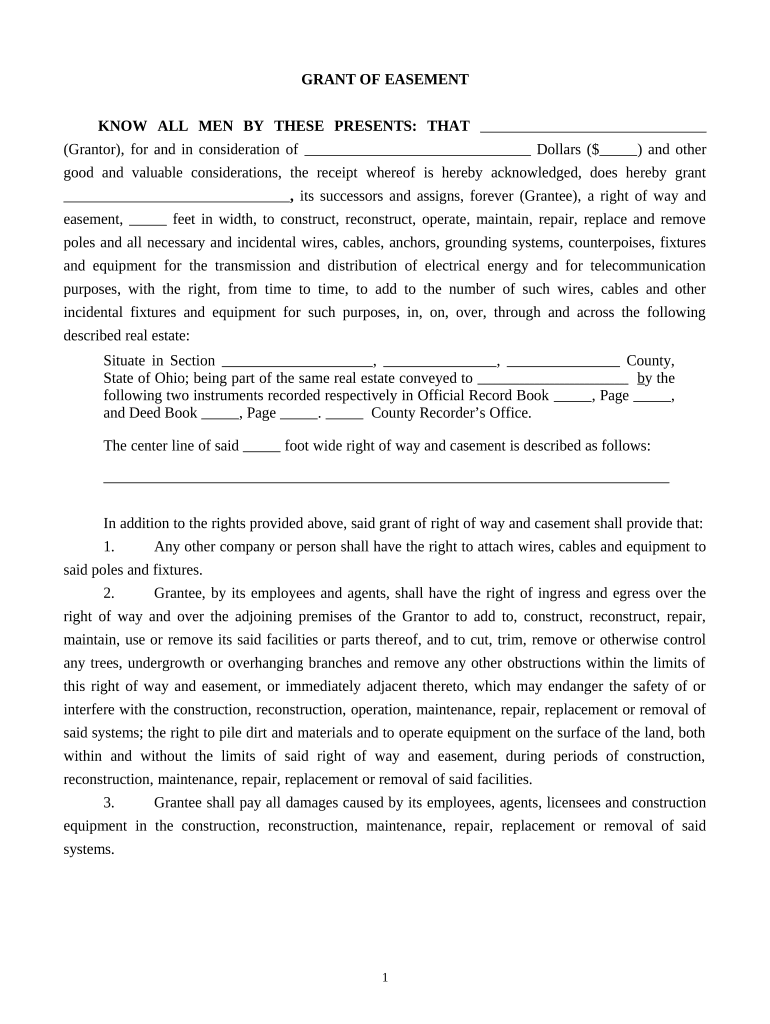
Grant of Easement is a written legal instrument that transfers or limits the right to use, access, or pass over real property while the fee simple estate remains with the owner. Commonly used to grant rights for utilities, access roads, drainage, or conservation, an easement describes the parties, precise property description, extent of rights granted, duration, and any conditions or compensation. Proper execution, notarization, and recording in the county land records create public notice and affect title. This document can be tailored as perpetual, temporary, affirmative, or restrictive.

Why a clear Grant of Easement matters

Well-drafted Grant of Easement clarifies rights and limits, reduces future disputes over access or maintenance, and enables utilities and development projects to proceed without transferring ownership. Recording the instrument preserves notice and supports enforceability against subsequent purchasers and lenders.

Why a clear Grant of Easement matters

Who typically prepares or signs an easement

Typical users include property owners, utility companies, developers, title companies, and attorneys managing rights and public records.

  • Property owners granting or reserving access to driveways, paths, and service lines.
  • Utility companies securing rights for lines, pipelines, meters, and maintenance access.
  • Developers, municipalities, and title agents managing easement records and compliance.

Key signer roles and responsibilities

Grantor — Owner

The property owner (grantor) must have authority to convey the easement, supply accurate legal description, and sign the instrument. Owners should confirm current title status and obtain title insurer or attorney review to prevent defects affecting future conveyances.

Grantee — Holder

The grantee must identify the intended use, duration, and maintenance obligations. Corporations or utilities should confirm corporate authorization, board resolutions, and applicable permits before accepting the easement to ensure enforceability and regulatory compliance.

Essential sections to include in the document

Core sections of a professional Grant of Easement define parties, property, rights granted, duration, consideration, conditions, and recording instructions to protect both title and use.

Parties

Identify grantor(s) and grantee(s) with full legal names, business entities, and contact addresses. Include capacity (owner, trustee, lessee) and attach any corporate authorization or power of attorney documents.
Property

Provide an exact legal description or recorded deed reference, include parcel or tax ID, delineate the easement area by metes and bounds or exhibit map, and attach plats or survey references for clarity.

Rights Granted

Describe the nature of rights: permanent or temporary, exclusive or nonexclusive, affirmative or restrictive, and specify permitted activities such as access, construction, or utility installation.

Duration

State the term: perpetual, fixed term with start and end dates, or term tied to a project. Include renewal, termination, and abandonment conditions if applicable.

Maintenance

Assign maintenance responsibility, cost allocation, and repair standards. Clarify access for inspections, timing for repairs, and indemnity for damage caused during maintenance activities and insurance requirements.

Recording

Specify the county recorder for filing, who pays recording fees, and provide a form of dedication or acknowledgment. Recording the easement supplies public notice and affects title search results.

Step-by-step: prepare, sign, and record

Follow these sequential steps to prepare, execute, and record a Grant of Easement correctly.

  • 01
    Draft: Draft precise legal description and scope.
  • 02
    Review: Obtain title and survey review.
  • 03
    Execute: Sign before required witnesses and notary.
  • 04
    Record: File with county recorder and pay fees.

How to configure an online signing workflow

Configure digital workflow fields and signer order for e-execution and recording-ready PDFs; include conditional fields for exhibits and signature blocks.

Field Configuration
Signature Block Assign signer, placement, and date field
Exhibit Upload Attach survey or map as required exhibit
Authentication Set email or SMS code authentication
Recording PDF Flatten signed PDF and generate cover sheet

Typical e-submission flow from signature to record

Typical e-submission workflow for a Grant of Easement from upload to recorded document and notifications.

  • Upload: Upload executed PDF and exhibits.
  • Prepare: Place signature and initial fields.
  • Sign: Signers authenticate and apply signatures.
  • Record: Export recorded-ready file for county recorder.

Platform capabilities to support easement workflows

Choose a platform that supports secure e-signature, audit trail, conditional fields, and whether a notarization add-on is required.

  • Formats: PDF, DOCX accepted
  • Integrations: Works with title and storage systems
  • Authentication: Email, SMS, or KBA options

Timing and recording considerations

Timing considerations: execution date, recording priority, and any statute-based deadlines affect enforceability and notice and costs.

Select Effective Date Carefully:

Enter date, MM/DD/YYYY; affects priority and obligations.

Record Promptly to Preserve Priority:

Record within county to establish notice; delays may allow prior interests.

Check Tax Parcel ID:

Include tax ID to match county indexing.

Confirm Witness Requirements:

Verify state-specific witness rules before signing.

Pay Recording Fees:

Budget for county fees and any certification copies.

Key milestones from negotiation to recording

Key processing milestones from negotiation through final recording and title update including survey and lender clearance.

01

Negotiation and Drafting

Agree on scope and prepare draft easement instrument.

02

Title and Survey Review

Title search and survey confirm legal description and encumbrances.

03

Execution and Notarization

Parties sign, witnesses attest, and notary acknowledges signatures.

04

Record and Update Title

File deed of easement, obtain recorded instrument, update title certificates.

Common pitfalls to avoid when preparing an easement

  • Using vague descriptions or failing to attach a survey creates ambiguity that can invalidate the easement or impair enforceability against future owners.
  • Omitting recording or delaying filing leaves no public notice and risks younger interests taking priority under local recording statutes.
  • Incorrect party names, missing signatures, or unsigned exhibits can trigger county recorder rejection and costly re-execution.
  • Assuming verbal agreements or unstated maintenance obligations leads to disputes; document maintenance, access windows, and liability allocations clearly.

Consequences of errors or omissions

Recording Delay: Loss of priority
Incorrect Names: Recorder rejection possible
Unclear Description: Boundary disputes risk
Missing Notarization: Recording refused
Unsigned Exhibits: Enforceability affected
Tax/Lien Issues: Title defects may arise

Security and compliance considerations for e-submission

Encryption: TLS 1.2/1.3 for data in transit.
Data at Rest: AES-256 encrypted storage in cloud
Certifications: SOC 2 Type II and ISO 27001
HIPAA: BAA available for covered entities
ESIGN / UETA: Compliant with federal and state laws
Audit Trail: Timestamp, IP, and action log

Practical examples of easement use

Real-world examples show how easements are drafted, executed, and recorded to enable access or utilities while preserving title.

Martin Properties

A regional developer needed a temporary construction easement to stage equipment and access a lot adjacent to an active subdivision; the scope required survey exhibits and a restoration clause.

  • Team used an executed recorded easement to clear title condition.
  • I can process and execute all of these documents online with 100% compliance and built-in security. Whether on mobile or working offline, I can get forms back to their necessary parties efficiently.

Optica Ventures

A small investment firm needed a permanent utility easement across a neighboring parcel to serve a multi-tenant building; title commitment revealed prior encumbrances that required clarification.

  • Title work and revised legal description resolved encumbrances.
  • The interface is simple and easy-to-use for our team; more importantly, it is just as easy for our customers. Electronic signing and recorded filing shortened the closing timeline and produced a recorded instrument accepted by the county recorder.

eSignature vendor pricing and feature snapshot relevant to easements

Comparing common eSignature plans for executing and recording easement documents; signNow is listed first per vendor pricing and feature differences.

signNow DocuSign Adobe Sign PandaDoc HelloSign
Starting Price $8/user/mo $15/user/mo $14/user/mo $19/user/mo $15/user/mo
Free Trial 7-day free trial Check vendor Check vendor Check vendor Check vendor
Bulk Send Yes Yes Yes Yes Varies by plan
Audit Trail Yes Yes Yes Yes Yes
HIPAA Compliant Yes Yes Yes No No

Frequently asked questions about Grants of Easement

Answers to common questions about executing, recording, and revising Grants of Easement, including notarization and e-signature concerns.


Need help? Contact support

be ready to get more
Join over 28 million airSlate SignNow users