Establishing secure connection…Loading editor…Preparing document…

Emancipation Form

This template is fully customizable. Edit the text, fill out the fields, and send it for signature. Give it a try!
Emancipation Form

What an Emancipation Form Is and When It’s Used

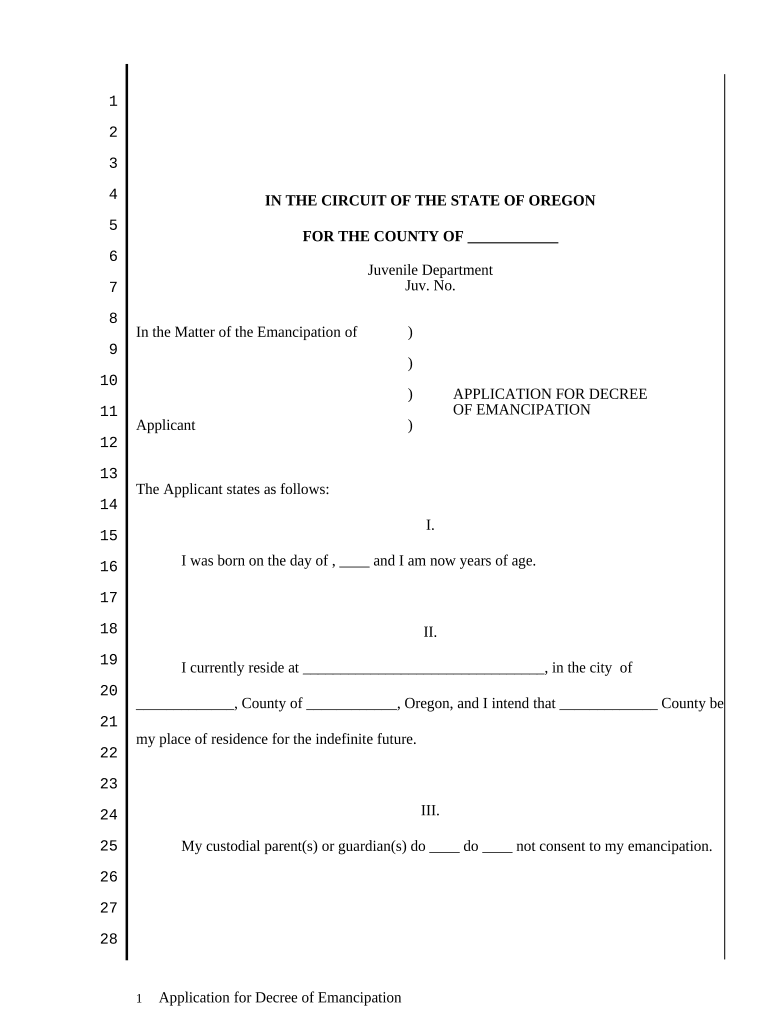
An Emancipation Form is a legal petition filed to request recognition that a minor should be treated as an adult for specified legal purposes. It typically asks a court to terminate parental control and grant the minor capacity to enter contracts, obtain employment, manage finances, and consent to medical care. Procedures, eligibility, and required evidence vary by state; courts consider factors such as age, financial independence, residency, and the minor’s best interests. This guide explains the form’s purpose, common fields, filing destinations, and technical options for completing and submitting the document securely.

Why a Correct Emancipation Form Matters

Using a properly completed Emancipation Form clarifies legal status, enables minors to contract and manage finances, and establishes clear responsibility for healthcare and schooling decisions. A correct filing reduces delays, limits legal disputes, and helps courts evaluate the minor’s readiness under state standards.

Why a Correct Emancipation Form Matters

Who Interacts with an Emancipation Petition

Minors seeking independence, parents or guardians, juvenile court personnel, social service agencies, and attorneys commonly use or review emancipation petitions.

  • Minors (typically older teens) who are financially independent or living apart from parents.
  • Parents or guardians responding to a petition or consenting to an emancipation request.
  • Attorneys, social workers, and court-appointed guardians representing a minor’s best interests.

Core Elements to Include on a Professional Emancipation Form

A complete Emancipation Form combines personal data, factual declarations, supporting evidence, parental consents or objections, notarization when required, and court filing instructions tailored to local procedure.

Identifying Information

Full legal name, date of birth, current address, and contact information for the minor, parents, and any guardian. Courts use this information to verify identity and service of process.
Factual Declaration

A sworn statement describing living arrangements, schooling, employment, and reasons for emancipation, and supporting dates, contacts, and witnesses. Courts expect chronological facts demonstrating independence and maturity.

Financial Evidence

Include pay stubs, employer letters, tax returns, bank statements, and proof of paying rent or utilities. Show consistent income or support covering living expenses for several months.

Parental Consent

If parents consent, include signed statements or affidavits. If parents object, attach their filings. The court weighs consent heavily but still evaluates the minor’s best interests independently.

Notarization

Many states require notarized signatures; others permit witness-only acknowledgements. For remote notarization, retain audio-video recording and certificate as required by the state’s RON rules and journal entries.

Filing Instructions

Specify court name, case type, filing fee, clerk contact, and service requirements. Include copies for parent, child welfare agencies, and any third parties required by local rules.

Step-by-Step: Preparing and Filing the Emancipation Petition

Follow these steps to prepare, verify, and file an emancipation petition so courts can adjudicate the minor’s request efficiently.

  • 01
    Gather Documents: Collect IDs, proof of residency, income records, and school or medical documents.
  • 02
    Complete Form: Enter accurate personal and petition details, including dates and signatures.
  • 03
    Attach Evidence: Upload supporting documents as PDF or scanned images.
  • 04
    File with Court: Submit to juvenile or family court per local rules; serve notice.

How eSubmission and Routing Typically Work

Overview of the typical submission path: prepare form, attach documents, obtain signatures, file with the appropriate court or agency.

  • Prepare Document: Use fillable PDF or word template.
  • Digitally Sign: Each signer applies an electronic signature with intent.
  • Notarize (if required): Use in-person or remote online notarization per state rules.
  • Submit Filing: Upload to court portal or deliver to clerk's office.

Key Digital Workflow Settings for Online Completion

Configure the digital workflow to ensure correct routing, signer authentication, attachments, and final delivery to the court or clerk.

Field Configuration
Signer Authentication and Verification Options Email, SMS code, or KBA per court preference.
Field Placement and Conditional Logic Rules Date, signature, initials, conditional fields to show evidence sections.
Required Attachments and Accepted File Formats PDF preferred; JPG and PNG accepted; maximum file sizes.
Court Filing Destination and Notification Recipients Specify court, clerk contact, and automatic email notifications.

Platform Capabilities to Check Before eFiling

Ensure your eSignature platform supports PDF/A, secure storage, and integrations with court portals or email delivery for official submissions.

  • File Formats: PDF, PDF/A, DOCX supported; preserve formatting.
  • Integrations: Supports Court portals, Google Drive, and Box.
  • Authentication: Multifactor options: SMS, email, KBA.

Security and Compliance Considerations

Encryption: TLS 1.2/1.3 in transit; AES-256 at rest.
Certifications: SOC 2 Type II, ISO 27001, PCI DSS.
HIPAA: BAA available for protected health information.
21 CFR Part 11: Supports compliance for FDA-regulated records.
Audit Trail: Detailed logs: timestamps, IP addresses.
Accessibility: WCAG 2.0 Level AA support.

Common Risks and Legal Consequences of Errors

Dismissal Risk: Incomplete petitions may be dismissed.
Delayed Decision: Missing evidence delays court ruling.
Financial Liability: Minor may assume debts and contracts.
Benefit Impact: Public benefits may be reduced or lost.
Notary Noncompliance: Improper notarization can void signatures.
Service Issues: Failure to serve parents can reject filing.

eSignature Provider Comparison for Emancipation Form Workflows

Compare common eSignature providers for submitting an Emancipation Form; signNow is listed first with typical plan and compliance characteristics for U.S. legal use.

signNow DocuSign Adobe Sign PandaDoc HelloSign
Starting Price $8/user/mo $15/user/mo $14/user/mo $19/user/mo $15/user/mo
Free Trial 7-day trial Varies by plan Varies by plan Varies by plan Varies by plan
Bulk Send Yes Yes Yes Yes No
Audit Trail Yes Yes Yes Yes Yes
HIPAA Compliant Yes Yes Yes No No
Envelope Cap No cap 100 envelopes/user/year Not specified Not specified Not specified

Frequently Asked Questions and Troubleshooting

Answers to frequent questions about completing, signing, notarizing, and filing an Emancipation Form, with troubleshooting for common evidence and service problems.


Need help? Contact support

be ready to get more
Join over 28 million airSlate SignNow users