Establishing secure connection…Loading editor…Preparing document…

Employee Handbook

This template is fully customizable. Edit the text, fill out the fields, and send it for signature. Give it a try!
Employee Handbook

What the Employee Handbook Is and What It Covers

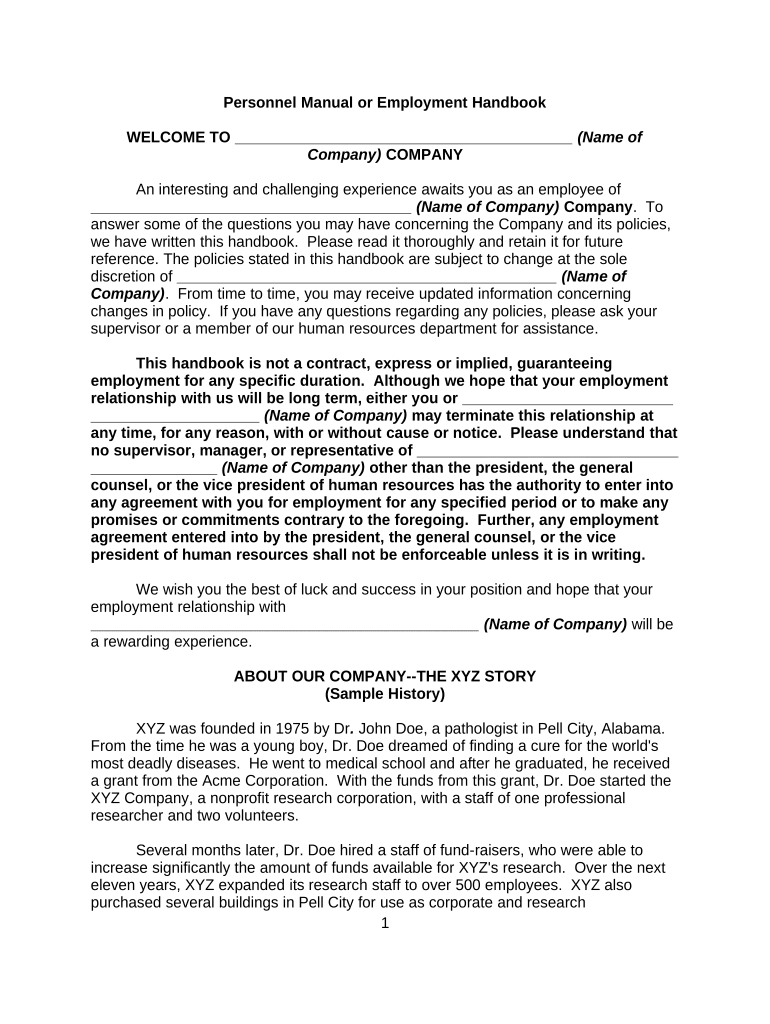
An Employee Handbook is a consolidated employer document that communicates workplace rules, policies, benefits, and expectations to employees. It typically includes company values, employment classifications, compensation and benefits summaries, attendance and leave rules, standards of conduct, disciplinary procedures, and an acknowledgment page for employees to sign. The Handbook serves as a reference for daily operations and a record of communicated policies; it is not a substitute for specific employment contracts or legally required notices that must be provided separately.

Why a Clear Employee Handbook Matters

A written Handbook reduces misunderstandings, supports consistent decision-making, and documents the employer’s communicated policies. When paired with proper distribution and signed acknowledgments, it helps demonstrate that employees received and understood workplace rules.

Why a Clear Employee Handbook Matters

Who Typically Creates and Uses an Employee Handbook

Human resources, general counsel, and senior leadership commonly prepare and update the Handbook; managers and employees use it daily as policy guidance.

  • Human resources teams — draft, update, and distribute policies and acknowledgments to staff.
  • Legal or compliance officers — review language for regulatory and liability concerns.
  • Line managers and supervisors — apply policies consistently across teams.

Distribution and signed acknowledgments tie the Handbook into onboarding, performance management, and compliance recordkeeping.

Primary Users and Signatories

HR Director

Leads policy drafting, approves final Handbook text, coordinates legal review, and manages distribution and retention of signed acknowledgments.

New Employee

Receives the Handbook at hiring, reviews policies, and provides a signed acknowledgment (electronic or paper) indicating receipt and understanding.

Core Sections to Include in a Professional Employee Handbook

A complete Handbook organizes workplace policies into clear, navigable sections so employees can find guidance quickly and managers can apply rules consistently.

Code of Conduct

Describe expected workplace behavior, anti-harassment rules, conflict-of-interest provisions, and reporting channels for misconduct, with examples and escalation steps.
Compensation & Time

Explain pay schedules, overtime rules, exempt/nonexempt classifications, meal and rest break policies, and payroll contact information.

Benefits Overview

Summarize health insurance, retirement plans, paid time off, leave entitlements, and enrollment procedures; attach details or reference benefit plan documents.

Leave & Attendance

Detail vacation, sick leave, family and medical leave eligibility, FMLA notice requirements, and attendance reporting expectations.

Discipline & Termination

Outline progressive discipline steps, immediate termination causes, final pay practices, and return-of-property obligations upon separation.

Acknowledgment & Revisions

Include a signature block for employee acknowledgment and explain how updates are communicated and when revised acknowledgments are required.

Required Information Fields in the Handbook Acknowledgment

Employee Name: Full legal name
Employee ID: Company-assigned ID
Job Title: Official position
Start Date: MM/DD/YYYY
Acknowledgment Date: MM/DD/YYYY
Signature: Typed or handwritten

Step-by-Step: Issuing and Collecting Handbook Acknowledgments

Follow a consistent sequence to distribute the Handbook, collect acknowledgments, and store signed records for compliance and audit readiness.

  • 01
    Prepare Handbook: Update policies, obtain legal review, and finalize the document.
  • 02
    Distribute to Employees: Send via internal portal, secure email, or integrated HR platform.
  • 03
    Collect Acknowledgments: Use signed acknowledgments (electronic or paper) and record the date.
  • 04
    Store Records: Retain signed copies in a secure, access-controlled archive.

Amendment Workflow for Handbook Updates

Use a documented review and approval workflow so updates are traceable and communicated consistently to staff.

01

Draft Revision:

HR proposes changes.
02

Legal Review:

Counsel reviews compliance risks.
03

Executive Approval:

Leadership signs off.
04

Publish Update:

Release revised Handbook to employees.
05

Collect Re-Acknowledgment:

Obtain new signatures if changes are material.
06

Archive Prior Versions:

Store previous editions with metadata.

Where to File, Send, or Submit Signed Handbooks

Decide a single authoritative repository and route all signed acknowledgments there to maintain a consistent audit trail.

  • HR Information System: Primary record stored with employee file.
  • Secure Cloud Archive: Encrypted storage for audit and retrieval.
  • Manager Records: Local copies kept for operational use only.
  • Legal Custodian: Retain copies when policies affect compliance.

Configuring an Online Distribution and Signing Workflow

Configure consistent settings when using an electronic delivery platform to ensure lawful signatures and retained evidence.

Field Configuration
Delivery Method Email link, secure portal, or HRIS push
Authentication Email link by default; add SMS or KBA if higher assurance needed
Signature Type ESIGN-compliant electronic signature (audit trail required)
Storage & Export Encrypted PDF with audit certificate

Digital Signing and Platform Considerations

Choose a platform that preserves an auditable record, supports the required authentication level, and stores signed files securely.

  • Authentication Options: Email-only, SMS code, or identity verification
  • Document Formats: PDF and DOCX with embedded audit trail
  • Integrations: Connect with HRIS, cloud storage, and SSO

Ensure the platform supports ESIGN/UETA compliance, retention export, and access controls; verify HIPAA BAA if you handle protected health information.

Common Timelines for Distribution and Acknowledgment

Adopt predictable deadlines so employees receive timely notice of policies and managers track compliance consistently.

New Hire Delivery:

Provide Handbook during onboarding or within first week

Acknowledgment Deadline:

Request signed acknowledgment within 14 calendar days

Annual Review:

Conduct policy review and issue annual confirmation

Material Changes:

Notify employees and collect re-acknowledgment within 30 days

Record Access:

Retain signed acknowledgments accessible for audits

Common Mistakes When Preparing a Handbook

  • Using vague or discretionary language that creates inconsistent enforcement and potential legal exposure for the employer.
  • Failing to update policies to reflect changes in law, which can result in incorrect guidance and compliance gaps.
  • Not collecting signed acknowledgments or losing records, which undermines proof of notice in disputes.
  • Mixing policy statements with contractual promises that unintentionally create employment contract obligations.

Risks and Consequences of an Incorrect or Missing Handbook

Wage & Hour Claims: Increased exposure
Discrimination Risk: Inconsistent policies
I-9 Noncompliance: Civil penalties
HIPAA Violations: Breach liability
Contract Formation: Unintended promises
Recordkeeping Gaps: Audit failures

Real-World Examples of Electronic Handbook Distribution

Organizations of different sizes use electronic distribution and e-signatures to reduce manual handling while preserving an audit trail.

Optica Ventures

Optica streamlined employee paperwork using an e-signature platform to speed onboarding

  • Interface simplicity reduced time-to-complete
  • The team found it easier for employees to return signed acknowledgments and for HR to centralize records for audits and payroll.

Fertility Centers of Illinois

The healthcare organization integrated digital workflows with existing systems to place signatures on required forms

  • Integration kept documents in the correct formats
  • This approach improved record accuracy and maintained compliance with internal privacy controls.

eSignature Provider Pricing and Feature Snapshot (vendor-first order preserved)

Compare common pricing and core capabilities across vendors when evaluating electronic signature options for Handbook distribution.

signNow DocuSign Adobe Sign PandaDoc HelloSign
Starting Price $8/user/mo $15/user/mo $14/user/mo $19/user/mo $15/user/mo
Free Trial 7-day free trial No trial noted No trial noted Yes, limited Yes, limited
Bulk Send Yes Yes Yes Yes No
Audit Trail Yes Yes Yes Yes Yes
HIPAA Compliant Yes Yes Yes No No

Practical Tips for Accurate and Efficient Handbook Completion

Adopt consistent practices to reduce rework and maintain defensible records across hires, promotions, and terminations.

Standardize Templates
Use a single approved Handbook template and versioning system to avoid conflicting sections or multiple in-force copies.
Collect Acknowledgments
Require signed acknowledgments for new hires and after material policy changes; timestamp and store securely.
Audit Trail
Retain an immutable audit trail showing signer identity, IP address, timestamp, and document version.
Legal Review
Have counsel review disciplinary, arbitration, and pay-classification language for state-specific compliance.

FAQs: Employee Handbook Distribution and Signatures

Answers to frequent questions about whether and how a Handbook can be distributed and acknowledged electronically in the U.S.


Need help? Contact support

be ready to get more
Join over 28 million airSlate SignNow users