Establishing secure connection…Loading editor…Preparing document…

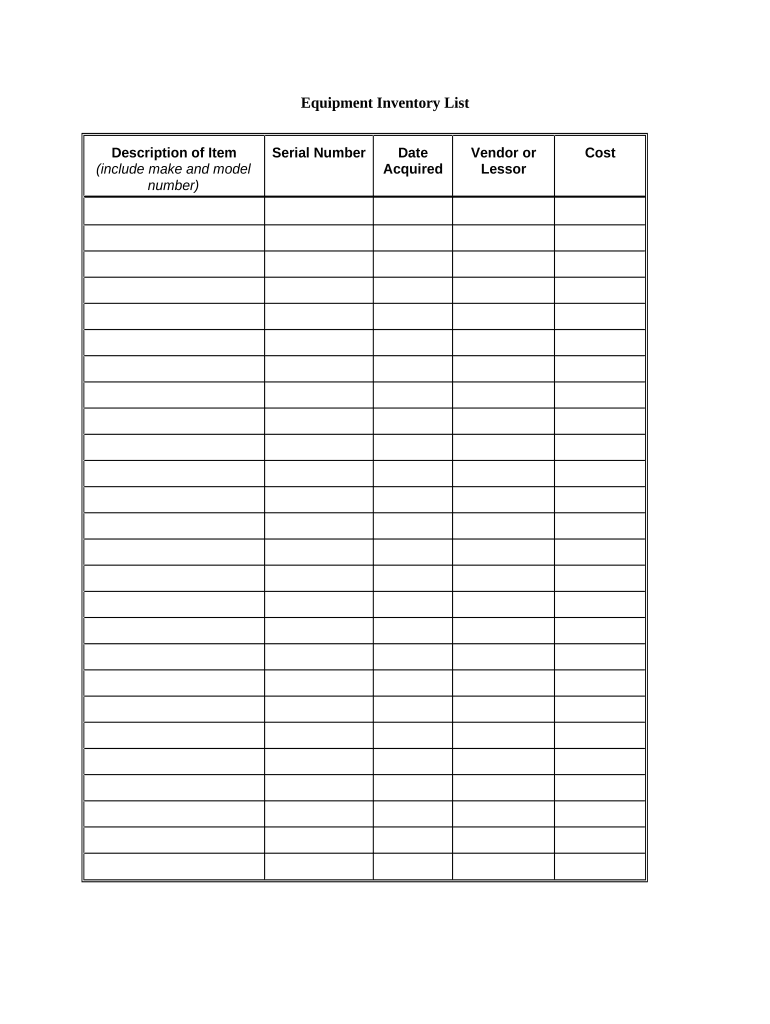
Equipment Inventory List

This template is fully customizable. Edit the text, fill out the fields, and send it for signature. Give it a try!
Equipment Inventory List

What an Equipment Inventory List Is and when it matters

An Equipment Inventory List is a formal, itemized record of physical assets owned, leased, or managed by an organization. It documents identifying details such as item description, manufacturer, model, serial number, location, custodian, acquisition date, purchase price, condition, and warranty or service information. Organizations use the list for accounting (depreciation), insurance, audits, maintenance scheduling, regulatory compliance, loss prevention, and asset transfers. A reliable inventory list supports accurate financial reporting, timely insurance claims, and efficient asset lifecycle management across departments.

Why maintain a formal Equipment Inventory List

A complete inventory reduces financial and operational risk by supporting depreciation schedules, insurance claims, and audit trails; it also clarifies custodial responsibility and helps plan maintenance and replacement budgets.

Why maintain a formal Equipment Inventory List

Who typically creates and relies on the Equipment Inventory List

Role clarity and a single authoritative list reduce duplication, simplify audits, and speed response to loss or transfer events.

  • Accounting teams for depreciation tracking and financial disclosures
  • Facilities and IT for maintenance, warranties, and asset allocation
  • Risk, insurance, and compliance teams for claims and audit evidence

Step-by-step: creating a usable Equipment Inventory List

Complete the inventory in a single pass, verify key identifiers, and route for approvals to create an authoritative record.

  • 01
    Gather asset data: Collect serial numbers, invoices, and warranty documents for each item.
  • 02
    Standardize entries: Use consistent naming, date format MM/DD/YYYY, and currency in USD.
  • 03
    Assign custodians: Record responsible persons and physical storage locations for each asset.
  • 04
    Approve and publish: Get accounting or asset manager sign-off and mark the list as authoritative.

How an inventory entry flows through your processes

A standard workflow moves data from collection to verification, approval, and integration with accounting or asset-management systems.

  • Data capture: Field teams scan or enter item details into the master template.
  • Verification: Audit serial numbers and invoices for accuracy.
  • Approval: Asset manager or controller signs off on additions and disposals.
  • Integration: Export to accounting or CMMS in supported formats (CSV, XLSX).

Typical online workflow settings for equipment inventories

Configure the digital workflow to reduce manual steps, enforce required fields, and route items to the right approvers.

Field Configuration
Required Fields Serial Number | Model | Date Acquired
Approval Routing Custodian → Asset Manager → Accounting
Notifications Email or in-app alerts on pending approvals
Export Format CSV | XLSX | PDF

Technical considerations for sharing and e-submitting inventories

Ensure the platform provides audit trails, user access controls, and export options so signed records can be retained and reproduced for audits.

  • File formats: PDF, DOCX, XLSX supported
  • Integrations: Salesforce, NetSuite, Google Workspace
  • Authentication: Email link, SMS code, or SSO

eSignature vendor pricing and feature snapshot useful for inventories

Compare starting price, trial availability, bulk send, audit trail, HIPAA support, and envelope or session limits across common vendors; signNow is listed first.

signNow DocuSign Adobe Sign PandaDoc HelloSign
Starting Price $8/user/mo $15/user/mo $14/user/mo $19/user/mo $15/user/mo
Free Trial Yes, 7-day trial Varies Varies Varies Varies
Bulk Send Yes Yes Yes Yes No
Audit Trail Yes Yes Yes Yes Yes
HIPAA Compliant Yes Yes Yes No No

Security and compliance items to include with digital inventories

Encryption: TLS 1.2/1.3 and AES-256
Audit Trail: Timestamp, IP, and action log
Access Controls: Role-based permissions
Data Residency: Specify storage location if required
HIPAA BAA: Execute BAA when PHI present
Retention Policy: Immutable records and export

Risks and consequences of an incorrect inventory

Insurance Denial: Claim disputes for incomplete listings
Audit Exposure: Accounting discrepancies and possible penalties
Operational Loss: Missed maintenance, downtime costs
Depreciation Errors: Incorrect tax basis or reporting
Warranty Loss: Invalid warranty claims
Legal Challenges: Disputes in asset transfers

Common mistakes when preparing an Equipment Inventory List

  • Omitting serial numbers or unique identifiers, which hinders recovery and warranty claims and reduces insurer confidence in the list.
  • Inconsistent naming and categorization across entries, causing reconciliation problems between operations and accounting systems.
  • Failing to record acquisition dates or purchase documents, which complicates depreciation schedules and tax treatments.
  • Not assigning custodians or locations, preventing accountability and delaying maintenance or relocation of critical equipment.

Six essential components of a professional Equipment Inventory List

Include these elements to create a defensible, audit-ready record that supports accounting, insurance, and operations.

Identification

Clear item description plus manufacturer and model so the asset is uniquely identifiable across systems and warranties.
Serial / VIN

Exact serial number or VIN for theft recovery, warranty validation, and insurer verification.

Acquisition Data

Purchase date and vendor invoice reference to support depreciation and provenance.

Financial Value

Purchase price and current book value for accounting and insurance valuations.

Custody & Location

Assigned custodian and physical location to show responsibility and enable physical audits.

Supporting Documents

Attach invoices, warranties, service records, and transfer paperwork for a complete evidence trail.

Practical tips for accurate and efficient inventories

Apply consistent standards and automation to reduce errors and administrative overhead when maintaining inventories.

Standardize naming
Adopt a naming convention and enforce it with templates to prevent duplicate or mismatched entries.
Use unique IDs
Scan or photograph serial numbers and link images to records to reduce manual transcription errors.
Schedule audits
Perform periodic physical audits and reconcile differences to keep records current and defensible.
Keep attachments
Store invoices, warranties, and service logs with each item for rapid verification and claims support.

How organizations use equipment inventories in practice

These brief examples show common, practical uses of a maintained equipment inventory across operations and finance.

Facilities Management

A facilities team documents HVAC and safety equipment for maintenance scheduling

  • Captures serials and service dates to plan preventive work
  • This reduces downtime, centralizes vendor warranty claims, and supplies insurers with immediate documentation after an incident.

IT Asset Control

An IT group tracks laptops, servers, and peripherals for lifecycle planning

  • Records serial numbers, assignment, and purchase invoices
  • The list informs depreciation schedules, supports theft recovery, and speeds device refresh cycles.

Frequently asked questions about Equipment Inventory Lists

Answers to typical questions about completeness, legal use, digital signing, retention, and state-specific concerns.


Need help? Contact support

be ready to get more
Join over 28 million airSlate SignNow users