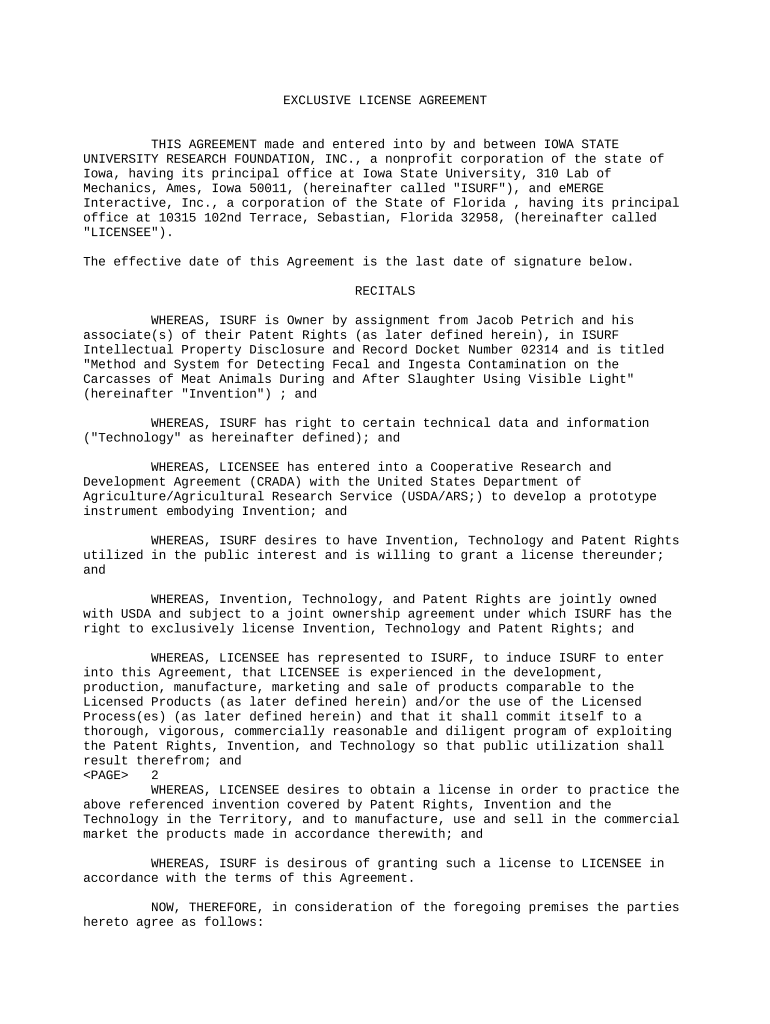
Exclusive Agreement Form
What the Exclusive Agreement Form Is
Why an Exclusive Agreement Form Matters
An exclusive agreement reduces overlap and competition between parties, secures investments in distribution or development, and sets measurable performance obligations. It creates clear legal rights and remedies if exclusivity is breached.
Who Typically Prepares and Signs This Form
Businesses, independent agents, licensors, distributors, and service providers commonly use exclusive agreements to control market access and protect investment.
- Manufacturers and distributors managing territorial or channel exclusivity for products or lines.
- Software or IP owners licensing technology to a single integrator or reseller.
- Service providers granting exclusive rights to agents, brokers, or regional partners.
Use counsel for high-value transactions and confirm signatory authority before execution to reduce disputes later.
Typical Signer Roles
Company Officer
A corporate officer (CEO, President, or General Counsel) signs when the company is a party. They confirm corporate authorization, binding the business to exclusivity obligations and indemnities; corporate resolution or Board approval may be required for high-value or long-term exclusives.
Independent Agent
An individual or small firm acting as licensee or distributor signs to accept territory, sales targets, and termination clauses. They should verify compensation, minimum performance metrics, and whether sub-licensing is permitted before signing.
Step-by-Step: Complete and Execute the Agreement
-
01Prepare draft: Gather party details, scope, territory, term, and consideration.
-
02Legal review: Have counsel verify enforceability and regulatory exceptions.
-
03Signatures: Collect authorized signatures, dates, and printed names.
-
04Record and distribute: Provide executed copies to all parties and retain originals.
Typical Online Execution Flow
-
Upload document: Add the PDF or DOCX to the eSignature platform.
-
Place fields: Insert signature, date, and initials fields for each signer.
-
Add signers: Enter signer emails and set signing order if needed.
-
Send and track: Dispatch invites, monitor status, and capture audit trail.
Configure a Secure Signing Workflow
| Field | Configuration |
|---|---|
| Signing Order | Sequential or parallel per transaction needs |
| Authentication | Email link standard; SMS or KBA for higher assurance |
| Access Control | Set expiration and reminder schedules |
| Audit Trail | Capture IP, timestamps, and action log |
Technical and Integration Considerations
Choose a platform that supports your file formats, integrations, and compliance needs while preserving a verifiable audit trail.
- File formats: PDF, DOCX, HTML supported
- Integrations: Salesforce, NetSuite, Google Workspace
- Authentication: Email, SMS, or advanced KBA
Confirm the provider supports required compliance (ESIGN, UETA) and any industry standards such as HIPAA or 21 CFR Part 11 before using electronic execution.
Key Timing Elements to Note
Effective Date:
The date obligations begin; written as MM/DD/YYYY.
Initial Term Length:
Defines the primary exclusivity period and renewal triggers.
Renewal Notice:
Specify days' advance notice required to renew or terminate.
Performance Deadlines:
Milestones tied to minimum purchase or sales targets.
Termination Notice:
Notice period for breach or convenience terminations.
Milestone Timeline for an Exclusive Agreement
Negotiation
Drafting and review of terms and exhibits.
Approval
Internal sign-offs and, where required, board approval.
Execution
All parties sign and exchange executed copies.
Onboarding
Operational handoff, training, and initial performance tracking.
Common Preparation Mistakes to Avoid
- Vague territorial language that leads to disputes about where exclusivity applies; be specific about geographic limits and distribution channels.
- Undefined performance metrics or vague ‘best efforts’ clauses that make it hard to measure compliance and to trigger remedies or termination.
- Missing or mismatched signatory authority where the signing representative lacks corporate authorization, which can lead to unenforceability or rescission.
- Failing to address post-termination obligations (inventory buyback, transition assistance, IP rights), causing operational and legal friction after the contract ends.
Penalties and Risks of Incorrect Execution
eSignature Pricing and Capabilities Comparison
| signNow | DocuSign | Adobe Sign | PandaDoc | HelloSign | |
|---|---|---|---|---|---|
| Starting Price | $8/user/mo | $15/user/mo | $14/user/mo | $19/user/mo | $15/user/mo |
| Free Trial | 7-day free trial | Varies by vendor | Varies by vendor | Varies by vendor | Varies by vendor |
| Bulk Send | Yes (Business Premium) | Varies by plan | Varies by plan | Varies by plan | No |
| Audit Trail | Yes | Yes | Yes | Yes | Yes |
| HIPAA Compliant | Yes | Yes | Yes | No | No |
| Envelope Cap | No cap | 100 envelopes/user/year | Varies | Varies | Varies |
Frequently Asked Questions
-
Can this be signed electronically?
Yes. Under the federal ESIGN Act (15 U.S.C. ch. 96) and UETA in most states, electronic signatures are valid so long as intent, consent, attribution, and retention requirements are satisfied.
-
When is notarization required?
Notarization is required when state law or the transaction type (for example, deeds) demands it. Check state rules for deeds and certain conveyances; remote online notarization may be available depending on jurisdiction.
-
What happens if a party uses the wrong legal name?
A mismatched name can create enforceability problems and tax-reporting errors. Correct names before signing and attach corporate resolutions or proof of authority if needed.
-
How do I revoke or terminate exclusivity?
Follow the termination clause: provide required notice, cure periods, and any post-termination obligations. Absent a contract right, unilateral revocation may expose you to breach claims.
-
Is a handwritten signature stronger than an e-signature?
Legally no. ESIGN and UETA treat electronic signatures as valid; enforceability depends on the evidence of intent, attribution, and ability to reproduce the record, not the physical medium.
-
How should executed copies be stored?
Retain a secure copy that is reproducible and tamper-evident. For healthcare or tax-related material, follow HIPAA and IRS retention rules; maintain audit logs for e-signed records.