Establishing secure connection…Loading editor…Preparing document…

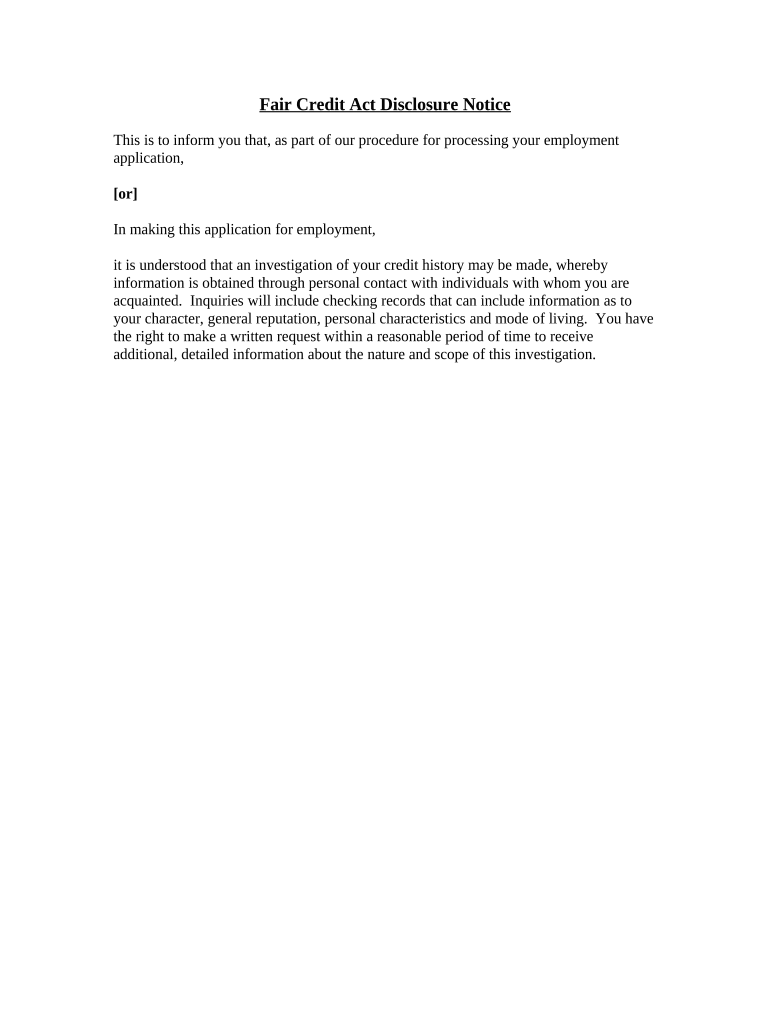
Fair Credit Act Disclosure Notice

This template is fully customizable. Edit the text, fill out the fields, and send it for signature. Give it a try!
Fair Credit Act Disclosure Notice

What the Fair Credit Act Disclosure Notice Is and When It Applies

The Fair Credit Act Disclosure Notice is a written statement provided to consumers when a credit decision, adverse action, or consumer report affects their account or application. It explains the reason for the action, identifies any consumer reporting agency used, and tells the consumer how to obtain a copy of the report and dispute inaccurate information. Organizations use this notice to meet federal consumer-protection requirements and to document that consumers received required information about credit-related decisions.

Why a Clear Disclosure Notice Matters

A properly completed Fair Credit Act Disclosure Notice reduces legal risk, supports regulatory compliance, and gives consumers the information they need to verify or dispute credit report information.

Why a Clear Disclosure Notice Matters

Who Prepares and Receives These Notices

Lenders, creditors, background-screening firms, and servicers typically prepare Fair Credit Act Disclosure Notices when consumer reports influence a decision or an adverse action occurs.

  • Real Estate and Mortgage teams — share disclosures related to loan underwriting and credit checks.
  • Healthcare billing and collections — use disclosures when third-party credit reports affect payment arrangements.
  • Financial services and lenders — provide notices for adverse action or underwriting denials.

Maintain accurate records of issuance and delivery to demonstrate compliance and to support any future consumer inquiries or disputes.

Core Elements to Include in a Professional Disclosure Notice

A compliant Fair Credit Act Disclosure Notice is concise and includes consumer-specific details, the reason for action, the reporting agency used, and instructions for obtaining and disputing the report.

Consumer Identity

Full name and mailing address used to match the consumer to the report and to avoid mistaken identity.
Action Summary

A short statement describing the adverse action or decision that triggered the disclosure.

Agency Identified

Name, address, and contact details of the consumer reporting agency whose data was used.

Reason Codes

Specific reason or permissible purpose for the inquiry, using plain language and any numerical reason codes required by policy.

Consumer Rights

Instructions on how to obtain a free report, how to dispute inaccuracies, and any time limits for doing so.

Signature Block

Authorized signer name, title, signature, and date to document who issued the notice.

Step-by-Step: Preparing and Delivering the Notice

Follow these steps to create, review, and deliver a compliant Fair Credit Act Disclosure Notice and retain proof of delivery.

  • 01
    Collect Data: Gather consumer name, address, report source, and decision details.
  • 02
    Draft Notice: Populate required fields and include clear reason language and CRA contact information.
  • 03
    Review: Verify accuracy, internal approvals, and any required legal language.
  • 04
    Deliver: Send by mail or accepted electronic method and retain proof of transmission.

How Electronic Delivery and eSubmission Work

An electronic workflow lets you generate the notice, authenticate the recipient, capture consent, and preserve an audit trail for compliance.

  • Document Creation: Upload template, populate fields, and apply conditional text where needed.
  • Signer Authentication: Choose authentication strength: email, SMS code, or stronger methods.
  • Consent Capture: Provide ESIGN consumer disclosure and capture consent before signing.
  • Archive: Save final PDF with audit trail and delivery evidence.

Typical Online Workflow Settings for eDelivery and Signing

Configure these settings in your eSignature platform to ensure the notice is delivered and recorded appropriately.

Field Configuration
Authentication Email link, SMS code, or two-factor authentication
Consumer Disclosure Present ESIGN consent before signature
Audit Trail Capture IP, timestamp, and action log
Retention Template Assign storage and retention metadata on completion

Technical Requirements and Supported Integrations

Choose a platform that supports required file formats, audit trails, and your integration needs.

  • File Formats: Accepts PDF, DOCX, and HTML inputs
  • Integrations: Connects with Salesforce, NetSuite, Microsoft 365
  • Authentication: Supports SMS codes, SSO, and advanced options

Confirm the vendor's compliance certifications and available APIs to automate creation, delivery, and archival workflows.

Timing, Deadlines, and Consumer Response Expectations

Meet federal and state timing requirements for notice delivery and allow consumers adequate time to request reports or dispute information.

Provide on Action:

Deliver notice concurrently with or promptly after adverse action

Consumer Report Access:

Consumers may request a free report per federal law

Dispute Window:

Allow time for consumer disputes to be initiated

Record Retention:

Retain notice and delivery proof per retention rules

State Variations:

Timing rules may vary by state statute or regulation

Key Processing Milestones from Decision to Archive

Track these milestones to ensure timely delivery, consumer response handling, and compliant retention of the disclosure notice.

01

Decision Finalized

Internal decision recorded and reason code assigned

02

Notice Generated

Notice populated and checked for accuracy

03

Notice Sent

Notice delivered and proof of transmission captured

04

Retention Start

Begin retention clock following delivery

Common Mistakes to Avoid When Preparing Notices

  • Using vague reason text that does not permit the consumer to understand the basis for action.
  • Failing to include the consumer reporting agency name and contact details required to obtain a report.
  • Delivering the notice without capturing ESIGN consumer consent when delivered electronically.
  • Not retaining proof of delivery or the audit trail needed to demonstrate compliance.

Penalties and Risks of an Incorrect or Missing Notice

Regulatory Fines: Civil penalties and enforcement actions
Litigation Risk: Class actions or individual claims
Remediation Costs: Expenses to correct reports and notify consumers
Reputational Harm: Loss of consumer trust and business impact
Backup Withholding: Tax withholding consequences if TIN errors occur
Operational Delay: Repeated disputes prolong decision cycles

eSignature Pricing Comparison for Notice Delivery and Signing

The table below summarizes starting prices and common capability differences among mainstream eSignature vendors; signNow is listed first for comparison.

signNow DocuSign Adobe Sign PandaDoc HelloSign
Starting Price $8/user/mo $15/user/mo $14/user/mo $19/user/mo $15/user/mo
Free Trial Yes, 7-day trial Varies by vendor Varies by vendor Varies by vendor Varies by vendor
Bulk Send Yes Yes Yes Yes Varies
Audit Trail Yes Yes Yes Yes Yes
HIPAA Compliant Yes Yes Yes No No

Frequently Asked Questions and Troubleshooting

Answers to common questions about electronic disclosures, enforceability, and practical handling of disputes and audits.


Need help? Contact support

be ready to get more
Join over 28 million airSlate SignNow users