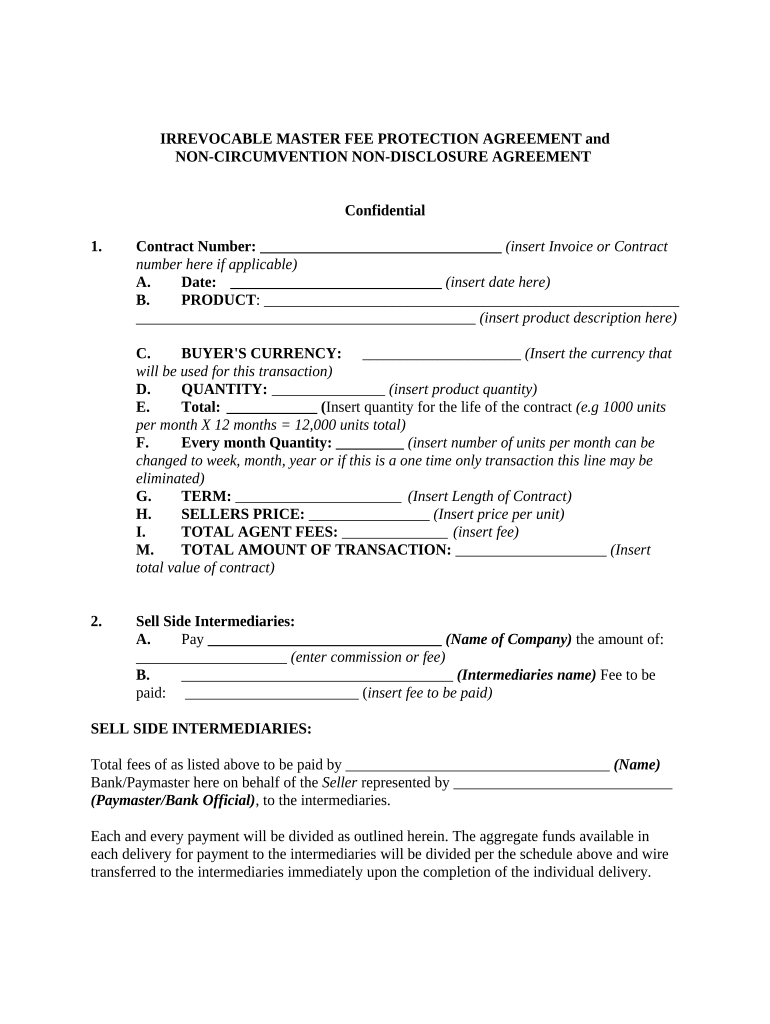
Fee Protection Agreement
What a Fee Protection Agreement Is and when it applies
Why including a Fee Protection Agreement matters
A clear Fee Protection Agreement reduces billing disputes, clarifies refund eligibility, and preserves the provider’s right to recover preparatory or cancellation costs quickly.
Which parties commonly use a Fee Protection Agreement
Typical users include professional services firms, contractors, consultants, and clients engaging in project-based or retainership work.
- Professional services firms — lawyers, consultants, accountants requiring upfront work and expense protection.
- Construction contractors — protect mobilization costs, material purchases, and scheduling commitments.
- Software and creative agencies — secure fees for custom work, milestones, and cancellation windows.
Who can sign on behalf of a party
Authorized Officer
A corporate officer listed in board resolutions or corporate records may sign on the company’s behalf. Confirm delegation in internal governance documents to avoid signature disputes during enforcement or collection.
Designated Agent
A named agent or authorized representative (with written power of attorney or signing authorization) may execute the agreement for an individual or entity; document the scope and duration of that delegation to preserve enforceability.
Consequences of an incomplete or incorrect agreement
How to complete a Fee Protection Agreement step by step
-
01Prepare: Gather party legal names and contract references
-
02Define fees: List amounts, schedule, and refundable portions
-
03Set triggers: Specify cancellation, delay, or force majeure events
-
04Sign: Obtain authorized signatures and dates
Typical routing and processing flow
-
Draft: Author prepares the agreement with fee and trigger detail
-
Review: Legal and finance confirm amounts and refund rules
-
Sign: Authorized signers execute the agreement
-
Archive: Store signed copy with audit trail
How to customize the online completion workflow
| Field | Configuration |
|---|---|
| Required Fields | Mark name, date, fee schedule as mandatory |
| Signer Order | Set sequential or parallel signing |
| Authentication | Use email, SMS code, or KBA per risk |
| Retention | Auto-save signed PDFs with audit trail |
Digital signing and technical requirements
Choose a platform that supports audit trails, date/time stamps, and secure storage to preserve the agreement’s evidentiary value.
- File formats: PDF, DOCX supported
- Integrations: CRM and cloud storage
- Security: TLS and AES encryption
Common eSignature vendor pricing and capability snapshot for Fee Protection Agreements
| signNow | DocuSign | Adobe Sign | PandaDoc | HelloSign | |
|---|---|---|---|---|---|
| Starting Price | $8/user/mo | $15/user/mo | $14/user/mo | $19/user/mo | $15/user/mo |
| Free Trial | 7-day free trial | Varies by plan | Varies by plan | Varies by plan | Varies by plan |
| Bulk Send | Yes | Yes | Yes | Yes | No |
| Audit Trail | Yes | Yes | Yes | Yes | Yes |
| HIPAA Compliant | Yes | Yes | Yes | No | No |
Frequently asked questions and common issues
-
Are electronically signed agreements valid?
Yes. Electronic signatures are legally valid under the ESIGN Act (15 U.S.C. §7001) and UETA in states that adopted it, provided the four-part validity test is met: intent, consent, attribution, and record retention.
-
Do I need a notary or witnesses?
Most fee protection clauses do not require notarization, but state laws or contract types may. For documents needing notarization or witnesses, follow state rules; some states require two witnesses for certain instruments.
-
How do I correct a signed agreement?
Avoid post-signature edits. Use an amendment or replacement agreement signed by all parties to record changes; maintain the original signed document for audit and evidentiary purposes.
-
How can I revoke or cancel the agreement?
Revocation depends on contract terms. Follow the agreement’s termination clause and provide required notices in writing. Refund obligations depend on the stated cancellation and fee provisions.
-
What authentication level is recommended?
Choose authentication proportional to risk: email link for low risk, SMS code or knowledge-based authentication for higher-risk agreements, and multi-factor or certificate-based methods for regulated records.
-
How should signed copies be stored?
Store signed PDFs with audit trails, secure encryption (TLS in transit, AES-256 at rest), and access controls. Keep retention schedules aligned with IRS, HIPAA, and state requirements.