Establishing secure connection…Loading editor…Preparing document…

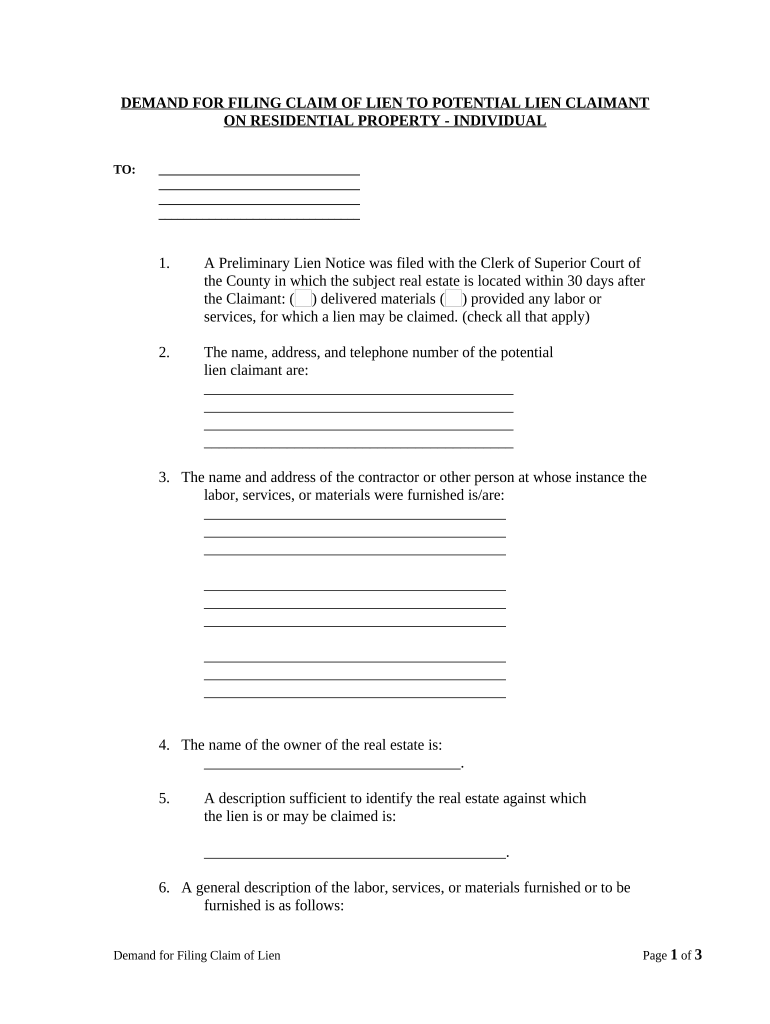
Georgia Demand for Filing Claim of Lien

This template is fully customizable. Edit the text, fill out the fields, and send it for signature. Give it a try!
Georgia Demand for Filing Claim of Lien

What the Georgia Demand for Filing Claim of Lien Is

The Georgia Demand for Filing Claim of Lien is a written notice used in construction and contracting contexts to inform a property owner, general contractor, or other responsible party that a claimant intends to file a mechanic's lien unless an outstanding payment dispute is resolved. The document summarizes the unpaid work or materials, the contract or project reference, and the amount claimed, and it often serves as a final business communication before formal lien filing in county records. It is a transactional tool — not the lien instrument itself — and is typically followed by statutory filing steps if payment is not made.

Why a Demand Notice Matters Before Filing a Lien

A clear demand clarifies the claim, documents attempts to collect, and can prompt payment without court involvement. It helps preserve a paper trail that supports later lien filing or collection actions and may reduce litigation by encouraging settlement.

Why a Demand Notice Matters Before Filing a Lien

Who Typically Prepares or Receives This Demand

Common users include trade contractors, subcontractors, suppliers, and property managers who have not been paid for materials or services on a Georgia property.

  • Trade contractors and subcontractors asserting unpaid balances for labor or materials provided to a construction project.
  • Suppliers who delivered materials and seek to preserve lien rights by documenting nonpayment.
  • Property owners, general contractors, or project managers who receive the notice and must respond or resolve the claim.

The demand is a business communication that can affect payment timing and legal options; accurate preparation and distribution are important to preserve remedies.

Step-by-Step: Preparing and Sending the Demand

Follow these steps to prepare a business-ready Georgia Demand for Filing Claim of Lien and to document your collection efforts before filing a formal lien.

  • 01
    Gather records: Collect contracts, delivery tickets, invoices, and change orders.
  • 02
    Draft demand: Summarize work, state amount due, and set a payment deadline.
  • 03
    Verify parties: Confirm legal owner name and mailing address for service.
  • 04
    Send and record: Deliver by certified mail and retain proof of delivery.

How to Build a Digital Demand Workflow

Configure an electronic workflow to create, route, sign, and archive demand notices consistently and with audit logs.

Field Configuration
Template Prepopulate standard fields and legal language.
Signature Order Set claimant first, then authorized rep of claimant.
Authentication Use email plus SMS or ID check for signer identity.
Recordkeeping Auto-save PDF with audit trail and metadata.

Typical Delivery and Response Flow

A clear flow reduces disputes and documents the timeline from demand delivery to payment or lien filing.

  • Prepare Demand: Draft notice and attach supporting invoices.
  • Deliver Notice: Send by certified mail and email for redundancy.
  • Await Response: Allow the stated deadline for payment or dispute.
  • Next Step: If unpaid, proceed with statutory lien filing steps.

Timing Considerations and Typical Deadlines

Timely action matters: document delivery and filing windows affect lien rights and potential penalties.

Demand deadline:

Set a specific payment date; often 10–30 days from delivery.

Proof of delivery:

Keep certified mail receipt and tracking number for records.

File promptly:

File lien within the state statutory period after last furnishing.

Respond to disputes:

Record any negotiations, partial payments, or release agreements.

Legal action timeline:

If lien is filed, litigation or foreclosure deadlines follow state rules.

Key Milestones from Demand to Lien Filing

Track these sequential milestones so each required action and evidence is collected on time.

01

Create Demand

Draft the notice and attach supporting invoices and change orders.

02

Serve Demand

Send to owner and general contractor with proof of delivery.

03

Wait Period

Allow the stated deadline for payment or response before filing.

04

File Claim

If unpaid, prepare and file the claim of lien with county records.

Essential Components of a Professional Demand Notice

A complete demand includes clear identification, an itemized claim, and precise instructions for payment and next steps.

Claimant Details

Legal name, mailing address, and contact information for the party asserting the claim.
Property Identification

Physical address and any parcel or legal description needed for record searches and indexing.

Scope of Work

Concise description of labor, materials, or services rendered tied to project milestones or invoices.

Amount Owed

Itemized unpaid amounts, retainage, and the total dollar claim being demanded.

Demand Terms

Payment deadline, acceptable payment methods, and statement of intent to file lien if unpaid.

Attachments

Include invoices, delivery receipts, change orders, and contract excerpts that support the claim.

Recordkeeping, Security, and Compliance Basics

Encryption In Transit: TLS 1.2/1.3
Encryption At Rest: AES-256
Audit Trail: Time-stamped actions retained
HIPAA Support: BAA available
ESIGN/UETA: Legally compliant
SOC/ISO: SOC 2 Type II, ISO 27001

Common Legal Risks from Errors or Omissions

Invalid Claim: May be voided in court
Statute Bar: Late filing can forfeit rights
Liability Exposure: Wrongful lien risks damages
Fee Exposure: Court costs and attorney fees
Title Issues: Clouded title until resolved
Reputational Risk: Prompt disputes may harm relations

Frequent Preparation Pitfalls to Avoid

  • Using an incorrect owner name or property description that prevents the county clerk from indexing the eventual lien properly.
  • Failing to attach or reference the invoices and delivery records that substantiate the amount claimed and the dates of last furnishing.
  • Missing the statutory window for filing a claim of lien after the last labor or material delivery, which can forfeit lien rights.
  • Relying on informal email confirmation alone instead of certified mail or proven delivery methods that create durable proof of notice.

Comparing Typical eSignature Pricing and Capabilities

Below is a concise vendor comparison showing starting price and common capability indicators relevant when digitizing demand notices and lien workflows.

signNow DocuSign Adobe Sign PandaDoc HelloSign
Starting Price $8/user/mo $15/user/mo $14/user/mo $19/user/mo $15/user/mo
Free Trial 7-day free trial, no credit card required Varies by vendor; check vendor site Varies by vendor; check vendor site Varies by vendor; check vendor site Varies by vendor; check vendor site
Bulk Send Available on select plans Available on select plans Available on select plans Available on select plans Available on select plans
Audit Trail Yes Yes Yes Yes Yes
HIPAA Compliant Yes Yes Yes No No

Technical Considerations for eSubmission and Storage

Choose a platform that supports secure delivery, storage, and the integrations your workflows require.

  • Supported Formats: PDF, DOCX, HTML
  • Integrations: Salesforce, NetSuite, Microsoft 365
  • Authentication: Email, SMS, advanced options

Frequently Asked Questions About the Georgia Demand for Filing Claim of Lien

Answers to common questions about preparation, distribution, and next steps if payment is not received.


Need help? Contact support

be ready to get more
Join over 28 million airSlate SignNow users