Establishing secure connection…Loading editor…Preparing document…

Finder's Agreement

This template is fully customizable. Edit the text, fill out the fields, and send it for signature. Give it a try!
Finder's Agreement

What a Finder's Agreement Covers and When it's Used

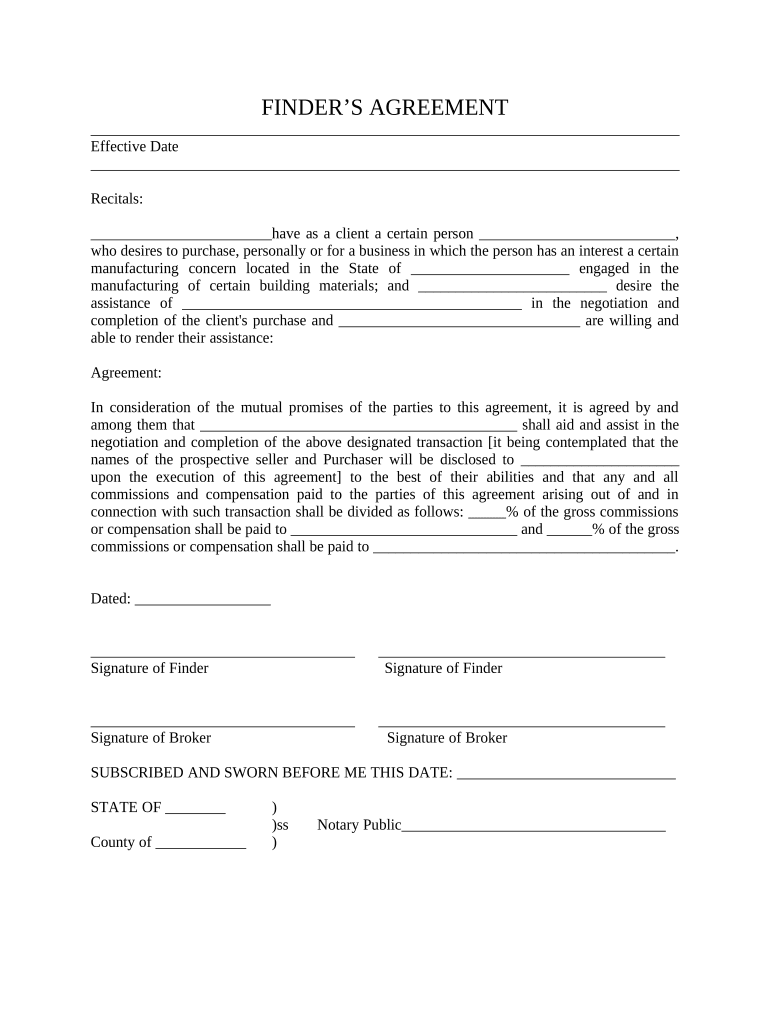
A Finder's Agreement is a contractual document that records the terms under which one party (the finder) introduces a potential client, investor, customer, or buyer to another party and the compensation payable for that introduction. It defines the covered introduction, the fee or commission structure, payment timing, any exclusivity or non-circumvention obligations, confidentiality requirements, and the governing law. The agreement helps reduce disputes by setting expectations about when a fee is earned, who qualifies as the introduced party, and how referrals are documented and paid.

Why a Written Finder's Agreement Matters

A clear Finder's Agreement documents intent and conditions for referral fees and reduces later disputes. It specifies triggers for payment, protects confidential information, and allocates risk between parties under applicable contract law and e-signature statutes such as the ESIGN Act (15 U.S.C. ch. 96, 2000) and state UETA rules.

Why a Written Finder's Agreement Matters

Who Typically Uses a Finder's Agreement

Use a Finder's Agreement when you want a written record of the introduction, a clear compensation trigger, and enforceable terms for confidentiality and non-circumvention.

  • Independent brokers and referral agents working on commission-based introductions for transactions.
  • Small business owners and startups seeking introductions to investors or strategic partners.
  • In-house business development or sales teams documenting relationships with external referrers.

Key Signers and Their Roles

Finder / Broker

The individual or firm that introduces prospects. Typically responsible for documenting the referral details, confirming consent to share contact information, and providing any supporting materials that establish the introduction occurred.

Client / Company Representative

The party that receives the introduction and agrees to pay the referral fee if specified conditions occur. This signer confirms the scope of covered introductions and accepts the payment terms, governing law, and confidentiality obligations.

Security and Compliance Considerations

ESIGN / UETA: Recognized for e-signature validity
Audit Trail: Timestamp, IP, and action history
Encryption: TLS 1.2/1.3 in transit
Data at Rest: AES-256 encrypted storage
HIPAA (if applicable): BAA required for PHI
Certifications: SOC 2 Type II, ISO 27001

Essential Elements to Include in a Professional Finder's Agreement

A complete Finder's Agreement should explicitly allocate rights and obligations. Include precise language for the introduction, the fee formula, timing and method of payment, term and termination, confidentiality, and the state law that governs disputes to avoid ambiguity.

Parties

Full legal names and entity types for both finder and recipient, including contact details and authorized signatory names to ensure enforceable identification.
Scope of Introduction

A clear description of the type of introductions that qualify (company names, investor types, territories, or product lines) and the time window during which introductions are eligible.

Compensation

Exact fee calculation: flat fee, percentage of transaction, or tiered schedule; specify gross vs net basis, caps, and whether fees apply to ancillary transactions.

Payment Terms

Trigger events for payment (signed contract, funds received), timing (e.g., within 30 days), currency, invoicing requirements, and any withholding or tax reporting obligations.

Term & Termination

Agreement duration, survival of key provisions, termination for cause, and post-termination referral windows that preserve fee rights for prior introductions.

Confidentiality & Non-Circumvention

Nondisclosure terms and restraints preventing the recipient from bypassing the finder to avoid fees, with defined remedies for breach.

Step-by-Step: Completing and Executing a Finder's Agreement

Follow these steps to prepare, sign, and store a Finder's Agreement so payment triggers are clear and records meet legal and tax requirements.

  • 01
    Draft Terms: Define scope, fee, and payment trigger.
  • 02
    Confirm Parties: Verify legal names and authority to sign.
  • 03
    Set Payment Terms: Specify timing, invoicing, and tax reporting.
  • 04
    Execute and Archive: Sign electronically, distribute copies, retain records.

How to Configure an Online Signing Workflow

Set up the signer order, authentication level, and template behavior before sending to reduce friction and ensure reliable evidence for the signing event.

Field Configuration
Authentication Method Email link or SMS code
Bulk Send Enable on premium plans
Template Usage Save as reusable template
Reminders Automated reminders every 3 days

Digital Signing Options and File Formats

Select settings for signer authentication, retention of the certificate of completion, and export options (PDF/A) to meet internal and regulatory audit needs.

  • Supported Formats: PDF, DOCX, HTML
  • Integrations: CRM and cloud storage
  • Authentication: Email, SMS, KBA options

Typical Routing and Sign-off Process

A standard digital workflow for a Finder's Agreement reduces manual steps and captures the signing evidence needed to prove execution and timing.

  • Upload Document: Add the final agreement file to the platform.
  • Place Fields: Assign signature, name, and date fields.
  • Send to Parties: Notify finder and recipient by email.
  • Complete Signing: Collect signatures and store certificate.

Key Deadlines and Reporting Dates to Track

Monitor payment windows, tax reporting obligations, and document retention dates that affect referral fees and compliance with tax rules.

Payment Due Date:

Typical term: within 30 days of trigger

Invoice Deadline:

Submit invoice within 60 days to preserve claim

1099-NEC Reporting:

Form 1099-NEC to recipient and IRS by Jan 31

Statute of Limitations:

Varies by state — consult counsel for specifics

Recordkeeping Start:

Retention begins at agreement effective date

Typical Processing Milestones from Draft to Payment

Track these stages so every milestone — from introduction to commission payment — is documented and auditable.

01

Draft Finalized

Terms agreed and document prepared for signature.

02

Execution

Parties sign and date the agreement.

03

Introduction Delivered

Finder provides contact details and evidence of introduction.

04

Fee Paid

Payment issued according to terms and recorded.

Common Mistakes to Avoid

  • Using vague fee language that fails to define the triggering event or calculation method, which often leads to disputes.
  • Failing to verify signer authority and legal names, causing delays and potential unenforceability in payment or tax reporting.
  • Not capturing a clear record of the introduction (email, timestamped contact details), which complicates proving entitlement to a fee.
  • Skipping specifications for tax reporting and invoicing, which can create withholding obligations or late-filings for payers.

Risks and Consequences of an Incomplete Agreement

Payment Disputes: Lost or delayed fees
Tax Exposure: Incorrect 1099 reporting
Contract Voidance: Identity mismatches risk unenforceability
Breach Claims: Confidentiality violations
Regulatory Risk: Industry-specific noncompliance
Reputational Harm: Damaged business relationships

How a Finder's Agreement Differs from Related Documents

Compare core characteristics to choose the right document for your relationship and compensation structure.

Criteria Finder's Agreement Brokerage Agreement
Purpose introduction only ongoing representation
Commission Trigger introduction success completed transaction
Authority no agent authority agent authority given
Typical Term short referral window longer engagement

eSignature Vendor Comparison for Executing Finder's Agreements

Basic feature and pricing comparisons for common eSignature vendors. signNow is listed first as the platform column. Verify vendor plans and trial availability directly with each provider.

signNow DocuSign Adobe Sign PandaDoc HelloSign
Starting Price $8/user/mo $15/user/mo $14/user/mo $19/user/mo $15/user/mo
Free Trial 7-day trial Varies by plan Varies by plan Varies by plan Varies by plan
Bulk Send Yes Yes Yes Yes No
Audit Trail Yes Yes Yes Yes Yes
HIPAA Compliant Yes Yes Yes No No

Real-World Examples of Finder-style Workflows

These examples illustrate how businesses manage referral agreements and use e-signatures to document introductions and fees.

Optica Ventures — Brian Fitzgibbons

Optica used digital agreements to document investor introductions and referral terms across deals

  • Quote: The interface is simple and easy-to-use for our team
  • The result was fewer manual follow-ups and clearer evidence of introductions when fee questions arose, simplifying bookkeeping and contract enforcement.

Martin Properties — Tim Martin

A real estate operator standardized finder terms for property purchaser referrals and used e-signatures for remote execution

  • Quote: I can process and execute all of these documents online with 100% compliance
  • That approach reduced in-person meetings and sped up payment cycles while preserving the audit trail for commissions.

Practical Tips for Accurate and Efficient Completion

Adopt these practices to reduce disputes, speed payments, and keep accurate records for tax and audit purposes.

Use Precise Fee Language
State exact calculation, base, and exclusions. Specify whether the fee applies to gross or net proceeds and include examples for common scenarios to prevent interpretation disputes.
Clarify Trigger Events
Define the precise event that earns the fee (signed contract, funding receipt, closing). Tie payment timing to objective milestones and require written evidence of the triggering event.
Preserve Evidence of Introduction
Require the finder to provide dated emails, meeting notes, or CRM records showing how and when the contact was introduced to support fee claims in case of dispute.
Address Tax Reporting
Specify whether the finder is paid as an independent contractor and include responsibility for providing a W-9 and for payer 1099-NEC reporting when applicable.

Frequently Asked Questions About Finder's Agreements

Answers to common legal, tax, and execution questions to help you avoid pitfalls and confirm enforceability.


Need help? Contact support

be ready to get more
Join over 28 million airSlate SignNow users