Establishing secure connection…Loading editor…Preparing document…

Accelerated Docket Waiver Oklahoma

This template is fully customizable. Edit the text, fill out the fields, and send it for signature. Give it a try!
Accelerated Docket Waiver Oklahoma

What the Accelerated Docket Waiver Oklahoma Is and when it’s used

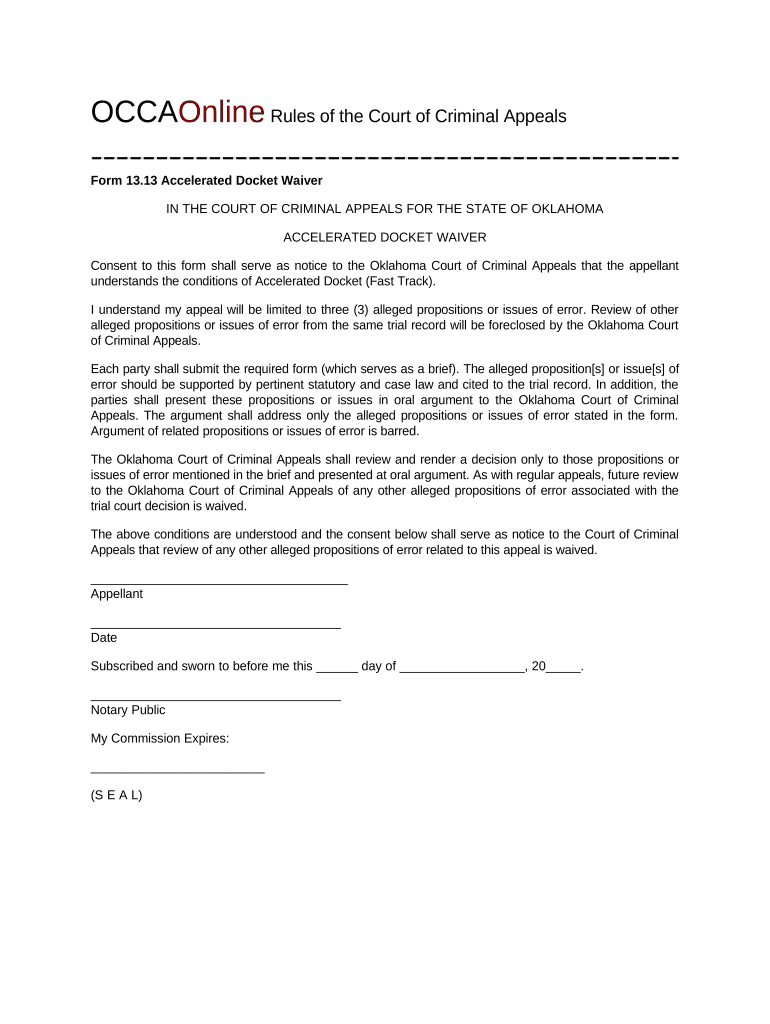
The Accelerated Docket Waiver Oklahoma is a court filing used in Oklahoma civil cases to request modification of standard scheduling or to waive placement on an accelerated docket under local rules. It documents the parties' agreement or a party's election to decline accelerated scheduling, clarifies affected deadlines, and notifies the court and opposing parties of the waiver. The form typically identifies the case, parties, the specific scheduling provisions being waived, reasons for the waiver, and required signatures. Filing procedures and acceptance vary by county court and local rule.

Why parties use an Accelerated Docket Waiver in Oklahoma

Filing a waiver gives courts a clear record that a party knowingly declines accelerated procedures, preserves procedural rights, and aligns scheduling expectations among parties and the judge. It reduces later disputes about scheduling choices and helps the clerk apply the correct calendar and notice requirements.

Why parties use an Accelerated Docket Waiver in Oklahoma

Who typically completes this waiver

The waiver is completed by the party or counsel responsible for scheduling decisions and must be served on opposing parties and filed with the court clerk.

  • Plaintiff or plaintiff's counsel making scheduling elections or concessions.
  • Defendant or defense counsel when declining or proposing alternative scheduling.
  • Self-represented litigants who must formally record a waiver with the court.

Typical signers and their roles

Plaintiff's Attorney

An attorney representing the plaintiff who signs to confirm the plaintiff's decision about accelerated scheduling. This signer explains scheduling impacts to the court and confirms service on opposing counsel; the signature is a representation of client authorization and procedural intent.

Self-Represented Litigant

A pro se party who signs the waiver to document their own choice regarding the docket. Courts expect clear identification, contact information, and an explicit statement that the party understands the waiver's consequences before accepting the filing.

Key data and security items to include and protect

Case Number: Court-assigned docket number
Party Names: Full legal names of all parties
Signature Date: MM/DD/YYYY date of execution
Contact Details: Address, phone, and email
Attorney Info: Bar number and firm details
Document Security: Retain encrypted copies; limit access

Step-by-step: Completing the Accelerated Docket Waiver Oklahoma

Follow these steps in order to prepare, sign, serve, and file a valid waiver that meets Oklahoma local rules and preserves record integrity.

  • 01
    Identify Case: Enter the court, case number, and caption exactly as the docket reads.
  • 02
    State Waiver Terms: Specify which accelerated docket rules or dates you are waiving.
  • 03
    Provide Reasoning: Briefly explain the factual or legal basis for the waiver where required.
  • 04
    Sign and Date: All signing parties must sign and date using the required format.

Filing flow: how the waiver moves through the system

The waiver follows a simple sender-to-court workflow; understanding each handoff reduces delays and rejection risk.

  • Prepare: Draft the waiver and verify local-rule requirements before signing.
  • Serve: Serve all opposing parties using the court-approved method.
  • File: Submit to the clerk either via e-filing or in-person per county rules.
  • Docketing: Clerk reviews and places the waiver on the case docket with an entry.

Digital workflow settings for online completion and e-filing

Configure your e-signature and e-filing workflow to meet authentication and court submission requirements.

Field Configuration
Signer Authentication Email link or SMS code
Signature Type Standard e-signature or drawn signature
Document Format PDF/A preferred for court filing
Audit Trail Maintain full timestamps and IP logs

Technical considerations for digital signing and submission

Use a platform that produces a tamper-evident final PDF and a complete audit trail to support enforceability and court acceptance.

  • PDF Support: PDF/A and PDF are acceptable
  • Integrations: Works with e-filing portals and document management
  • Authentication: Email, SMS, or stronger methods

Timelines to watch when submitting a waiver

Several time frames matter: service timing, hearing scheduling, and clerk processing. Plan ahead to meet local deadlines.

Service Timing:

Serve opposing parties before filing per local rule.

Hearing Windows:

Coordinate waiver filing ahead of any scheduled accelerated hearing.

Clerk Processing:

Allow extra time for manual review and docketing.

Opposition Period:

Track any period for opposing party objection.

Renewal or Withdrawal:

Note deadlines for revoking or amending the waiver.

Common pitfalls to avoid when preparing the waiver

  • Failing to use the exact court caption and case number, which can cause misfiling and delays in docket entry.
  • Not certifying proper service method or omitting the certificate of service, leading to questions about notice.
  • Using ambiguous language about the waiver's scope, which can create disputes over which deadlines were actually waived.
  • Submitting an unsigned or improperly dated waiver, which courts commonly reject as incomplete.

Consequences of an incorrect or incomplete waiver

Rejected Filing: Clerk may reject the waiver
Procedural Prejudice: Lost scheduling rights
Opposition Motion: Opposing party may move to set aside
Hearing Delay: Case timeline can be extended
Sanctions Risk: Possible sanctions for misrepresentation
Record Ambiguity: Unclear waiver can cause appeal issues

What a professional waiver includes

A complete waiver combines precise identification, clear waiver language, proof of service, and authenticated signatures to produce an enforceable court record.

Case Caption

Full court name, division, and case number exactly as on the docket to ensure the waiver files to the correct record and avoids clerical misplacement.
Statement of Waiver

A concise clause describing which accelerated docket rules or specific deadlines are waived and by which party, removing ambiguity about scope and effect.

Reasoning or Stipulation

A brief factual or legal justification or mutual stipulation from the parties when the court requires grounds for modifying docket status.

Service Certificate

A signed certificate stating the method and date of service on opposing parties, showing compliance with procedural notice requirements.

Signature Block

Printed name, role (counsel or pro se), contact information, and an executed signature line dated in MM/DD/YYYY format for all signatories.

Court Request Language

A final paragraph requesting the clerk and judge to note the waiver on the docket and adjust scheduling as appropriate.

Comparison: common eSignature providers for executing and storing waivers

Platform pricing and core features vary; signNow is listed first to show a representative cost and capability baseline for e-signature use with legal filings.

signNow DocuSign Adobe Sign PandaDoc HelloSign
Starting Price $8/user/mo $15/user/mo $14/user/mo $19/user/mo $15/user/mo
Free Trial 7-day free trial No No Yes, limited Yes, limited
Bulk Send Yes Yes Yes Yes No
Audit Trail Yes Yes Yes Yes Yes
HIPAA Compliant Yes Yes Yes No No

Frequently asked questions about completing and filing the waiver

Answers to the most common procedural and technical questions about drafting, signing, and filing an Accelerated Docket Waiver in Oklahoma.


Need help? Contact support

be ready to get more
Join over 28 million airSlate SignNow users