Establishing secure connection…Loading editor…Preparing document…

Gift Deed

This template is fully customizable. Edit the text, fill out the fields, and send it for signature. Give it a try!
Gift Deed

What a Gift Deed Is and when it transfers property

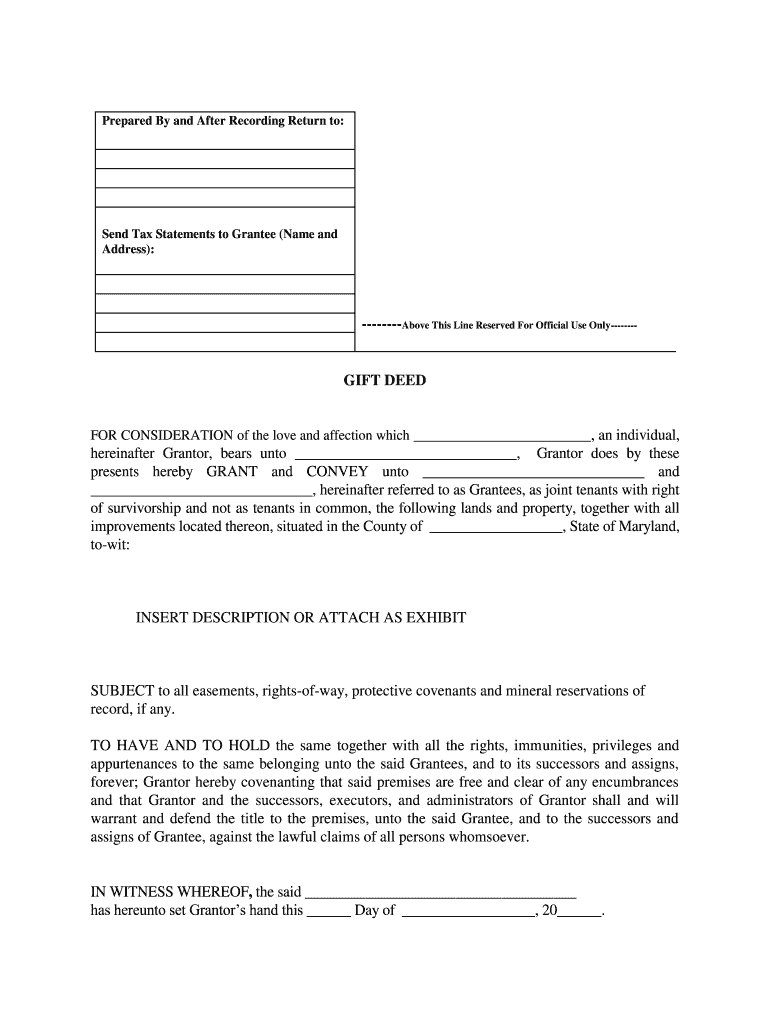
A Gift Deed is a legal instrument used to voluntarily transfer ownership of real property from one person (the donor) to another (the donee) without payment or exchange of consideration. In the United States, a valid gift deed typically identifies the parties, describes the property, states the donor's present intent to make an immediate gift, and is signed, notarized, and recorded where required by state law. Gift deeds can include conditions or reserved rights and are distinct from wills because they transfer title during the donor's lifetime.

Why a clear Gift Deed matters for title and estate planning

Use a Gift Deed to effect an immediate, revocable or irrevocable transfer of property ownership without sale. It clarifies title, documents donor intent, supports recording, and can help with estate planning, tax planning, and avoiding probate when executed according to applicable state requirements.

Why a clear Gift Deed matters for title and estate planning

Who commonly prepares or receives a Gift Deed

Typical users include donors, donees, attorneys, title companies, and real estate professionals preparing an inter vivos property transfer.

  • Donors: individuals gifting property, often seeking lifetime transfer or estate simplification.
  • Donees: family members or organizations receiving title, may need identification and acceptance documentation.
  • Real estate professionals: prepare deeds, coordinate recording, and confirm tax and lien status.

Core elements every professional Gift Deed should include

Core Gift Deed elements ensure clarity of transfer, protect interests, and make the document acceptable for recording and title search processes.

Parties

Identify donor and donee by full legal name, type of ownership (individual, trust, entity), and contact address. Mismatched names can create recording or title issues that delay transfer.
Property Description

Provide a precise legal description from the current deed or survey, including lot, block, parcel number, and address. Avoid informal descriptions like 'my house' as imprecise.

Intent Statement

State clear present intent to gift property immediately and whether the gift is absolute, conditional, or subject to reserved rights such as life estate or revocation.

Consideration

Although a gift deed normally records 'for love and affection' or zero monetary consideration, state-specific language may be required to avoid tax or recording objections.

Signatures & Dates

All donors must sign and date the deed in the presence of a notary and any state-required witnesses; include printed names and the signer capacity (individual or trustee).

Notary & Recording

Complete a notary acknowledgment per state statute and record the signed deed in the county recorder's office where the property is located to perfect title and provide public notice.

Step-by-step: complete, notarize, and record a Gift Deed

Follow these steps to complete a Gift Deed accurately, notarize it, and record it to transfer title and provide public notice.

  • 01
    Prepare Draft: Gather current deed and legal description.
  • 02
    Describe Property: Insert exact metes-and-bounds or parcel ID.
  • 03
    Sign & Notarize: Donor signs before a notary; witnesses as required.
  • 04
    Record Deed: File with county recorder and pay applicable fees.

How the Gift Deed process flows from draft to recorded title

This overview shows the sequence from drafting a Gift Deed through signing, notarization, recording, and final title update with the county office.

  • Draft Document: Create deed with precise legal description.
  • Signers Authenticate: Signer identity verified; consent and intent recorded.
  • Notarization: Notary acknowledges signature and completes certificate.
  • Recording: Recorder accepts, indexes, and returns recorded deed.

Digital completion and eSubmission considerations for Gift Deeds

Electronic completion and eSubmission options reduce in-person steps but must meet state notary and recording requirements for real property transfers.

  • File Formats: PDF or DOCX accepted by many counties.
  • Authentication: Email, SMS, or government ID verification.
  • Integrations: Works with cloud storage and CRM systems.

Recommended online workflow settings when preparing a Gift Deed

Suggested online workflow settings for completing and submitting a Gift Deed using an eSignature platform and county recording preparation.

Field Configuration
Signer Authentication and Verification Method Email link plus government ID check recommended
Document Field Placement and Required Flags Place signature, date, and notarization blocks clearly
Notary Acknowledgment and Witness Requirements Include statutory notary text and witness lines when needed
Recording Package Preparation and Fee Check Attach original deed, proof of tax status, and fee payment

Immediate risks from an incorrect or incomplete Gift Deed

Recording Rejection: Improper form or errors cause denial.
Title Cloud: Unclear ownership or liens may persist.
Gift Tax Exposure: Donor may owe gift tax reporting.
Corrective Deed Needed: Errors can require costly corrective deeds.
Invalid Transfer: Missing notarization may void transfer.
Legal Challenge: Disputes can lead to litigation.

Common preparation mistakes to avoid

  • Using an informal or incomplete property description can cause the recorder to reject the deed and require a corrected instrument or survey.
  • Entering donor or donee names that do not match government IDs or recorded records leads to title issues and may necessitate a corrective deed.
  • Failing to verify tax liens, mortgages, or other encumbrances before transfer can leave the donee responsible for outstanding obligations.
  • Assuming remote notarization or electronic recording is accepted without checking state and county rules may delay or invalidate the filing.

Practical best practices to reduce errors and protect parties

Follow these best practices to reduce errors, support smooth recording, and limit legal and tax exposure when gifting real property.

Confirm legal description and parcel identifiers
Obtain the current deed and an up-to-date survey if possible; copy the exact metes-and-bounds or recorded plat language. Cross-check parcel numbers and assessor information to prevent ambiguity and recording rejection.
Review liens, mortgages, and tax status
Order a title search or request a title report to surface outstanding mortgages, judgments, or tax liens. Obtain lien releases or lender consent before recording to avoid future claims against the donee.
Use precise signature and notarization steps
Have donor sign in the physical presence of a notary per state law; include any required witness signatures. Ensure the notary completes the correct acknowledgment or jurat language required by the recording jurisdiction.
Consider federal gift tax and estate planning
Consult tax counsel about IRS Form 709 when cumulative gifts exceed the annual exclusion; keep valuation records and file returns timely to avoid penalties and protect the donee's basis and obtain professional appraisal when required.

Real-world Gift Deed examples and outcomes

Real-world Gift Deed examples show common uses like family transfers and charitable conveyances, and how procedures differ by jurisdiction.

Family Transfer

A parent transferred a residential parcel to an adult child via a gift deed to simplify estate administration and avoid probate on a small urban parcel.

  • Donee recorded deed promptly to secure title.
  • After recording, the donee confirmed clear title via a title search; the parent filed Form 709 because cumulative gifts exceeded the annual exclusion, documenting appraised value for IRS compliance and retained records for tax and title purposes for several years.

Charitable Conveyance

A donor conveyed a small commercial lot to a nonprofit by gift deed to facilitate community redevelopment while preserving tax-deductible contribution records.

  • Nonprofit recorded deed and updated insurance.
  • The nonprofit verified clear title and recorded the deed; the donor worked with counsel to confirm charitable deduction eligibility and kept copies of the recorded instrument and appraisals for IRS documentation.

Vendor pricing and feature snapshot for Gift Deed eSigning and management

Quick vendor pricing and feature comparison for signing and managing a Gift Deed; signNow appears first in the comparison per verified platform data.

signNow DocuSign Adobe Sign PandaDoc HelloSign
Starting Price $8/user/mo $15/user/mo $14/user/mo $19/user/mo $15/user/mo
Free Trial 7-day free trial, no credit card required Varies by plan Varies by plan Varies by plan Varies by plan
Bulk Send Yes Yes Yes Yes No
Audit Trail Yes Yes Yes Yes Yes
HIPAA Compliant Yes Yes Yes No No
Envelope Cap No cap 100 envelopes/user/year Varies by plan Varies by plan Varies by plan

Frequently asked questions about Gift Deeds and electronic handling

Answers to common Gift Deed questions covering validity, notarization, recording, tax reporting, revocation, and electronic signing best practices in the United States.


Need help? Contact support

be ready to get more
Join over 28 million airSlate SignNow users