Establishing secure connection…Loading editor…Preparing document…

Receivable Write Off Form

This template is fully customizable. Edit the text, fill out the fields, and send it for signature. Give it a try!
Receivable Write Off Form

What the Receivable Write Off Form Is and when it applies

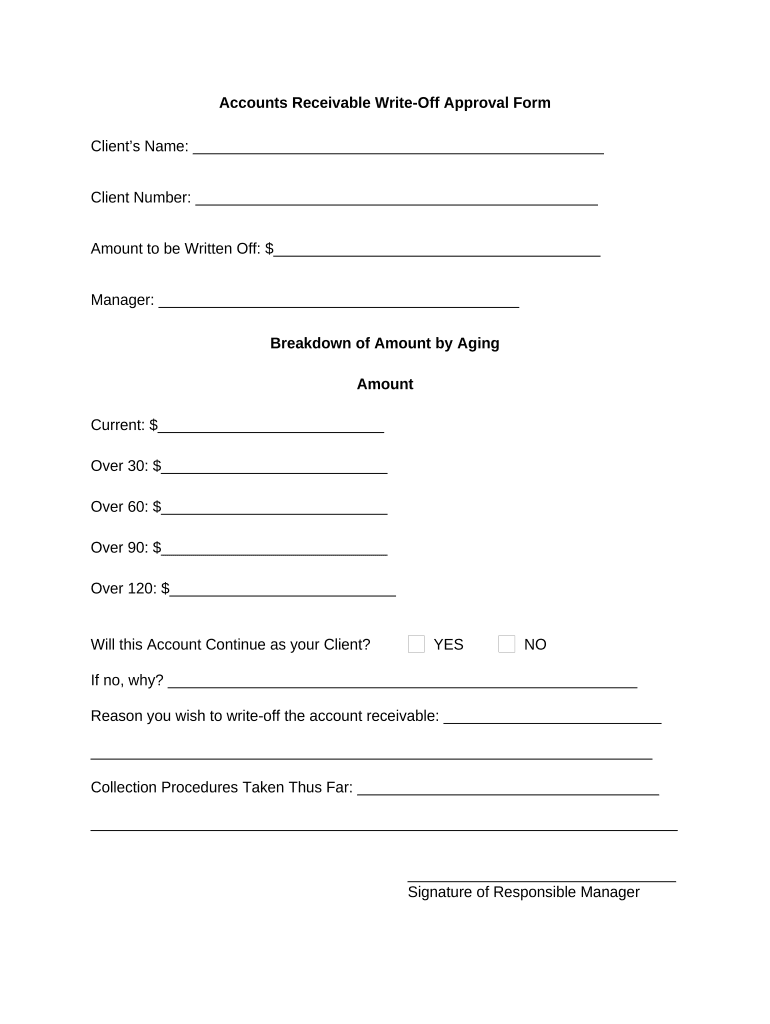
A Receivable Write Off Form documents the authorized removal of an unpaid receivable from active accounts receivable and records the company decision to classify the balance as uncollectible. It typically records the customer identity, original invoice details, payments or credits applied, the write-off amount, the approval authority and the accounting entries required to clear the balance. Organizations use the form to maintain audit trails, support internal controls, justify tax treatment, and provide evidence for external auditors and regulators that write-offs were properly authorized and recorded in accordance with company policy.

Why a clear Receivable Write Off Form matters

A well-structured form creates an auditable justification for removing receivables, reduces dispute exposure, and aligns accounting entries with internal control policies and external reporting requirements under GAAP and tax rules.

Why a clear Receivable Write Off Form matters

Who typically completes and reviews the form

Keep signatures and approval dates on file to support audits and any subsequent tax or regulatory inquiries.

  • Accounts receivable clerks and credit analysts prepare the draft form, attaching invoice history and collection notes for reviewer context.
  • Controllers and accounting managers review and approve write-offs to ensure correct journal entries and GAAP compliance before posting.
  • Legal or collections teams may sign off for charged-off accounts requiring settlement, bankruptcy considerations, or litigation hold status.

Step-by-step: completing and approving the write-off

Use this sequence to prepare, approve, and record a compliant write-off.

  • 01
    Gather documentation: Collect invoice, aging, and collection notes before starting.
  • 02
    Calculate net amount: Verify payments, credits, and dispute holds to compute the write-off.
  • 03
    Get approval: Route to controller or delegated approver for signature.
  • 04
    Post accounting entry: Record journal entry and reconcile AR subsidiary ledger.

How to configure the online write-off workflow

Standardize fields and routing rules to streamline approvals and maintain an audit trail.

Field Configuration
Upload method PDF or DOCX upload accepted; map to template fields automatically.
Field types Text, currency, date, dropdown for approval reason.
Conditional fields Show recovery plan fields when 'partial write-off' selected.
Signer order Requestor → Credit Manager → Controller

Where to send the completed form and what happens next

After completion route the form to accounting systems and stakeholders to close the loop.

  • Submit to accounting: Attach approved form to the AR ticket and post journal entry.
  • Notify collections: Inform collections team to stop active collection efforts on the balance.
  • Archive for audit: Store signed PDF with metadata in the records retention system.
  • Report to management: Include write-offs in monthly control reports and variance analysis.

Technical and integration considerations for digital completion

Ensure the platform captures an audit trail, stores signed files securely, and supports export to your ERP for posting journal entries.

  • Integrations: Salesforce, NetSuite, Google Workspace, Microsoft 365
  • File formats: PDF and DOCX with field mapping
  • Authentication: Email link, SMS code, or SSO

Timelines, deadlines, and processing expectations

Define internal timing to ensure consistent posting and reporting of write-offs.

Internal review period:

Complete documentation within five business days of recommending write-off.

Approval window:

Obtain manager or controller approval within ten business days.

Accounting cutoff:

Post journal entries in the month the write-off is approved.

Monthly reporting:

Include write-offs in month-end close pack and variance analysis.

Retention start:

Signed form archived immediately upon final approval.

Common mistakes to avoid when preparing the form

  • Incomplete payment history or missing credit memos that change the net uncollectible amount and cause reconciling errors.
  • Lack of proper authorization where junior staff approve write-offs without delegated authority, breaching internal control policies.
  • Failing to link the write-off to an AR aging bucket or collection history, creating audit trail gaps and recovery confusion.
  • Posting write-offs in the wrong accounting period, which can misstate revenue and lead to reporting restatements.

Risks and consequences of incorrect or unauthorized write-offs

Financial misstatement: May cause misstated receivables or bad-debt expense.
Tax exposure: Incorrect write-offs can affect taxable income and deductions.
Audit findings: Weak controls can trigger external audit exceptions.
Recovery loss: Premature write-offs may foreclose future collection action.
Internal control breach: Unauthorized approvals violate segregation of duties.
Reputational risk: Customer disputes about incorrect write-offs harm relationships.

Information and security elements to capture on the form

Signer identity: Name, title, email, and authentication method
Approval timestamp: ISO-style timestamp recorded in audit trail
Document hash: Tamper-evident fingerprint where supported
Retention tag: Record retention classification and retention date
Related references: Invoice IDs, payment refs, and collection case number
Access controls: Restrict edit rights after final approval

Key components of a professional Receivable Write Off Form

A comprehensive form balances accounting needs, auditability, and legal defensibility; include the six elements below to ensure completeness.

Header details

Include company name, department, form version, and unique form identifier so every saved file can be traced to a single controlled record and to prevent use of outdated templates.
Account history

Provide the full payment and billing history, aging schedule, dispute notes and contact attempts so reviewers can assess collection efforts and the decision rationally.

Net calculation

Show original invoice amount, applied credits and payments, and the computed write-off amount to create a clear numeric trail for posting and tax review.

Approval block

Require printed name, title, signature, and date from an authorized approver; capture delegated authority limits to validate the signatory's authority during audits.

Accounting entry

Specify the journal entry, general ledger accounts, and reversing instructions where applicable so the transaction posts correctly in the ERP system.

Audit notes

Attach collection correspondence, legal opinions, and documentation of bankruptcy or insolvency where applicable to support the write-off if reviewed externally.

Real examples showing how organizations use the form

These short case arcs illustrate how signNow customers standardize write-off approvals and preserve audit trails.

Martin Properties — retail leasing

Martin Properties moved to online write-off forms to reduce manual errors and speed approvals.

  • The team integrated signed records with their property management system.
  • The result was consistent documentation across portfolios, faster month-end reconciliation, and an auditable trail accessible to accounting and property managers when reviewing tenant accounts.

Fertility Centers of Illinois — healthcare

A healthcare provider centralized write-off approvals for patient balances using electronic forms and controlled access.

  • They captured authorization and billing notes with every write-off.
  • This approach improved reconciliation accuracy, preserved HIPAA-conscious access controls, and provided the documentation needed to support financial statements and payer inquiries.

Common eSignature options for completing and approving write-offs

Select an eSignature provider based on price, compliance needs like HIPAA, and bulk-processing capabilities; signNow appears first for direct comparison with common alternatives.

signNow DocuSign Adobe Sign PandaDoc HelloSign
Starting Price $8/user/mo $15/user/mo $14/user/mo $19/user/mo $15/user/mo
Free Trial 7-day free trial No free trial No free trial Yes, limited Yes, limited
Bulk Send Yes Yes Yes Yes No
Audit Trail Yes Yes Yes Yes Yes
HIPAA Compliant Yes Yes Yes No No
Envelope Cap No cap 100 envelopes/user/year Varies by plan Varies by plan Varies by plan

Frequently asked questions about Receivable Write Off Forms

Answers to common questions about validity, signatures, storage, and next steps when issues arise.


Need help? Contact support

be ready to get more
Join over 28 million airSlate SignNow users