Establishing secure connection…Loading editor…Preparing document…

Gift of Entire Interest in Literary Property

This template is fully customizable. Edit the text, fill out the fields, and send it for signature. Give it a try!
Gift of Entire Interest in Literary Property

What the Gift of Entire Interest in Literary Property Is

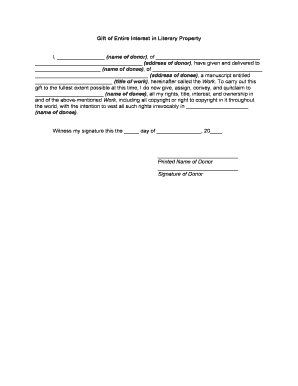
A Gift of Entire Interest in Literary Property is a written assignment transferring all rights, title, and interest in a specified literary work from the donor (assignor) to the recipient (assignee). It is commonly used to transfer copyright ownership, including reproduction, adaptation, distribution, and public performance rights. The document should identify the literary work, state the scope of rights transferred, specify the effective date, and include the signatures of the parties. Proper execution, including any required notarization or witness attestation, helps ensure the transfer is enforceable against third parties.

Why a Complete Assignment Matters

A full-interest gift clarifies ownership, removes ambiguity about exploitation rights, and enables the recipient to license, register, or enforce the copyright. It reduces future disputes over derivative works, royalties, and moral-rights questions, and preserves the assignee’s ability to register the work with the U.S. Copyright Office.

Why a Complete Assignment Matters

Who Typically Prepares or Receives This Assignment

Common parties include authors, heirs, publishers, literary executors, and organizations acquiring rights for publication or adaptation.

  • Individual authors transferring ownership to a publisher or personal beneficiary
  • Heirs or estate representatives assigning rights they received by inheritance
  • Publishers, production companies, or nonprofits accepting a full ownership transfer

Each party’s role and expectations should be spelled out in the instrument to avoid later disputes about royalties, credits, or retained moral rights.

Typical Signatories and Their Roles

Author / Assignor

The individual or entity who currently holds copyright and is transferring all rights. The assignor should confirm ownership, disclose prior grants, and sign with capacity; mismatched names may cause registration or enforcement issues.

Assignee / Recipient

The person or organization receiving the entire interest and who will exercise exclusive rights. The assignee should verify the scope of rights being transferred and retain executed originals for copyright registration and proof of chain of title.

Essential Elements to Include in a Professional Assignment

A complete Gift of Entire Interest in Literary Property should be precise about parties, the work, the scope of rights, the effective date, consideration (if any), and signatures; additional clauses cover warranties, moral rights, and governing law.

Parties

Full legal names and contact details for assignor and assignee; include corporate titles for organizations to confirm signing authority and capacity.
Work Identification

Clear title, alternate titles, registration numbers (if any), creation date, and a brief description sufficient to identify the specific literary work being transferred.

Scope of Rights

Language assigning the entire copyright worldwide or limited to specified territories, and specifying included rights such as reproduction, adaptation, distribution, public performance, and moral-right waivers if applicable.

Consideration

State the consideration (if any), whether monetary, nominal, or a gift; if zero consideration, state that the transfer is a gift to avoid ambiguity about intent.

Warranties and Indemnities

Standard representations about ownership, no conflicting grants, and the assignor’s authority to transfer; include remedies or indemnities for breaches.

Execution Details

Signature blocks with printed names, dates, and any notarization or witness lines required by jurisdiction to support recordation or registration.

Critical Data Elements to Record

Assignor Name: Full legal name
Assignee Name: Full legal name
Work Details: Title and description
Effective Date: MM/DD/YYYY
Scope of Transfer: Territory and rights
Execution: Signatures and notarization

Step-by-Step: Completing the Assignment

Follow a clear sequence to prepare, execute, and preserve the assignment so the transfer is legally effective and accepted for copyright registration.

  • 01
    Prepare: Identify parties and the literary work
  • 02
    Draft: Use clear assignment language transferring all rights
  • 03
    Execute: Have parties sign with required notarization or witnesses
  • 04
    Record: Retain originals and consider registration with Copyright Office

How the Transfer Works in Practice

A properly executed assignment creates a chain of title enabling the assignee to register copyright, license the work, and enforce rights in court.

  • Agreement Creation: Document drafted and reviewed by parties
  • Execution: Assignor and assignee sign with date
  • Documentation: Original stored; copies distributed
  • Optional Registration: Assignee files with U.S. Copyright Office

Typical Digital Workflow for Executing the Assignment

A digital workflow speeds execution while preserving an audit trail; configure authentication and retention before sending the document for signature.

Field Configuration
Signature Fields Place sign and date fields for each party
Authentication Use email link or SMS code; consider ID verification
Notary Integration Support RON where required and available
Retention Store executed originals as PDF/A

Digital Signing and Submission Considerations

Choose a platform that supports a clear audit trail, appropriate signer authentication, and secure storage to preserve enforceability.

  • Authentication: Email, SMS, or KBA
  • Audit Trail: IP, timestamp, and event log
  • File Formats: PDF, DOCX, and PDF/A export

Ensure the platform is compliant with ESIGN and UETA and, where applicable, supports HIPAA, 21 CFR Part 11, or a BAA; confirm notarization options for RON if notarization is required.

Time-Sensitive Steps to Watch

Certain post-transfer actions have deadlines — for example, recording, tax reporting, and any notice periods tied to preexisting agreements or registrations.

Recordation Consideration:

File with Copyright Office promptly to establish public record

Tax Reporting:

Report transfers when applicable for gift or income tax

Third-Party Notifications:

Notify existing licensees or co-authors as required by contract

Statute of Limitations:

Effective date affects deadlines for disputes and infringement suits

Contractual Windows:

Observe notice periods under prior publishing agreements

Key Milestones from Draft to Registered Title

A milestone timeline clarifies when drafting, execution, and optional registration should occur to secure enforceable ownership and public notice.

01

Draft Completed

Finalize assignment language and confirm parties

02

Signatures Obtained

All signers execute with any required witnesses or notary

03

Original Stored

Place signed original in secure custody

04

Record or Register

Assignee files for registration with Copyright Office

Risks and Consequences of an Improper Assignment

Invalid Transfer: Title disputes
Registration Denial: Copyright Office rejection
Tax Exposure: Gift or income tax issues
Third-Party Claims: Breach of prior licenses
Enforcement Limits: Reduced ability to sue infringers
Revocation Risk: Disputes over donor capacity

Common Preparation Mistakes to Avoid

  • Failing to precisely identify the literary work, which can result in ambiguity about what rights were transferred and create grounds for dispute.
  • Omitting prior license disclosures or failing to terminate conflicting grants, which can leave the assignee with limited or nonexclusive rights.
  • Using vague transfer language such as 'all rights as owner may have' instead of an explicit assignment of 'all rights, title and interest worldwide.'
  • Neglecting notarization or witness lines where local practice or registration benefits make them advisable, which can hinder recordation or title clarity.

eSignature Platform Pricing and Feature Snapshot

Compare common capability and pricing benchmarks for signing and storing assignments; signNow is listed first for reference against major alternatives.

signNow DocuSign Adobe Sign PandaDoc HelloSign
Starting Price $8/user/mo $15/user/mo $14/user/mo $19/user/mo $15/user/mo
Free Trial Yes, 7-day trial Varies Varies Varies Varies
Bulk Send Yes Yes Yes Yes No
Audit Trail Yes Yes Yes Yes Yes
HIPAA Compliant Yes Yes Yes No No
Envelope Cap No cap 100 envelopes/user/year Varies Varies Varies

Frequently Asked Questions About Assigning Literary Rights

Answers to common questions about execution, enforceability, notarization, registration, revocation, and e-signing for a Gift of Entire Interest in Literary Property.


Need help? Contact support

be ready to get more
Join over 28 million airSlate SignNow users