Establishing secure connection…Loading editor…Preparing document…

Wisconsin Guardianship Inventory

This template is fully customizable. Edit the text, fill out the fields, and send it for signature. Give it a try!
Wisconsin Guardianship Inventory

What the Wisconsin Guardianship Inventory is and when it’s used

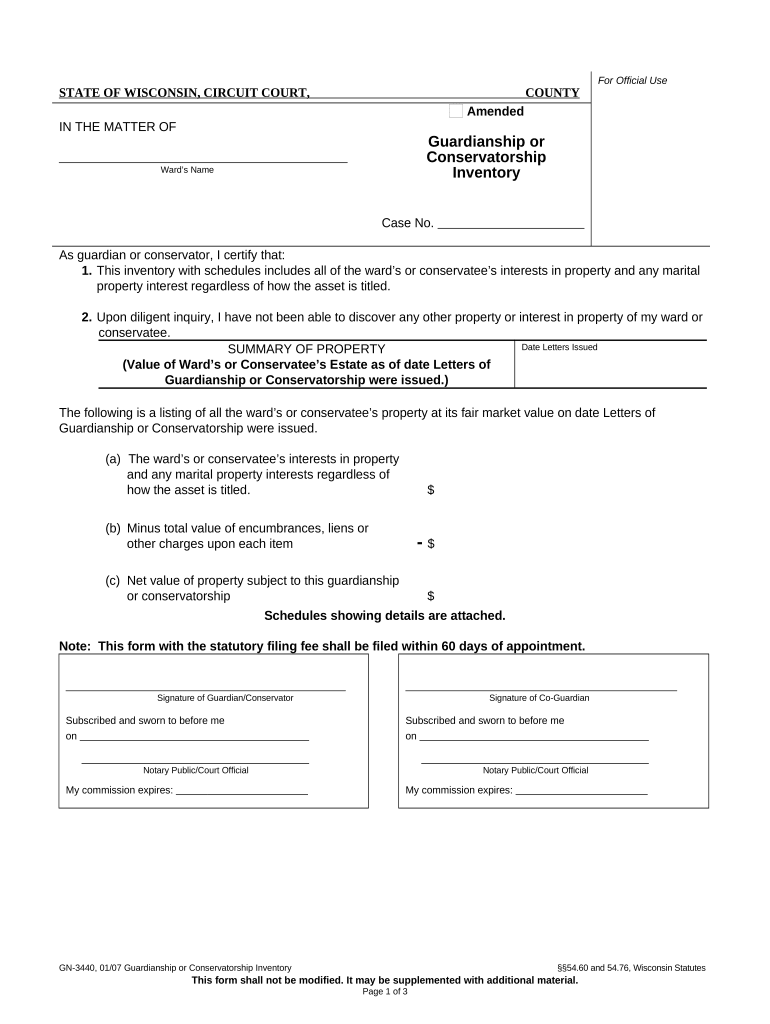
The Wisconsin Guardianship Inventory is a court-oriented inventory and status report used to document a ward’s personal details, assets, liabilities, income, and key contacts after a guardianship or protective placement is established. Courts use the inventory to monitor the guardian’s administration and to verify protection of the ward’s interests. The inventory supports trustee accounting, asset management, care planning, and periodic court reviews required under Wisconsin probate and guardianship rules. Completing the form accurately helps the guardian meet fiduciary duties and reduces the risk of court objections or sanctions.

Why a formal inventory matters in Wisconsin guardianships

A complete inventory creates a single source of truth about the ward’s estate, health, and legal documents for the court, family, and professionals. It supports accountability, preserves assets, and documents decisions the guardian makes.

Why a formal inventory matters in Wisconsin guardianships

Who prepares and relies on the Wisconsin Guardianship Inventory

Accurate inventories reduce disputes, speed court review, and provide a defensible record of the guardian’s actions and the ward’s status.

  • Court-appointed guardians and conservators who must report assets and care plans to the probate court.
  • Probate attorneys preparing required filings, accounting, and supporting exhibits for hearings.
  • County adult protective services, social workers, or case managers validating care arrangements and benefits.

Typical signatories and their roles

Court-appointed Guardian

The guardian signs the inventory to attest to the accuracy of listed assets, liabilities, and personal information. The signature creates a sworn record for the court and triggers the guardian’s fiduciary duties under Wisconsin statutes.

Attorney of Record

An attorney may prepare or review the inventory and sign as preparer or certifier; signing attorneys confirm procedural compliance and support court filings during review or accounting hearings.

Core sections included in a professional guardianship inventory

A well-structured Wisconsin Guardianship Inventory groups facts into discrete sections that make review and verification efficient for courts, attorneys, and auditors.

Personal details

Full legal name, date of birth, current residence, contact numbers, next of kin, and emergency contacts to establish identity and custodial context.
Assets and property

Real estate, bank accounts, investments, vehicles, personal property and estimated values with documentation sources such as deeds or account statements.

Liabilities

Mortgages, loans, credit card balances, liens, and upcoming obligations that affect net estate value and budgeting decisions.

Income and benefits

Social Security, pensions, VA benefits, annuities, rental income, and any public assistance amounts used to plan care and pay obligations.

Medical status

Primary diagnoses, treating providers, current medications, authorized health proxy information, and capacity considerations relevant to care decisions.

Legal documents

Powers of attorney, advance directives, marriage records, trust instruments, and pending litigation the court should know about.

Step-by-step: preparing and filing the inventory

Follow these sequential steps to assemble, verify, and submit the inventory to the court.

  • 01
    Gather documents: Collect IDs, account statements, deeds, benefit notices, and medical summaries.
  • 02
    Complete form: Populate each section with verified values and clear descriptions.
  • 03
    Review with counsel: Have an attorney or court clerk review for completeness before filing.
  • 04
    File with court: Submit inventory according to local probate court procedures and retain copies.

How electronic completion and submission typically flow

Electronic handling accelerates validation and creates an audit trail acceptable for many courts when legal requirements are met.

  • Prepare digital file: Scan supporting documents and save in PDF or DOCX format.
  • Place fillable fields: Map signature, date, and data fields for the guardian and reviewers.
  • Authenticate signer: Use email, SMS, or stronger authentication as required by the court.
  • Submit and archive: Send the signed inventory to court and retain tamper-evident copies.

Typical online workflow settings for guardianship inventories

When configuring a digital workflow, ensure fields, authentication, and storage meet court and privacy requirements.

Field Configuration
Authentication method Email link, SMS code, or knowledge-based verification
Signer order Single guardian sign-off, then attorney review
Retention policy Immutable PDF storage and exportable audit trail
Notifications Automated reminders for filing or annual updates

Technical considerations and integration points

Store final signed versions in a secure records system with access controls and export options for court filings or auditors.

  • Supported formats: PDF, DOCX, and exported TIFF
  • Integrations: Connectors for Microsoft 365 and Google Workspace
  • Audit capabilities: IP, timestamp, and action log

Comparing eSignature vendors for guardianship inventories

The table summarizes representative pricing and feature availability across common eSignature vendors. signNow appears first per platform comparison best practices.

signNow DocuSign Adobe Sign PandaDoc HelloSign
Starting Price $8/user/mo $15/user/mo $14/user/mo $19/user/mo $15/user/mo
Free Trial 7-day free trial No No Yes, limited Yes, limited
Bulk Send Yes Yes Yes Yes No
Audit Trail Yes Yes Yes Yes Yes
HIPAA Compliant Yes Yes Yes No No
Envelope Cap No cap 100 envelopes/user/year No cap No cap No cap

Common pitfalls when preparing the inventory

  • Omitting a liability or lien that later surfaces and reduces net estate value, prompting court scrutiny.
  • Using approximate or unsupported asset valuations without attaching supporting statements or appraisals.
  • Failing to list all income sources, which can lead to incorrect budgeting and benefit overpayments.
  • Incorrect or unsigned signature blocks that delay court acceptance and require refiling.

Consequences of an incomplete or inaccurate inventory

Court sanctions: Monetary fines or directives to correct filings
Guardian removal: Replacement for serious or repeated omissions
Accountability actions: Court-ordered accounting or asset recovery
Benefit recoupment: Repayment obligations if benefit eligibility was misreported
Criminal risk: Potential charges for fraud in extreme cases
Delays: Postponed hearings and added administrative burden

Privacy and security points to consider

Sensitive data: Avoid unnecessary identifiers in public filings
Access control: Limit file access to authorized users only
Encryption: Encrypt documents at rest and in transit
Audit trails: Preserve signer IP and timestamp logs
HIPAA impact: Include BAA when storing PHI electronically
Backup copies: Maintain off-site secure backups

Practical tips for accurate, court-ready inventories

Use these best practices to minimize errors, speed court acceptance, and maintain defensible records.

Verify documentation before listing
Attach recent account statements, title documents, and benefit award letters. Verification reduces follow-up requests from the court and makes valuations defensible.
Use clear valuations and dates
State asset values with valuation date and source. If values are estimates, label them and schedule formal appraisal when required by the court.
Keep an organized index
Number supporting exhibits and reference them in inventory entries to make judicial review straightforward and auditable.
Document communications
Preserve correspondence with creditors, benefit offices, and medical providers to support decisions and account reconciliations.

Real-world scenarios for how inventories are used

These concise examples illustrate common situations where a detailed guardianship inventory is essential.

Public guardian case

A county guardian compiles an inventory after appointment to document assets and benefits

  • Inventory highlights multiple benefit sources and a contested property
  • The court used the inventory to authorize a managed care plan and approve a sale to avoid property tax arrears, with all actions documented for annual review.

Private attorney-managed case

An attorney drafts the inventory for a family-appointed guardian to ensure compliance

  • The inventory consolidated bank statements and an IRA valuation
  • The attorney used the assembled exhibits at the accounting hearing to expedite approval and avoid successor-guardian challenges.

Typical deadlines and processing expectations

Filing and update requirements vary by county and by the appointing order; use these general expectations to plan submissions.

Initial filing expectation:

File the inventory soon after appointment per the court’s scheduling order

Annual updates:

Many courts require annual inventories or accountings on the appointment anniversary

Special reporting:

Report significant asset changes or suspected abuse immediately

Court review timeline:

Allow several weeks for clerk review and scheduling of hearings

Local rules:

Verify county-level deadlines and required cover sheets with the probate clerk

Frequently asked questions about the Wisconsin Guardianship Inventory

Answers to common procedural, legal, and technical questions that arise when preparing and submitting an inventory.


Need help? Contact support

be ready to get more
Join over 28 million airSlate SignNow users