Establishing secure connection…Loading editor…Preparing document…

Reciprocal Agreement Between Homeowner’s Associations

This template is fully customizable. Edit the text, fill out the fields, and send it for signature. Give it a try!
Reciprocal Agreement Between Homeowner’s Associations

What a Reciprocal Agreement Between Homeowner’s Associations Is

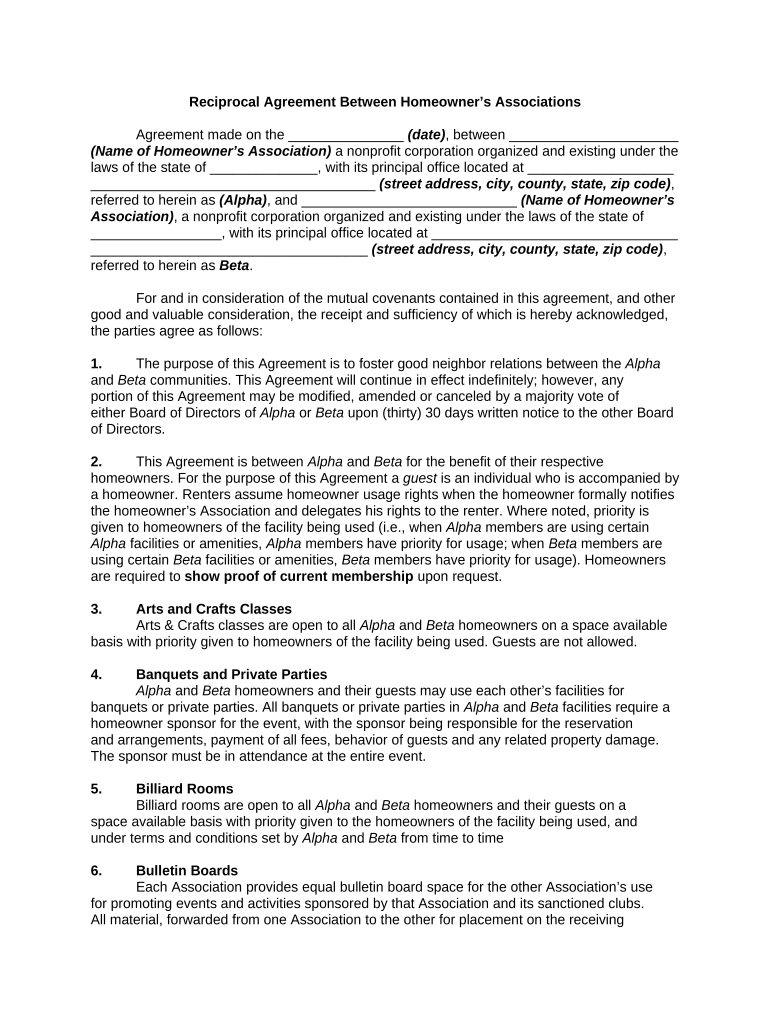
A Reciprocal Agreement Between Homeowner’s Associations is a written contract between two or more homeowners’ associations that allocates shared responsibilities, use rights, and costs for common facilities or services. Typical topics include maintenance obligations for shared roads, landscaping, utilities, access easements, insurance allocation, dispute resolution, and cost-sharing formulas. The agreement defines parties, effective dates, renewal or termination triggers, and how amendments will be approved. Although not always recorded, the agreement can be drafted to run with the land or to create contract rights enforceable against successor associations.

Why formalizing reciprocity between HOAs matters

A formal reciprocal agreement clarifies obligations, reduces member disputes, and protects reserve funding by defining maintenance, cost allocation, and liability between associations under clear contract terms.

Why formalizing reciprocity between HOAs matters

Who typically prepares and reviews these agreements

Several stakeholders participate in creating and approving reciprocal HOA agreements.

  • Board members and property managers who negotiate operational terms and approve budgets for shared services.
  • Association legal counsel who draft enforceable provisions, review governing documents, and verify recording implications.
  • Contractors and insurance brokers who advise on scope of maintenance work and required coverages.

In practice, a collaborative process that includes legal review and board approval helps avoid later disputes and supports enforceability.

Primary signers and their roles

Association President

The elected board officer typically signs on behalf of an HOA after board resolution authorizing the agreement. The signer's authorization should be documented in meeting minutes or a board resolution to avoid later challenges to authority.

Association Manager

A professional manager may execute or countersign if the board has delegated signing authority in governance documents; the delegation should be explicit and recorded to ensure enforceability.

Essential data elements to include

Parties: Full legal names
Property Addresses: Street, city, state
Effective Date: MM/DD/YYYY
Maintenance Scope: Services listed
Insurance Requirements: Coverage limits
Dispute Resolution: Arbitration or litigation

Key risks and legal consequences of errors

Unenforceability: Missing authorization
Liability Exposure: Insufficient insurance
Funding Shortfall: Unclear cost sharing
Recording Issues: Improper notice
Member Disputes: Ambiguous rights
Tax Consequences: Misallocated expenses

Common drafting and processing mistakes to avoid

  • Failing to document board approval or a formal resolution authorizing execution, which can make the agreement vulnerable to challenge in court.
  • Using vague language about cost allocation or maintenance standards, leading to disagreement over what services are covered and who pays.
  • Neglecting to require adequate insurance coverage or primary/secondary liability allocation between associations, exposing members to uninsured losses.
  • Assuming the agreement automatically binds successors without addressing recording, assignment language, or notice to subsequent owners.

Step-by-step: completing a reciprocal HOA agreement

Follow these steps in order to prepare, approve, and execute a reliable reciprocal agreement between associations.

  • 01
    Draft terms: Define scope, costs, insurance, and duration clearly.
  • 02
    Legal review: Counsel checks enforceability and recording needs.
  • 03
    Board approval: Adopt a resolution authorizing execution.
  • 04
    Execution: Signatures, notarization, and distribution to parties.

Typical routing and approval workflow

A standard workflow routes the agreement from drafter to signers with built-in approval gates and recordkeeping steps.

  • Draft: Prepared by counsel or manager for review.
  • Internal review: Board and committees comment and amend.
  • Authorize: Board resolution permits signing.
  • Execute: Signatures notarized if required and copies distributed.

Core provisions to include in a professional agreement

A comprehensive reciprocal agreement uses clear clauses, defined metrics, and stable processes to reduce ambiguity and future disputes.

Scope of Services

Describe exactly which facilities and services are shared, list exclusions, set quality or maintenance standards, and identify responsible parties for routine versus capital repairs.
Cost Allocation

Specify whether costs are shared equally, by unit count, by lot lineal frontage, or another formula; include billing schedules and late-payment remedies to protect reserves.

Term and Renewal

Set the initial term, automatic renewal conditions, notice periods for nonrenewal, and procedures for renegotiation to manage long-term obligations.

Insurance and Indemnity

Require minimum coverages and primary/secondary liability allocation; state who carries property, general liability, and worker’s compensation policies.

Dispute Resolution

Include escalation steps, mediation or arbitration clauses, and venue selection to reduce litigation costs and clarify process if disagreements arise.

Assignment and Successors

Address whether obligations run with the land, require notice on transfer, and state how new associations or owners assume responsibilities.

How to configure a digital signing workflow for the agreement

Configure the digital workflow so each signer sees required fields, authentication, and an audit trail preserved automatically.

Field Mapping Place signature, date, and initials fields for each authorized signer.
Authentication Level Use email + SMS or two-factor for board-level signers.
Signing Order Set sequential signing to reflect approval flow.
Notifications Enable reminders and completed-document emails.
Audit Trail Capture IP, timestamps, and action history.

Digital signing considerations and integrations

Choose a signing solution that supports secure authentication and auditable records for board-level agreements.

  • Document Formats: PDF and Word supported
  • Integrations: Connectors for Google Drive and Microsoft 365
  • Security: AES-256 at rest

Verify the vendor’s compliance posture, encryption standards, and integration compatibility with your document management or property management systems before finalizing the workflow.

Typical timing milestones and expectations

Estimate realistic timelines for negotiation, approval, and recording so stakeholders can plan budgets and meetings.

Negotiation Period:

2–6 weeks depending on complexity and counsel availability

Board Approval:

Allow one board cycle plus meeting notice requirements

Notarization Window:

Complete notarization at execution or shortly thereafter

Recording (if chosen):

Record within 30–60 days to provide public notice

Member Notification:

Deliver summary to members within 30 days of execution

Comparing eSignature vendors for executing the agreement

Vendor pricing and capabilities vary; signNow is listed first as the neutral reference point and competing vendor columns include commonly published starting prices.

signNow DocuSign Adobe Sign PandaDoc HelloSign
Starting Price $8/user/mo $15/user/mo $14/user/mo $19/user/mo $15/user/mo
Free Trial 7-day free trial Contact vendor Contact vendor Contact vendor Contact vendor
Bulk Send Yes Yes Yes Yes No
Audit Trail Yes Yes Yes Yes Yes
HIPAA Compliant Yes Yes Yes No No

Frequently asked questions about Reciprocal Agreements Between Homeowner’s Associations

Answers to common legal, procedural, and technical questions encountered when preparing and signing reciprocal HOA agreements.


Need help? Contact support

be ready to get more
Join over 28 million airSlate SignNow users