Signatory Block
Full legal name, address, and connection to the underlying document; this anchors the notary act to the correct individual and avoids misidentification disputes.
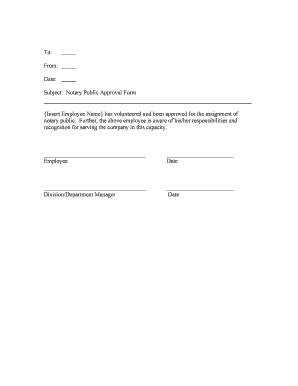
A correctly completed Notary Public Approval Form creates a durable legal record of identity, intent, and the notary act, supporting enforceability under the ESIGN Act (15 U.S.C. ch. 96) and state notary statutes (UETA where adopted). Clear fields reduce later disputes and simplify records retention for regulatory and audit needs.

Organizations and individuals use the form when an official notarial acknowledgement or approval is required before a document is accepted or filed.
The form bridges signer intent and official acknowledgment; parties on both sides of a transaction depend on its accuracy for legal and administrative certainty.
A commissioned notary public who performs identity verification, administers oaths if needed, completes the notarial certificate, and signs the approval form. The notary must follow state rules for seal, journal entries, and any remote notarization procedures.
An approving official (title may be registrar, compliance officer, or clerk) who requires the notarized approval to accept or file the underlying document and who may record the approval date and internal tracking number.
Full legal name, address, and connection to the underlying document; this anchors the notary act to the correct individual and avoids misidentification disputes.
Type of ID presented, issuing authority, ID number or partial number, and method used for proofing (credential analysis, knowledge-based, or in-person visual check).
Standardized wording that states the notary's action (acknowledgement, jurat, signature witnessing), the jurisdiction, date, and notary commission details per state law.
Space for any required witness names and signatures when the state or document type mandates witnesses alongside the notary acknowledgment.
Internal tracking number, document reference, filing office, and timestamps for each approval step to support audits and chain-of-custody.
Fields to indicate RON session ID, audio/video file reference, and retention instructions when remote notarization is used.
| Field | Configuration |
|---|---|
| Signer Authentication | Email + SMS code or KBA as required |
| Routing Order | Sequential: signer → notary → approver |
| Retention | Store signed PDF + audit trail 6 years |
| Notifications | Enable signer and approver alerts |
Verify that your eSignature platform supports the authentication and retention features required for the notary process.
Date on the certificate anchors legal effect and filing eligibility.
Often required for 5–10 years under state RON rules.
Allow several business days for review and indexing.
File with agencies by their specified deadlines when notarization affects submissions.
Provide copies promptly to courts or authorities upon lawful request.
| signNow | DocuSign | Adobe Sign | PandaDoc | HelloSign | |
|---|---|---|---|---|---|
| Starting Price | $8/user/mo | $15/user/mo | $14/user/mo | $19/user/mo | $15/user/mo |
| Free Trial | 7-day free trial | Varies | Varies | Yes, limited | Yes, limited |
| Bulk Send | Yes | Yes | Yes | Yes | No |
| Audit Trail | Yes | Yes | Yes | Yes | Yes |
| HIPAA Compliant | Yes | Yes | Yes | No | No |