Establishing secure connection…Loading editor…Preparing document…

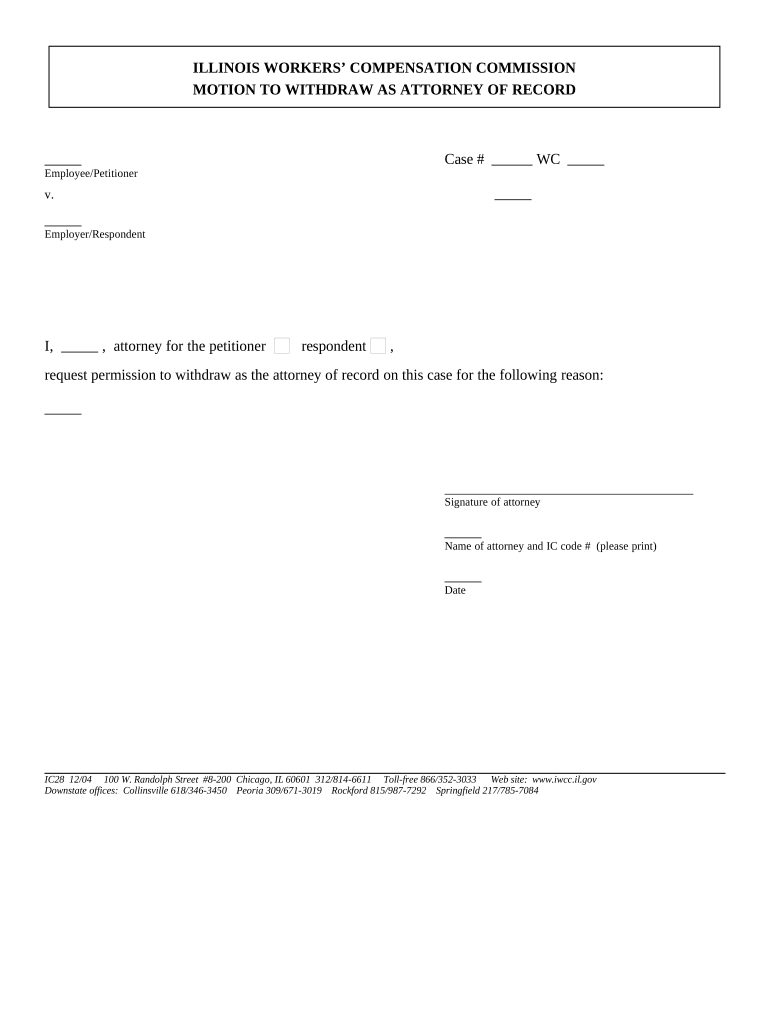
Illinois Workers Compensation Form

This template is fully customizable. Edit the text, fill out the fields, and send it for signature. Give it a try!
Illinois Workers Compensation Form

What the Illinois Workers Compensation Form Is and Covers

The Illinois Workers Compensation Form is the standardized document employers, treating providers, and insurers use to report workplace injuries and occupational illnesses under the Illinois Workers' Compensation Act. It records claimant identity, employer and job details, a factual description of the incident, medical treatment and billing entries, wage data, and required attestations. Proper completion initiates the claim process, supports timely benefit decisions and medical care, and creates an auditable record for insurers and the Illinois Workers' Compensation Commission; electronic filing may be acceptable where state or carrier systems allow.

Why Accurate Completion Matters for Employers and Claimants

Completing the Illinois Workers Compensation Form accurately preserves injured worker rights, meets statutory reporting expectations, and speeds claim evaluation. Clear, complete entries reduce follow-up requests, limit dispute risk, and provide a defensible record for benefit determinations and potential appeals before the Illinois Workers' Compensation Commission.

Why Accurate Completion Matters for Employers and Claimants

Who Typically Completes and Manages These Forms

Typical participants who complete and manage the Illinois Workers Compensation Form include employers, injured workers, and medical providers.

  • Employers and HR staff: complete employer sections, report incident details, and submit to insurer.
  • Injured workers or representatives: confirm personal and injury information and sign where required.
  • Treating medical providers: complete treatment sections and provide clinical findings and billing codes.

Typical Roles and Responsibilities

Employer HR Manager

Responsible for recording initial incident details, employer identification, job and wage information, and filing with the insurer. They coordinate return-to-work steps, preserve payroll and scheduling records, and respond to insurer follow-up requests during claim adjudication.

Workers' Compensation Attorney

Represents claimant or employer for appeals, settlements, and complex disputes. Reviews completed forms for accuracy, requests supplemental medical or wage documentation, prepares legal notices, and ensures deadlines and evidentiary standards are met.

Essential Sections a Professional Form Must Include

A complete Illinois Workers Compensation Form should group claimant, incident, employer, medical, wage, and signature information so examiners can evaluate coverage and benefits without needing routine clarifications.

Claimant Details

Full legal name, date of birth, Social Security number or TIN, contact information, and employment status. Accurate claimant identifiers prevent processing delays and ensure benefits are assigned to the correct person.
Incident Description

A concise factual account of the event, including date, time, location, activity, and witness names. Objective language and specific details support timely adjudication and reduce ambiguity in coverage decisions.

Employer Information

Legal business name, FEIN/TIN, address, supervisor contact, job title, and payroll classification. Correct employer identifiers link the claim to the appropriate policy and determine benefit calculations.

Medical Treatment

Initial and ongoing treatment dates, provider name and address, diagnosis codes or clinical findings, and expected recovery information. Attach medical records and billing data to substantiate care and service dates.

Wage and Work Details

Usual weekly wage, hours worked, pay rate, last day worked, and pay period. Accurate wage data is essential for calculating temporary and permanent benefit amounts.

Signatures and Attestations

Signatures from employer, claimant, and treating clinician where required, with printed names and dates. Attestations validate the reported facts and trigger insurer review and investigation.

Step-by-Step: Complete and Submit the Illinois Workers Compensation Form

Follow these practical steps to gather data, complete the form properly, and submit to the insurer or state system where required.

  • 01
    Gather Information: Collect claimant, job, incident, witness, and payroll details before beginning the form.
  • 02
    Complete Employer Section: Enter employer name, address, FEIN/TIN, supervisor, and payroll classification accurately.
  • 03
    Document Injury Details: Record date/time, location, activity, body part, and objective facts about the event.
  • 04
    Sign and Submit: Obtain required signatures and file with insurer portal or via accepted carrier channels.

Digital Workflow Settings to Streamline Form Completion

Recommended platform settings can reduce errors and automate routing for faster claim initiation.

Field Configuration
Authentication Method Email + SMS code
Field Types Text, date, select lists
Conditional Logic Show medical fields when injury indicated
Notification Settings Immediate email to HR and insurer

Technical Requirements for Electronic Completion and Submission

Choose a platform that supports secure uploads, common file formats, and reliable signer authentication for Illinois Workers Compensation Forms.

  • Integrations: HRIS and insurer claims portals
  • Formats: PDF and DOCX export/import support
  • Authentication: Email, SMS, KBA options

Typical Filing Flow From Completion to Claim Intake

This sequence shows how a completed Illinois Workers Compensation Form moves from the preparer through authentication and into insurer or state processing.

  • Prepare Document: Populate all required fields and attach medical and payroll records.
  • Authenticate Signers: Use email links, SMS codes, or ID verification where stronger proof is needed.
  • File Electronically: Submit to the insurer portal or carrier system where electronic filing is accepted.
  • Maintain Records: Store signed copies, audit trail, and supporting documents for retention.

Timing Expectations and Typical Reporting Windows

Employers and providers should report incidents promptly; insurers often impose specific submission windows and timely notice preserves the claimant's rights.

Initial Employer Notice:

Report to insurer promptly; many carriers expect submission within 7–30 days of knowledge.

Medical Treatment Reporting:

Providers should document treatment dates and forward reports without unnecessary delay.

Claim Filing:

Formal claim initiation may require additional forms or evidence within insurer timelines.

Statute of Limitations:

Observe applicable time limits to preserve rights; reporting supports timely filing.

Record Retention:

Keep records for federal and state-required retention periods applicable to the file.

Security and Compliance Controls to Protect Claim Data

Encryption: TLS 1.2/1.3 in transit
Data at Rest: AES-256 encryption at rest
Audit Trail: Timestamped actions, IP, signer log
Access Controls: Role-based access and MFA
HIPAA Support: BAA available for PHI handling
Compliance: ESIGN, UETA, SOC 2 Type II

Key Risks and Consequences of Incorrect or Late Forms

Delayed Reporting: May delay benefits or raise disputes
Incomplete Records: Can lead to claim denial
Incorrect Dates: Affects statute of limitation
Missing Signatures: May invalidate submission
PHI Exposure: Violates HIPAA without BAA
False Statements: Fraud penalties and civil liability

Common Preparation Errors to Avoid

  • Providing vague incident descriptions that omit date, location, or activity increases follow-up and slows claim adjudication.
  • Entering inconsistent claimant identifiers between payroll and claim forms causes verification delays and possible benefit misallocation.
  • Attaching incomplete or redacted medical records forces insurer requests for additional documentation and prolongs benefit processing.
  • Using unsigned or undated forms, or failing to capture a verifiable signer audit trail, can result in rejection or dispute of the filing.

Practical Tips to Reduce Errors and Speed Processing

Adopt these practices to make submissions more accurate, auditable, and less likely to trigger disputes.

Verify Identity
Confirm claimant legal name, SSN/TIN, and contact details against government ID or payroll records prior to submission. Accurate identity data reduces misrouting and suspected fraud, and speeds insurer verification processes.
Attach Supporting Records
Provide initial medical reports, employer incident logs, payroll statements, and witness information with the form. Complete attachments reduce follow-up requests, accelerate adjudication, and improve reserve accuracy.
Use Structured Language
Record events in objective, factual terms and avoid medical conclusions unless provided by a clinician. Clear structure reduces ambiguity for claims examiners and supports consistent coverage determinations.
Maintain Audit Trail
Retain signed PDFs, eSignature certificates, IP logs, and version history. An auditable trail supports appeals, regulatory reviews, and establishes a reliable sequence of actions.

eSignature Vendor Pricing and Feature Snapshot for Form Signing

Comparison of common eSignature vendors and core pricing/features relevant to signing and submitting Illinois Workers Compensation Forms.

signNow DocuSign Adobe Sign PandaDoc HelloSign
Starting Price $8/user/mo $15/user/mo $14/user/mo $19/user/mo $15/user/mo
Free Trial 7-day free trial Varies by vendor Varies by vendor Varies by vendor Varies by vendor
Bulk Send Yes Yes Yes Yes Yes
Audit Trail Yes Yes Yes Yes Yes
HIPAA Compliant Yes Yes Yes No No
Envelope Cap No cap 100 envelopes/user/year Varies by plan Varies by plan Varies by plan

Operational Examples of Form Use

Two concise examples show how organizations incorporate the form into daily operations and eSubmission workflows.

Mid-size Manufacturer

A mid-size manufacturer created a standardized incident intake checklist to populate forms quickly and consistently for shop-floor injuries.

  • Uses HRIS integration to prefill employer and payroll fields.
  • By combining prefilled employee data, attached medical reports, and an e-signature workflow, they reduced completion time and insurer follow-ups, improving claim throughput and record accuracy.

Small Medical Clinic

A small medical clinic records patient injury details and transmits signed forms to insurers under HIPAA-compliant workflows.

  • Maintains a BAA with the e-sign vendor to protect PHI.
  • The clinic uses secure e-submission, limits PHI in form fields, attaches clinical notes separately, and retains records six years to comply with HIPAA retention requirements.

Frequently Asked Questions About the Illinois Workers Compensation Form

Answers to common questions about e-signing, filing responsibilities, and correcting or withdrawing a submitted form.


Need help? Contact support

be ready to get more
Join over 28 million airSlate SignNow users