Establishing secure connection…Loading editor…Preparing document…

Letter Regarding Attorney's Fees in Conservatorship

This template is fully customizable. Edit the text, fill out the fields, and send it for signature. Give it a try!
Letter Regarding Attorney's Fees in Conservatorship

What the Letter Regarding Attorney's Fees in Conservatorship Is

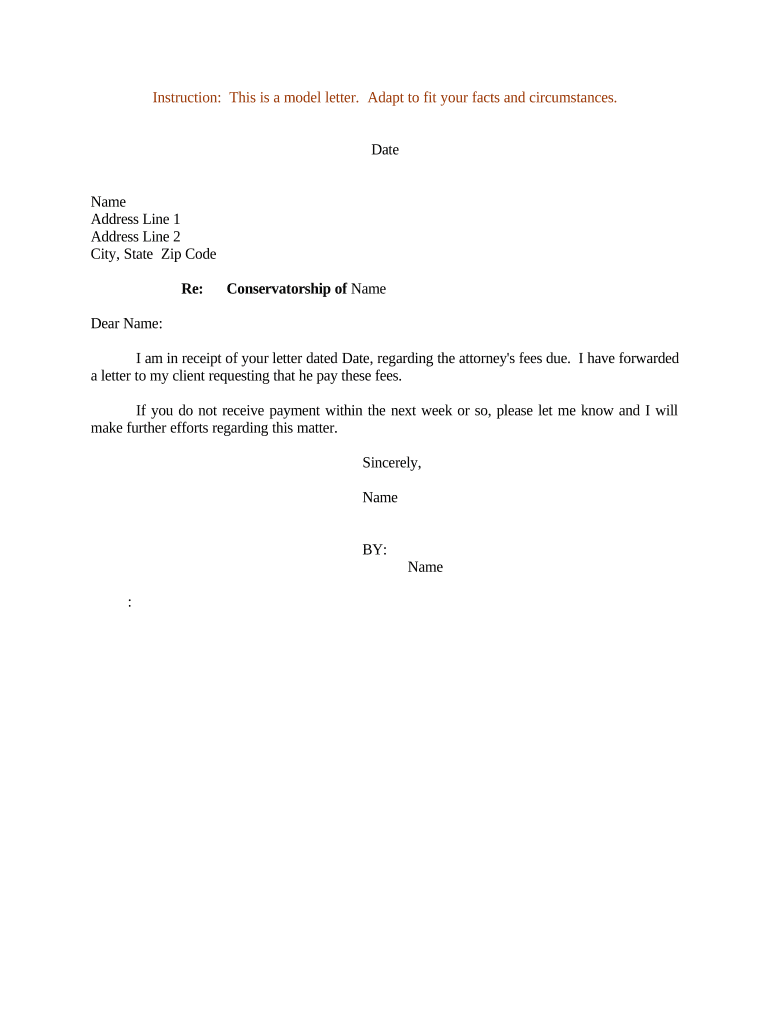
A Letter Regarding Attorney's Fees in Conservatorship is a formal written notice prepared by a conservator or the conservator's attorney that itemizes legal services performed for the conservatorship estate, summarizes fees and expenses, and requests court review or payment. It is typically attached to a petition for allowance of fees or to a periodic accounting submitted to the probate or family court. The letter creates a clear record of billing, the scope of work, dates of service, and supporting invoices to help the court and interested parties evaluate reasonableness.

Why a Clear, Documented Fee Letter Matters

A concise fee letter clarifies charges, supports court approval, preserves fiduciary accountability, and reduces disputes among heirs and interested parties by supplying the court with itemized evidence of legal work and costs.

Why a Clear, Documented Fee Letter Matters

Who Typically Prepares and Receives This Letter

The letter is prepared and used in the conservatorship context to document attorney billing and to ask the court to allow fees or authorize payment.

  • Conservators and guardians who manage the conservatee's assets and pay estate expenses.
  • Attorneys for the conservator who prepare the petition, itemize fees, and seek court allowance.
  • Probate court clerks and interested parties (heirs, creditors) who review fee requests.

Primary Signers and Authors

Conservator

The conservator signs when submitting a fee letter supporting estate disbursements; the conservator verifies that charges were necessary and that funds were available to pay legal costs.

Conservator's Attorney

The attorney prepares the letter, itemizes services, and signs to attest to the accuracy of billed time, rates, and that services benefited the estate in accordance with fiduciary duties.

Core Elements to Include in a Professional Fee Letter

A properly prepared letter is concise, follows local court rules, and attaches supporting invoices and any required forms so the judge can evaluate reasonableness and grant allowance or payment.

Caption

Case caption and court reference including probate court name, case number, conservatee name, and title such as 'In re Conservatorship of [Name]'.
Purpose Statement

A short opening that explains the letter's objective: petition for approval of attorney fees, payment from estate funds, or inclusion with an accounting.

Itemized Billing

A clear, date-ordered list of tasks, hours, hourly rates or flat fees, and total amounts for each invoice with invoice numbers for cross-reference.

Description of Services

Plain-language summaries of legal work performed (e.g., petitions, hearings, discovery, document preparation) tied to specific dates and invoices.

Request for Relief

A concise request stating the specific relief sought (allow fees of $X, authorize payment from estate funds, or approval of fee distribution).

Signatures

Signature lines for the attorney and conservator, printed names, bar number for the lawyer, and date; include contact information for follow-up.

Step-by-Step: Preparing and Submitting the Letter

Follow a consistent sequence to prepare the letter, attach supporting documents, obtain required signatures, and file and serve according to local procedures.

  • 01
    Draft the Letter: Compose a concise statement of purpose and itemized billing for the court's review.
  • 02
    Attach Exhibits: Include invoices, time records, retainer agreement, and prior orders relevant to fees.
  • 03
    Review and Sign: Have the attorney and conservator sign; verify bar numbers and dates.
  • 04
    File and Serve: File with the probate court and serve copies on all interested parties per local rules.

Where the Letter Goes and Who Receives It

Routing the letter correctly ensures proper notice: file with the court, include it in the estate file, and serve all required parties so objections can be raised in time.

  • Probate Court File: File the original letter and exhibits with the court clerk as part of the conservatorship file.
  • Service to Parties: Serve the conservatee's counsel, heirs, and any listed creditors per local service rules.
  • Estate Records: Attach the letter and invoices to the estate's accounting records for audit and audit trail purposes.
  • Court Hearing: If required, schedule or appear at the fee-allowance hearing with copies available for the judge and parties.

How to Set Up a Digital Workflow for the Letter

Configure a repeatable digital workflow for drafting, review, signing, filing, and storage to maintain a consistent audit trail and reduce errors.

Field Configuration
Document Template Use a standardized template with caption, itemized table, and signature fields.
Authentication Require signer email confirmation or SMS code for identity assurance.
Attachments Automate attaching invoices and exhibits as PDF appendices.
Retention Set automatic archival to secure storage after filing.

Technical Requirements for Digital Completion and Submission

Choose a platform that supports PDF, Word, audit trails, and common integrations so filings remain reproducible and verifiable.

  • File Formats: PDF and DOCX supported for court-ready submissions.
  • Authentication: Email or SMS codes, optional two-factor authentication.
  • Integrations: Works with common cloud storage and case-management tools.

Timing Considerations and Typical Deadlines

Timing depends on local probate rules; plan ahead to allow notice, a statutory objection window, and scheduling of a fee-allowance hearing if required.

When to File:

File with the next accounting or when fees are incurred and need court allowance.

Service Period:

Serve interested parties per local rules, often concurrently with filing.

Objection Window:

Allow at least 21–30 days for parties to object where local rules require prior notice.

Hearing Timeframe:

If a hearing is set, expect scheduling within weeks to months depending on court backlog.

Record Retention:

Keep originals and exhibits after filing per statutory retention guidance.

Essential Information to Record in the Letter

Conservatee Details: Full legal name
Case Reference: Court and case number
Invoice Summary: Itemized totals
Service Dates: Range of dates
Attorney ID: Bar number
Relief Requested: Specific allowance

Consequences of an Incomplete or Incorrect Letter

Fee Disallowance: Court may deny requested fees
Delayed Distribution: Estate payments may be postponed
Ethics Inquiry: Potential disciplinary review
Repayment Obligation: Disallowed fees may require refund
Tax Exposure: Incorrect reporting on estate returns
Creditor Claims: Improper notice can trigger disputes

Common Mistakes to Avoid When Preparing the Letter

  • Using vague descriptions of work without linking tasks to dates and invoices makes it difficult for the court to evaluate reasonableness.
  • Failing to serve all interested parties or using an incorrect caption can lead to objections or a returned filing by the clerk.
  • Leaving out the retainer agreement or time records removes key evidence the judge needs to verify billed hours.
  • Relying on unsigned or improperly authenticated electronic signatures where local rules require notarization or additional authentication.

Practical Examples: Typical Scenarios and Outcomes

Two concise examples show how clear documentation affects court review and estate administration outcomes.

Approved Fee Petition

A conservator submits an itemized letter with invoices and prior court orders

  • Judge confirms fees are reasonable after a 21-day notice period
  • The court allows payment from estate funds and issues a written order permitting distribution.

Disputed Billing

An attorney files a vague fee letter without time entries

  • An heir objects and requests a hearing
  • The court orders supplementation; some fees are disallowed and the attorney must refund amounts deemed unreasonable.

Practical Tips for Accurate and Efficient Fee Letters

Follow consistent formatting, include clear exhibits, and maintain an auditable trail to reduce objections and speed court review.

Standardize the Template
Use a repeatable template with the court caption, itemized table, and exhibit references so every filing meets clerk expectations and reduces clerical errors.
Attach Supporting Invoices
Include original invoices, time entries, and the retainer agreement so the court can verify billed tasks and hours without requesting supplemental documents.
Confirm Local Rules
Check the probate court's local rules for required language, filing formats, service methods, and any statutory notice periods before submitting the letter.
Preserve an Audit Trail
Keep signed originals or secure electronic records showing signer identity, timestamps, and file provenance to support authenticity if challenged.

eSignature Provider Comparison for Completing and Submitting the Letter

Comparison of common eSignature vendors with signNow in the leading column for reading convenience; select a provider that meets authentication and retention needs for court filings.

signNow DocuSign Adobe Sign PandaDoc HelloSign
Starting Price $8/user/mo $15/user/mo $14/user/mo $19/user/mo $15/user/mo
Free Trial Yes, 7-day trial Yes, free trial available Yes, free trial available Yes, free trial available Yes, free trial available
Bulk Send Yes Yes Yes Yes No
Audit Trail Yes Yes Yes Yes Yes
HIPAA Compliant Yes Yes Yes No No

Frequently Asked Questions About the Letter Regarding Attorney's Fees in Conservatorship

Answers to common procedural and legal questions about preparing, signing, and filing fee letters in conservatorship cases.


Need help? Contact support

be ready to get more
Join over 28 million airSlate SignNow users