Establishing secure connection…Loading editor…Preparing document…

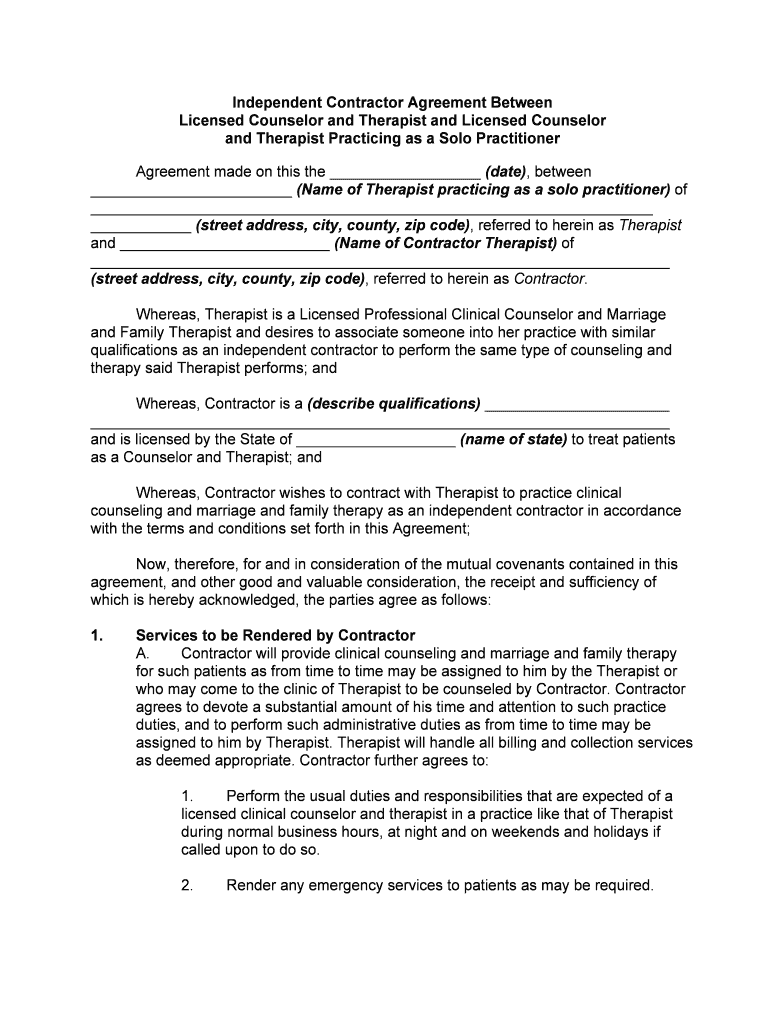
Independent Contractor Agreement for Counseling Services

This template is fully customizable. Edit the text, fill out the fields, and send it for signature. Give it a try!
Independent Contractor Agreement for Counseling Services

What this Independent Contractor Agreement for Counseling Services is and when it’s used

An Independent Contractor Agreement for Counseling Services is a written contract that sets the terms between a licensed counselor or therapist working as an independent contractor and the clinic, practice, school, or agency that engages them. It clarifies scope of services, payment terms, scheduling, confidentiality, recordkeeping, insurance and liability, and the contractor’s professional responsibilities. The agreement distinguishes contractor status from employment, preserves client privacy obligations under healthcare law, and provides a clear baseline for dispute resolution and termination.

Why a clear independent contractor agreement matters for counseling practices

A well-drafted agreement reduces legal risk by defining roles, protecting patient privacy, and documenting payment and insurance obligations. It helps ensure compliance with ESIGN and UETA when signed electronically and supports enforceability of confidentiality and indemnity provisions.

Why a clear independent contractor agreement matters for counseling practices

Who typically uses this agreement and where it fits

Use this agreement when an individual counselor provides services to an organization but is not hired as an employee.

  • Solo counselors contracting with a group practice for client referrals and office use.
  • Community clinics engaging licensed therapists on a per-session or per-week basis.
  • Schools or universities contracting licensed counselors for on-site student services.

The document helps each party set expectations about billing, client records, licensing, and termination without creating an employment relationship.

Representative signer roles

Licensed Counselor

A licensed mental health professional who provides clinical services under their own credentials and controls methods of treatment. The counselor signs to accept independent contractor status, confirms licensure, carries required liability insurance, and agrees to confidentiality and recordkeeping terms.

Practice Owner

An authorized representative of the clinic or agency who approves the contractor arrangement, sets payment rates and scheduling procedures, and confirms that the organization will not treat the contractor as an employee for payroll or benefits purposes.

Core clauses to include in a professional counseling contractor agreement

A comprehensive agreement addresses service scope, payment, confidentiality, compliance, and the end-of-engagement process. Each clause should be specific, measurable, and consistent with applicable healthcare privacy and professional licensing rules.

Scope of Services

Define the types of counseling, estimated hours, client assignment process, and any supervision or reporting obligations so there is no ambiguity about expected deliverables.
Payment Terms

Specify rates, invoicing frequency, accepted payment methods, late payment penalties, and whether the contractor is responsible for billing third-party payers or private clients.

Confidentiality

Require compliance with patient privacy obligations, data handling procedures, and any required patient authorization language for sharing protected health information.

Term and Termination

State the initial term, renewal mechanics, notice periods for termination for cause or convenience, and obligations that survive termination such as confidentiality.

Insurance and Liability

Include required professional liability insurance limits, indemnification language, and responsibilities for claims arising from the contractor’s acts or omissions.

Independent Contractor Status

Explicitly state that the contractor is not an employee, is responsible for taxes, and will maintain professional licensure and credentialing independently.

Step-by-step: completing the agreement and getting it executed

Follow these sequential steps to prepare, review, and complete the contractor agreement so both parties retain enforceable records.

  • 01
    Draft: Populate all fields with accurate, current information and attach license copies.
  • 02
    Review: Have legal counsel or a compliance lead review for privacy and labor classification risk.
  • 03
    Sign: Execute signatures electronically or in person; ensure consent for electronic records where required.
  • 04
    Retain: Store the executed agreement in a secure, access-controlled file system with an audit trail.

Typical online execution workflow for this counseling contractor agreement

Electronic execution follows a standard flow: prepare the document, assign signer roles, choose authentication, collect signatures, then distribute copies and preserve the audit trail.

  • Upload Document: Upload the template to your eSignature platform in PDF or DOCX format.
  • Place Fields: Add signature, date, and initial fields where required and mark any conditional fields.
  • Assign Signers: Enter signer names and emails and set signing order if needed.
  • Authentication: Select signer authentication such as email link, SMS code, or higher assurance options.

Recommended settings when configuring a digital signing workflow

Configure these settings to balance signer convenience, evidence of consent, and regulatory requirements for counseling records.

Field Configuration
Signature Type Allow typed or drawn signatures; enable audit trail.
Authentication Use email link + optional SMS code for higher assurance.
Document Retention Enable secure archival with exportable audit logs.
Attachments Require license and insurance uploads before signing.

Technical considerations for eSigning and secure storage

Verify the eSignature platform supports required security, authentication, and integrations before execution.

  • Integrations: Supports major systems like EHR and CRM integrations.
  • File Formats: Accepts PDF and DOCX source files.
  • Authentication Options: Offers email, SMS, and advanced signer verification.

Choose a platform that preserves a detailed audit trail, encrypts stored records, and can export signed PDFs for secure long-term retention.

eSignature vendor comparison for signing counseling contractor agreements

Compare common plan features and starting prices for straightforward eSignature use. signNow is listed first per vendor comparison conventions; verify specific plan features before purchase.

signNow DocuSign Adobe Sign PandaDoc HelloSign
Starting Price $8/user/mo $15/user/mo $14/user/mo $19/user/mo $15/user/mo
Free Trial 7-day free trial Varies by plan Varies by plan Varies by plan Varies by plan
Bulk Send Yes (Business Premium) Varies by plan Varies by plan Varies by plan Varies by plan
Audit Trail Yes Yes Yes Yes Yes
HIPAA Compliant Yes Yes Yes No No
Envelope Cap No envelope cap 100 envelopes/user/year Varies by plan Varies by plan Varies by plan

Security and compliance controls to require in the agreement or platform

Encryption: TLS 1.2/1.3 in transit; AES-256 at rest
Audit Trail: Detailed logs with timestamps and IP addresses
Access Controls: Role-based access and user authentication
HIPAA Support: Business associate agreement required
Certifications: SOC 2 Type II and ISO 27001 available
Retention Export: Ability to export signed PDFs and logs

Common risks and potential penalties if the agreement is incorrect

Misclassification Risk: Worker misclassified as contractor
HIPAA Violations: Privacy breaches and fines
Tax Reporting: Incorrect 1099 reporting penalties
Insurance Gaps: Uncovered malpractice claims
Unenforceable Terms: Ambiguous obligations may be void
Billing Disputes: Delayed payment or litigation

Frequent drafting and execution pitfalls to avoid

  • Using vague compensation language such as 'reasonable compensation' without defining rates or billing intervals can lead to disputes and delayed payments.
  • Failing to require current professional license and insurance certificates up front increases exposure to claims and regulatory action if the contractor’s credentials lapse.
  • Omitting explicit confidential information handling and patient data instructions can result in noncompliance with privacy obligations and potential regulatory penalties.
  • Relying on unsigned or loosely executed electronic acknowledgements without clear consent can undermine enforceability and complicate dispute resolution.

Practical tips for accurate and efficient completion

Use consistent templates, gather required attachments before execution, and use an auditable eSignature process to reduce rework and evidentiary gaps.

Standardize Templates
Maintain one approved template and track revisions; avoid ad hoc edits that create inconsistent obligations.
Collect Documents
Require license, malpractice insurance, and W-9 prior to first billable session to streamline onboarding.
Use Conditional Fields
Make payment and scope options conditional to prevent contradictory terms appearing together.
Preserve Audit Trails
Ensure signed copies include a certificate of completion with signer authentication details.

Timing considerations and typical processing expectations

Key dates include the effective date, billing cycles, insurance renewal deadlines, and notice periods for termination or changes to scope.

Effective Date:

Enter as MM/DD/YYYY at signing

Invoice Cycle:

Specify net terms such as Net 30 or Net 45

Notice Period:

Commonly 30 days for termination without cause

Insurance Renewal:

Require proof of renewal before policy expiration

Record Retention:

Follow retention schedule after termination

Example scenarios showing how the agreement is used

Two practical examples illustrate typical adaptations of the contractor agreement in real settings.

Community Clinic Contract

A clinic engages a licensed counselor for 20 hours weekly

  • The agreement requires the contractor to carry $1M liability insurance
  • The clinic collects license and insurance copies, uses a monthly invoice cycle, and retains signed agreements for seven years for audit purposes.

University Counseling Services

A university hires part-time counselors per semester

  • The contract limits services to student mental health and campus outreach
  • It includes FERPA-aware record handling, a semester-based invoicing schedule, and clear termination at semester end.

Frequently asked questions about Independent Contractor Agreements for Counseling Services

Answers to common questions about execution, signatures, tax forms, and privacy compliance when using this agreement.


Need help? Contact support

be ready to get more
Join over 28 million airSlate SignNow users