Establishing secure connection…Loading editor…Preparing document…

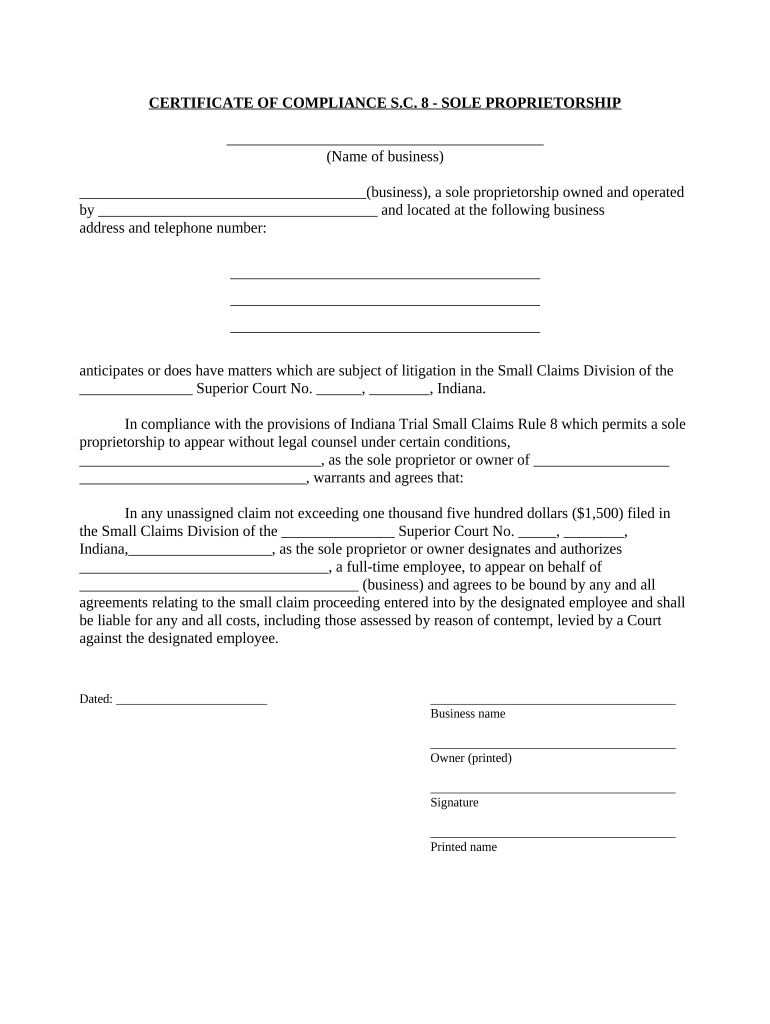
Indiana Sole Proprietorship

This template is fully customizable. Edit the text, fill out the fields, and send it for signature. Give it a try!
Indiana Sole Proprietorship

What an Indiana Sole Proprietorship Is

An Indiana Sole Proprietorship is an unincorporated business owned and operated by a single individual in Indiana. It has no separate legal entity from the owner, so the owner reports business income and expenses on personal tax returns and is personally liable for debts and obligations. Establishing a sole proprietorship in Indiana typically requires registering a business name (if different from owner) with the county or state, obtaining required licenses or permits, and registering for state tax accounts. It is the default business form for many small, single-owner operations because it is simple and cost-effective to begin.

Reasons to Choose a Sole Proprietorship in Indiana

Use an Indiana Sole Proprietorship when you need a fast, low-cost way to start a one-owner business while keeping administrative overhead low. It simplifies tax reporting and bank setup but offers no liability protection, so owners should weigh personal risk versus convenience.

Reasons to Choose a Sole Proprietorship in Indiana

Who Typically Uses These Forms

Typical users who rely on Indiana Sole Proprietorship forms include sole owners starting small businesses, independent contractors, and casual sellers registering a trade name.

  • Independent contractors filing a trade name and local business licenses.
  • Solo retail or service operators opening a bank account under a DBA.
  • Freelancers and gig workers formalizing operations for tax and permitting.

Step-by-Step: Establishing Your Indiana Sole Proprietorship

Follow these steps to establish, register, and maintain an Indiana Sole Proprietorship accurately and in compliance with state and local requirements.

  • 01
    Choose Name: Decide legal owner name or DBA; check availability online.
  • 02
    Register: File county DBA or Indiana business registration where applicable.
  • 03
    Licenses: Obtain local and state occupational licenses and permits required.
  • 04
    Taxes: Apply for EIN if hiring; register for Indiana tax accounts.

Configure an Online Signing Workflow

Configure an online signing workflow to collect signatures, route copies, and capture an audit trail for Indiana Sole Proprietorship filings.

Field and Configuration Settings Guide Configuration
Authentication method for signer identity Email link or SMS code; stronger KBA optional
Attachment requirements for identity verification Attach driver license for identity verification when needed
Routing and recipient rules for documents Auto-forward signed copy to owner and tax preparer
Retention and storage policy for records Store signed PDF and audit trail for required retention period

Distribution Channels and Technical Needs

Common distribution options and integrations for e-signing Indiana Sole Proprietorship forms include email, cloud storage, and API-based connectors to business systems.

  • Email: Send secure signing link via email
  • Cloud Storage: Save copies to Google Drive, Box, or OneDrive
  • Integrations: Connectors: Salesforce, NetSuite, Microsoft 365

Digital Submission Flow for Sole Proprietorship Forms

Typical e-submission flow for an Indiana Sole Proprietorship form simplifies collection, verification, and storage of signed documents and audit evidence.

  • Upload: Attach completed PDF or DOCX to the platform
  • Place Fields: Add signature, date, and TIN fields before sending
  • Authenticate: Choose email, SMS code, or KBA for signer verification
  • Archive: Store signed PDF with timestamped audit trail

Essential Sections to Include on the Form

Key sections in a professional Indiana Sole Proprietorship form make responsibilities, tax treatment, and contact points explicit to prevent ambiguity and enable smooth compliance.

Owner Details

List the proprietor's full legal name, taxpayer identification (SSN or EIN), complete mailing address, and contact phone or email. Accurate owner details are essential for tax reporting and banking.
DBA

If using a trade name, record the 'doing business as' name exactly as registered with the county or state. Include registration number and filing county to match official records.

Business Activity

Describe primary business activities using clear, industry-standard terminology and examples of services or products. Accurate activity descriptions assist in identifying licensing obligations, zoning restrictions, and the correct tax treatment.

Effective Date

Specify the effective date of the sole proprietorship using MM/DD/YYYY format. This date determines when tax reporting begins and can affect permit and license renewal cycles.

Signatures

Include a signature block for the owner with printed name, signature, and date. For notarized submissions, add a notary acknowledgement and follow state notary rules.

Compliance Notes

List applicable permits, tax account numbers, and renewal dates. Note industry-specific obligations such as professional licensing, sales tax collection, or health department approvals where relevant.

Security and Compliance Highlights for Electronic Filing

Encryption: TLS 1.2/1.3 in transit; AES-256 at rest
Certifications: SOC 2 Type II and ISO 27001 certified
HIPAA: BAA available for protected health information
Audit Trail: Complete timestamped logs and signer metadata
Authentication: Supports email, SMS, KBA, and SSO
Accessibility: WCAG 2.0 Level AA compliant

Primary Risks and Potential Penalties

Personal Liability: Owner personally liable for business debts
Tax Reporting Errors: Incorrect TIN triggers backup withholding (24%)
Filing Penalties: Late 1099s subject to $60–$330 penalties
I-9 Violations: Recordkeeping failures risk $281–$2,789 fines
Notary Noncompliance: Improper notarization can void filings
Intentional Disregard: Willful failure faces $660+ per form

Common Preparation Challenges to Avoid

  • Using mismatched owner name or DBA leading to bank account denial, payer confusion, and IRS backup withholding due to incorrect TIN or name/TIN mismatches.
  • Failing to obtain required local permits or occupational licenses can result in fines, business closure orders, or inability to legally operate in specific municipalities.
  • Neglecting to register a DBA where required exposes the owner to enforcement actions and prevents use of the trade name for banking and contracts.
  • Assuming sole proprietorship limits liability; owners remain personally responsible for debts, torts, and contractual obligations unless they form an LLC or corporation.

eSignature Plan Comparison for Filing and Signing

Compare typical eSignature plan features and pricing to support eSigning Indiana Sole Proprietorship forms across vendors.

signNow DocuSign Adobe Sign PandaDoc HelloSign
Starting Price $8/user/mo $15/user/mo $14/user/mo $19/user/mo $15/user/mo
Free Trial 7-day free trial Varies by plan Varies by plan Varies by plan Varies by plan
Bulk Send Yes (Business Premium tier) Yes (100 envelopes/year limit) Yes Yes No
Audit Trail Yes Yes Yes Yes Yes
HIPAA Compliant Yes Yes Yes No No

Practical Use Cases from Small Businesses

Real-world examples show how sole proprietors use these forms for registration, banking, and compliance in Indiana.

Local Contractor

A sole-owner remodeling contractor in Indianapolis needed to register a DBA and open a business bank account quickly.

  • Used signNow eSign to submit filings.
  • The contractor completed the county fictitious name filing, shared signed copies with the bank and accountant, and avoided delays from in-person appointments. Electronic audit trails simplified recordkeeping for tax season and license renewals.

Freelance Designer

A graphic designer operating as a sole proprietor needed to collect signed client agreements for remote projects.

  • Streamlined onboarding, invoicing, and payments.
  • Using online forms and eSignature, the designer reduced contract turnaround time, stored executed agreements in secure cloud storage, and demonstrated clear scopes of work to clients—reducing disputes and speeding payment cycles.

Frequently Asked Questions and Answers

Answers to common questions about forming, signing, and submitting Indiana Sole Proprietorship documents, including eSignature and retention concerns.


Need help? Contact support

be ready to get more
Join over 28 million airSlate SignNow users