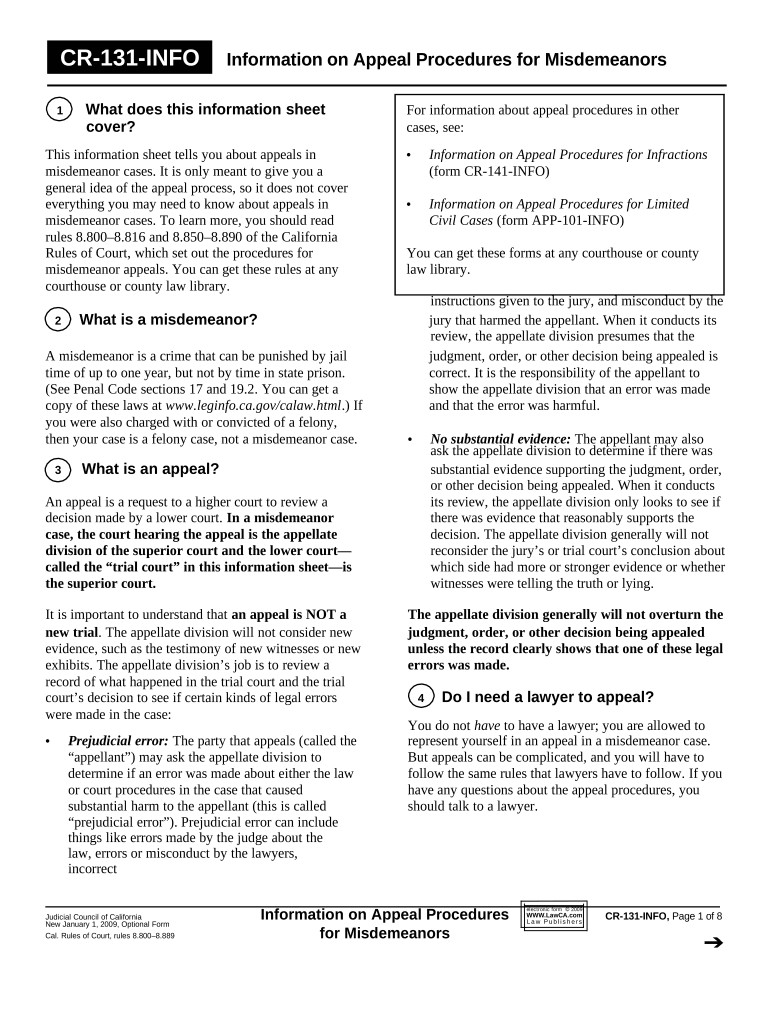
CR-131-INFO Information on Appeal Procedures for Misdemeanors
1 What does this information sheet For information about appeal procedures in other
cover? cases, see:
This information sheet tells you about appeals in • Information on Appeal Procedures for Infractions
misdemeanor cases. It is only meant to give you a (form CR-141-INFO)
general idea of the appeal process, so it does not cover
everything you may need to know about appeals in • Information on Appeal Procedures for Limited
misdemeanor cases. To learn more, you should read Civil Cases (form APP-101-INFO)
rules 8.800–8.816 and 8.850–8.890 of the California
Rules of Court, which set out the procedures for You can get these forms at any courthouse or county
misdemeanor appeals. You can get these rules at any law library.
courthouse or county law library.
instructions given to the jury, and misconduct by the
2 What is a misdemeanor? jury that harmed the appellant. When it conducts its
review, the appellate division presumes that the
A misdemeanor is a crime that can be punished by jail judgment, order, or other decision being appealed is
time of up to one year, but not by time in state prison. correct. It is the responsibility of the appellant to
(See Penal Code sections 17 and 19.2. You can get a show the appellate division that an error was made
copy of these laws at www.leginfo.ca.gov/calaw.html .) If and that the error was harmful.
you were also charged with or convicted of a felony,
then your case is a felony case, not a misdemeanor case. • No substantial evidence: The appellant may also
ask the appellate division to determine if there was
3 What is an appeal? substantial evidence supporting the judgment, order,
or other decision being appealed. When it conducts
An appeal is a request to a higher court to review a its review, the appellate division only looks to see if
decision made by a lower court. In a misdemeanor there was evidence that reasonably supports the
case, the court hearing the appeal is the appellate decision. The appellate division generally will not
division of the superior court and the lower court— reconsider the jury’s or trial court’s conclusion about
called the “trial court” in this information sheet—is which side had more or stronger evidence or whether
the superior court. witnesses were telling the truth or lying.
It is important to understand that an appeal is NOT a The appellate division generally will not overturn the
new trial . The appellate division will not consider new judgment, order, or other decision being appealed
evidence, such as the testimony of new witnesses or new unless the record clearly shows that one of these legal
exhibits. The appellate division’s job is to review a errors was made.
record of what happened in the trial court and the trial
court’s decision to see if certain kinds of legal errors 4 Do I need a lawyer to appeal?
were made in the case:
You do not have to have a lawyer; you are allowed to
• Prejudicial error: The party that appeals (called the represent yourself in an appeal in a misdemeanor case.
“appellant”) may ask the appellate division to But appeals can be complicated, and you will have to
determine if an error was made about either the law follow the same rules that lawyers have to follow. If you
or court procedures in the case that caused have any questions about the appeal procedures, you
substantial harm to the appellant (this is called should talk to a lawyer.
“prejudicial error”). Prejudicial error can include
things like errors made by the judge about the
law, errors or misconduct by the lawyers,
incorrect
_____________________________________________________________________________
Judicial Council of California Information on Appeal Procedures CR-131-INFO, Page 1 of 8
New January 1, 2009, Optional Form
Cal. Rules of Court, rules 8.800–8.889 for Misdemeanors el ectr onic form 2009
WWW.LawCA.com
L a w P u b l i s h e r s
CR-131-INFO Information on Appeal Procedures for Misdemeanors
If you are representing yourself, you must inform the convicted of committing the misdemeanor. The other
court if your address, telephone number, or other contact party is called the RESPONDENT; in a misdemeanor
information changes so that the court can contact you if case, this is usually the government agency that filed the
needed. criminal charges (on court papers, this party is called the
People of the State of California).
5 How do I get a lawyer to represent me?
7 Can I appeal any decision that the trial
The court is required to appoint a lawyer to represent court made?
you if you are indigent (you cannot afford to pay for a
lawyer) and: No. Generally, you may appeal only the final judgment
—the decision at the end that decides the whole case.
• Your punishment includes going to jail or paying a The final judgment includes the punishment that the
fine of more than $500 (including penalty and other court imposed. Other rulings made by the trial court
assessments) or before final judgment generally cannot be separately
appealed, but can be reviewed only later as part of an
• You are likely to suffer other significant harm as a appeal of the final judgment. In a misdemeanor case, the
result of being convicted. party convicted of committing a misdemeanor
usually appeals that conviction or the sentence
(punishment) ordered by the trial court. In a
The court may, but is not required to, appoint a lawyer to misdemeanor case, a party can also appeal from:
represent you on appeal in other circumstances if you are • An order granting or denying a motion to suppress
indigent. You are automatically considered indigent if evidence (Penal Code section 1538.5(j))
you were represented by the public defender or other
court-appointed lawyer in the trial court. You will also • An order made by the trial court after judgment that
be considered indigent if you can show that your income affects a substantial right of the appellant (Penal
and assets are too low to pay for a lawyer. Code section 1466(2)(B))
If you think you are indigent, you can ask the court to 8 How do I start my appeal?
appoint a lawyer to represent you for your appeal. You
tells the other party in the case and the trial court First, you must file a notice of appeal. The notice of appeal
may use Request for Court-Appointed Lawyer in that you are appealing the trial court’s decision. You
Misdemeanor Appeal (form CR-133) to ask the court to may use Notice of Appeal (Misdemeanor) (form
appoint a lawyer to represent you on appeal in a CR-132) to prepare and file a notice of appeal in a
misdemeanor case. You can get form CR-133 at any information about finding a lawyer on the California
courthouse or county law library. any misdemeanor case. You can get form CR-132 at
If you want a lawyer and you are not indigent or if the courthouse or county law library.
court turns down your request to appoint a lawyer, you
must hire a lawyer at your own expense. You can get 9 Is there a deadline for filing my notice
Courts Online Self-Help Center. of appeal?
Yes. Except in the very limited circumstances listed in
6 Who can appeal? rule 8.853(b), in a misdemeanor case, you must file
Only a party in the trial court case can appeal a decision your notice of appeal within 30 days after the trial court
in that case. You may not appeal on behalf of a friend, a makes (“renders”) its final judgment in your case or
spouse, a child, or another relative. issues the order you are appealing. (You can get a copy
The party that is appealing is called the APPELLANT; of rule 8.853 at any courthouse or county law library.)
in a misdemeanor case, this is usually the party
_____________________________________________________________________________
New January 1, 2009 Information on Appeal Procedures CR-131-INFO, Page 2 of 8
for Misdemeanors
CR-131-INFO Information on Appeal Procedures for Misdemeanors
Other parts of your punishment, such as fines or
The date the trial court makes its judgment is probation conditions, will be postponed (“stayed”), only
normally the date the trial court issues its order if you request a stay and the court grants your request. If
saying what your punishment is (sentences you). you want a stay, you must first ask the trial court for a
This deadline for filing the notice of appeal cannot stay. You can also apply to the appellate division for a
be extended. If your notice of appeal is late, the stay, but you must show in your application to appellate
appellate division will not be able to consider division that you first asked the trial court a stay and that
your appeal. the trial court unjustifiably denied your request. If
you do not get a stay and you do not pay your fine or
complete another part of your punishment by the date
10 How do I file my notice of appeal? ordered by the court, a warrant may be issued for your
arrest or a civil collections process may be started
against you, which could result in a
To file the notice of appeal in a misdemeanor case, you civil penalty being added to your fine.
must bring or mail the original notice of appeal to the
clerk of the trial court that made the judgment or 12 What do I need to do after I file my
issued the order you are appealing. It is a good idea to appeal?
bring or mail an extra copy to the clerk and ask the
clerk to stamp it to show that the original You must tell the trial court whether you want a record
has been filed. of what was said in the trial court (this is called a record
of the “oral proceedings”) sent to the appellate division
There is no fee for filing the notice of appeal in a and, if so, what form of that record you want to use.
misdemeanor case. You can ask the clerk of that court if You may use Notice Regarding Record of Oral
there are any other requirements for filing your notice of Proceedings(Misdemeanor) (form CR-134) for this notice.
appeal. (You can get form CR-134 at any courthouse or county
After you file your notice of appeal, the clerk will send a law library.) You must file this notice either:
copy of your notice of appeal to the office of the
prosecuting attorney (for example, the district attorney, (1) within 20 days after you file your notice of
county counsel, city attorney, or state Attorney General). appeal, or, if it is later
11 If I file a notice of appeal, do I still have (2) within 10 days after the court decides whether
to go to jail or complete other parts of to appoint a lawyer to represent you (if you ask
my punishment? the court to appoint a lawyer within 20 days
after you file your notice of appeal).
Filing the notice of appeal does NOT automatically 13 In what cases does the appellate
postpone your punishment, such as serving time in jail, division need a record of what was
paying fines, or probation conditions. said in the trial court?
If you have been sentenced to jail in a misdemeanor You do not have to send the appellate division a record
case, you have a right to be released either with or of what was said in the trial court. But if you want to
without bail while your appeal is waiting to be decided, raise any issue in your appeal that would require the
but you must ask the court to set bail or release you. If raise any issue in your appeal that would require the
the trial court has not set bail or released you after your appellate division to consider what was said in the trial
notice of appeal has been filed, you must ask the trial court, the appellate division will need a record of these
court to set bail or release you. If the trial court denies oral proceedings. For example, if you are claiming that
your release or sets the bail amount higher than you there was not substantial evidence supporting the
think it should be, you can apply to the appellate judgment, order, or other decision you are appealing,
division for release or for lower bail. the appellate division will need a record of the oral
_____________________________________________________________________________
New January 1, 2009 Information on Appeal Procedures CR-131-INFO, Page 3 of 8
for Misdemeanors
CR-131-INFO Information on Appeal Procedures for Misdemeanors
proceedings. Since the appellate division judges were reporter made a record of your case before you
not there for the proceedings in the trial court, an official choose this option.
record of these oral proceedings must be prepared and
sent to the appellate division for its review. Cost : Ordinarily, the appellant must pay for
preparing a reporter’s transcript. The court
Depending on what form of the record you choose to reporter will provide the clerk of the trial court
use, you will be responsible for paying to have the with an estimate of the cost of preparing the
official record of the oral proceedings prepared (unless transcript and the clerk will notify you of this
you are indigent) or for preparing an initial draft of this estimate. If you want the reporter to prepare a
record yourself. If you do not take care of these transcript, you must deposit this estimated amount
responsibilities, a record of the oral proceedings in the with the clerk within 10 days after the clerk sends
trial court will not be prepared and sent to the appellate you the estimate.
division. If the appellate division does not receive this
record, it will not be able to consider what was said in If, however, you are indigent (you cannot afford to
the trial court in deciding whether a legal error was pay the cost of a reporter’s transcript), you may be
made. able to get a free transcript. If you were
represented by the public defender or another
court-appointed lawyer in the trial
14 What are the different forms of the court, you are automatically considered
record? indigent. If you were not represented by a court-
appointed lawyer in the and file Defendant’s
There are three ways a record of the oral proceedings in Financial Statement on Eligibility for Appointment
the trial court can be prepared and provided to the of Counsel and Reimbursement and Record on
appellate division in a misdemeanor case: Appeal at Public Expense (form MC-210), to show
a. If a court reporter was there during the trial court that you are indigent. You can get form MC-210 at
proceedings, the reporter can prepare a record called a “reporter’s transcript.” any courthouse or
county law . The court will review this form to
b. If the proceedings were officially electronically decide whether you are indigent.
recorded, the trial court can have a transcript
prepared from that recording; or if the court has a If you are indigent, a court reporter made a
local rule permitting this and you and the record of your case, and you show that you need
respondent (the prosecuting agency) agree a transcript, the court must provide you with a free
(“stipulate”) to this, you can use the official transcript. Whether you need a transcript depends
electronic recording itself as the record, instead of on the issues you are raising on appeal. If the
a transcript. issues you are raising on appeal include that
there was not substantial evidence supporting
c. You can use a statement on appeal. the judgment, order, or other decision you
are appealing or that there was misconduct
Read below for more information about these options. in your case that harmed you, that is
generally enough to show that you need a
a. Reporter’s transcript transcript. If you ask for a reporter’s
transcript, the court may ask you what
When available: In some misdemeanor cases, a issues you are raising on appeal and may
court reporter is there in the trial court and makes decide that a statement on appeal or a
a record of the oral proceedings. If a court reporter transcript of only some of the oral
made a record of your case, you can ask to have proceedings will be a good enough record
the court reporter prepare a transcript of those oral to consider the issues you are raising.
proceedings, called a “reporter’s transcript.” You
should check with the trial court to see if a court
_____________________________________________________________________________
New January 1, 2009 Information on Appeal Procedures CR-131-INFO, Page 4 of 8
for Misdemeanors
CR-131-INFO Information on Appeal Procedures for Misdemeanors
Completion and delivery: Once you deposit the The court will review this form to decide
estimated cost of the transcript or show the court whether you are indigent.
you are indigent and need a transcript, the clerk
will notify the reporter to prepare the transcript.
When the reporter completes the transcript, the If you are indigent, an official electronic recording
clerk will send the reporter’s transcript to the of your case was made, and you show that you
appellate division. need a transcript, the court must provide you with
a free transcript. Whether you need a transcript
b. Official electronic recording or transcript depends on the issues you are raising on appeal. If
from an official recording the issues you are raising on appeal include that
there was not substantial evidence supporting the
When available: In some misdemeanor cases, the judgment, order, or other decision you are
trial court proceedings are officially recorded on appealing or that there was misconduct in your
approved electronic recording equipment. If your case that harmed you, that is generally enough to
case was officially recorded, you can ask to have a show that you need a transcript. If you ask for a
transcript prepared from that official electronic transcript, the court may ask you what issues you
recording. You should check with the trial court to are raising on appeal and may decide that a
see if your case was officially electronically statement on appeal or a transcript of only some of
recorded before you choose this option. the oral proceedings will be a good enough record
to consider the issues you are raising.
If the court has a local rule for the appellate
division permitting this and all the parties agree Completion and delivery: Once you deposit the
(“stipulate”), a copy of the official electronic estimated cost of the transcript or the official
recording itself can be used as the record of the electronic recording with the clerk or show the
oral proceedings instead of preparing a transcript. court you are indigent and need a transcript, the
You should check with the trial court to see if your clerk will have the transcript or copy of the
case was officially electronically recorded and recording prepared. When the transcript is
check to make sure there is a local rule permitting completed or the copy of the official electronic
the use of the recording itself before choosing this recording is prepared, the clerk will send the
option. If you choose this option, you must attach transcript or recording to the appellate division.
a copy of your agreement with the other parties
(called a “stipulation”) to your notice regarding c. Statement on appeal
the oral proceedings.
Description: A statement on appeal is a summary
Cost: Ordinarily, the appellant must pay for of the trial court proceedings approved by the trial
preparing a transcript or making a copy of the court judge who conducted those proceedings (the
official electronic recording. If, however, you are term “judge” includes commissioners and
indigent (you cannot afford to pay the cost of the temporary judges).
transcript or recording), you may be able to get a
free transcript or recording. If you were When available: If the trial court proceedings
represented by the public defender or another were not recorded either by a court reporter or by
court-appointed attorney in the trial court, you are official electronic recording equipment, or if you
automatically considered indigent. If you were not do not want to use either of these forms of the
represented by a court-appointed lawyer in the record, you can choose (“elect”) to use a statement
trial court, you can complete and file Defendant’s on appeal as the record of the oral proceedings in
Financial Statement on Eligibility for Appointment the trial court (please note that it may take more of
of Counsel and Reimbursement and Record on your time to prepare a statement on appeal than to
Appeal at Public Expense (form MC-210) to show use either a reporter’s transcript or electronic
that you are indigent. You can get form MC-210 at recording, if they are available).
any courthouse or county law library.
_____________________________________________________________________________
New January 1, 2009 Information on Appeal Procedures CR-131-INFO, Page 5 of 8
for Misdemeanors
CR-131-INFO Information on Appeal Procedures for Misdemeanors
Contents: A statement on appeal must include a proposed statement to the clerk when you file
summary of the oral proceedings that the appellant your original and ask the clerk to stamp this
believes necessary for the appeal and a summary copy to show that the original has been filed.
of the trial court’s decision. It must also include a
statement of the points the appellant is raising on You can get more information about how to serve
appeal. (See rule 8.869 of the California Rules of court papers and proof of service from What Is
Court for more information about what must be Proof of Service? (form APP-109-INFO) and on
included in a statement on appeal and the the California Courts Online Self-Help Center.
procedures for preparing a statement. You can get
this rule at any courthouse or county law library.
Review and modifications: The prosecuting
Preparing a proposed statement: If you choose to attorney and any other party have 10 days from the
use a statement on appeal, you must prepare a date you serve your proposed statement to serve
proposed statement. If you are not represented by and file proposed changes (called “amendments”)
a lawyer, you must use Proposed Statement on to this statement. The trial court judge then
Appeal (Misdemeanor) (form CR-135) to prepare reviews both your proposed statement and any
your proposed statement. You can get form proposed amendments and makes any corrections
CR-135 at any courthouse or county law library. or modifications to the statement needed to make
sure that the statement provides a complete and
accurate summary of the trial court proceedings.
Serving and filing a proposed statement: You
must serve and file your proposed statement in the Completion and certification: If the judge makes
trial court within 20 days after you file your notice any corrections or modifications to the proposed
regarding the record of the oral proceedings. statement, the corrected or modified statement will
“Serve and file” means that you must: be sent to you, the prosecuting attorney, and any
• Have somebody over 18 years old who is not a other party for your review. If you disagree with
party to the case—so not you—mail or deliver anything in the judge’s statement, you will have
(“serve”) a copy of the proposed statement to 10 days from the date the statement is sent you to
the prosecuting attorney and any other party in serve and file objections to the statement. The
the way required by law. judge then reviews any objections, makes any
additional corrections to the statement, and
• Make a record that the proposed statement has certifies the statement as a complete and accurate
been served. This record is called a “proof of summary of the trial court proceedings.
service.” Proof of Service (Appellate Division)
(form APP-109) can be used to make this Sending the statement to appellate division: Once
record. The proof of service must show who the trial court judge certifies the statement on
served the proposed statement, who was appeal, the trial court clerk will send the statement
served with the proposed statement, how the to the appellate division along with the clerk’s
proposed statement was served (by mail or in transcript.
person), and the date the proposed statement
was served. 15 Is there any other part of the record
that needs to be sent to the
appellate
• File the original proposed statement and the division?
proof of service with the trial court. You
should make a copy of the proposed statement Yes. There are two other parts of the official record that
you are planning to file for your own records need to be sent to the appellate division:
before you file it with the court. It is a good • Documents filed in the trial court: The trial court
idea to bring or mail an extra copy of the clerk is responsible for preparing a record of the
____________________________________________________________________________
New January 1, 2009 Information on Appeal Procedures CR-131-INFO, Page 6 of 8
for Misdemeanors
CR-131-INFO Information on Appeal Procedures for Misdemeanors
written documents filed in your case, called a serving, and filing briefs in misdemeanor appeals,
“clerk’s transcript,” and sending this to the appellate including requirements for the format and length of
division. (The documents the clerk must include in those briefs. You can get copies of these rules at any
this transcript are listed in rule 8.861 of the courthouse or county law library.
California Rules of Court. You can get a copy of this
rule at any courthouse or county law library.
Contents: If you are the appellant (the party who is
appealing), your brief, called the “appellant’s opening
• Exhibits submitted during trial: Exhibits, such as brief,” must clearly explain what you believe are the
photographs, that were admitted in evidence, legal errors made in the trial court. Your brief must refer
refused, or lodged (temporarily placed with the to the exact places in the clerk’s transcript and the
court) in the trial court are considered part of the reporter’s transcript (or other record of the oral
record on appeal. If you want the appellate division proceedings) that support your argument. Remember
to consider such an exhibit, however, you must ask that an appeal is not a new trial. The appellate division
the trial court clerk to send the original exhibit to the will not consider new evidence, such as the testimony of
appellate division within 10 days after the last new witnesses or new exhibits, so do not include any
respondent’s brief is filed in the appellate division. new evidence in your brief.
(See rule 8.870 of the California Rules of Court for
more information about this procedure. You can get Serving and filing: You must serve and file your brief in
a copy of this rule at any courthouse or county law the appellate division by the deadline the court set in the
library or online at www.courtinfo.ca.gov/rules. ) notice it sent you, which is usually 30 days after the
Sometimes, the trial court returns an exhibit to a record is filed in the appellate division. “Serve and file”
party at the end of the trial. If the trial court returned means that you must:
an exhibit to you or another party and you or the • Have somebody over 18 years old who is not a party
other party ask for the exhibit to be sent to the
appellate division, the party who has the exhibit to the case—so not you—mail or deliver (“serve”)
must deliver that exhibit to the appellate division as the brief to the respondent (the prosecuting agency)
soon as possible. and any other party in the way required by law.
• Make a record that the brief has been served. This
16 What happens after the record is record is called a “proof of service.” Proof of Service
prepared? (Appellate Division) (form APP-109) can be used to
make this record. The proof of service must show
As soon as the record of the oral proceeding is ready, the who served the brief, who was served with the brief,
clerk of the trial court will send it to the appellate how the brief was served (by mail or in person), and
division along with the clerk’s transcript. When the the date the brief was served.
appellate division receives this record, it will send you a
notice telling you when you must file your brief in the • File the original brief and the proof of service with
appellate division. the appellate division. You should make a copy
of the brief you are planning to file for your own
17 What is a brief? records before you file it with the court. It is a good
idea to bring or mail an extra copy of the brief to the
A brief is a party’s written description of the facts in the clerk when you file your original and ask the clerk to
case, the law that applies, and the party’s argument about stamp this copy to show that the original has been
the issues being appealed. If you are represented by a filed.
lawyer in your appeal, your lawyer will prepare your
brief. If you are not represented by a lawyer in your You can get more information about how to serve court
appeal, you will have to prepare your brief yourself. You papers and proof of service from What Is Proof of
should read rules 8.880–8.891 of the California Rules of Service? (form APP-109-INFO).
Court, which set out the requirements for preparing,
____________________________________________________________________________
New January 1, 2009 Information on Appeal Procedures CR-131-INFO, Page 7 of 8
for Misdemeanors
CR-131-INFO Information on Appeal Procedures for Misdemeanors
If you do not file your brief by the deadline set by the 21 What happens after oral argument?
appellate division, the court may dismiss your appeal.
After the oral argument is held (or the date it was
18 What happens after I file my brief? scheduled passes if all the parties waive oral
argument), the judges of the appellate division will
make a decision
Within 30 days after you serve and file your brief, the about your appeal. The appellate division has 90 days
respondent (the prosecuting agency) may, but is not after the date scheduled for oral argument to decide the
required to, respond by serving and filing a respondent’s appeal. The clerk of the court will mail you a notice of
brief. If the respondent does not file a brief, the appellant that decision.
does not automatically win the appeal. The court will
decide the appeal on the record, the appellant’s brief,
and any oral argument by the appellant.
22 What should I do if I want to give up
my appeal?
If the respondent serves and files a brief, within 20 days If you decide you do not want to continue with your
after the respondent’s brief was served, you may, but are appeal, you must file a written document with the
not required to, serve and file another brief replying to appellate division notifying it that you are giving up (this
the respondent’s brief. This is called a “reply brief.” is called “abandoning”) your appeal. You can use
Abandonment of Appeal (Misdemeanor) (form CR-137)
19 What happens after all the briefs have to file this notice in a misdemeanor case. You can get
been filed? form CR-137 at any courthouse or county law library.
Once all the briefs have been served and filed or the time
to serve and file them has passed, the court will notify If you decide not to continue your appeal and it is
you of the date for oral argument in your case. dismissed, you will (with only very rare exceptions)
permanently give up the chance to raise any objections
20 What is oral argument? to your conviction, sentence, or other matter that
you could have raised on the appeal. If you were
released from custody with or without bail or
“Oral argument” is the parties’ chance to explain their your sentence or any probation conditions were
arguments to the appellate division judges in person. stayed during the appeal, you may be required to start
You do not have to participate in oral argument if you do serving your sentence or complying with your probation
not want to; you can notify the appellate division that conditions immediately after your appeal is dismissed.
you want to “waive” oral argument. If all parties waive
oral argument, the judges will decide your appeal
based on the briefs and the record that were submitted.
But if one party waives oral argument and another
party or parties does not, the appellate division will
hold oral argument with the party or parties who did
not waive it.
If you choose to participate in oral argument, you will
have up to 10 minutes for your argument, unless the
court orders otherwise. Remember that the judges will
already have read the briefs, so you do not need to
read your brief to the judges. It is more helpful to tell
the judges what you think is most important in your
appeal or ask the judges if they have any questions
you could answer.
____________________________________________________________________________
New January 1, 2009 Information on Appeal Procedures CR-131-INFO, Page 8 of 8
for Misdemeanors