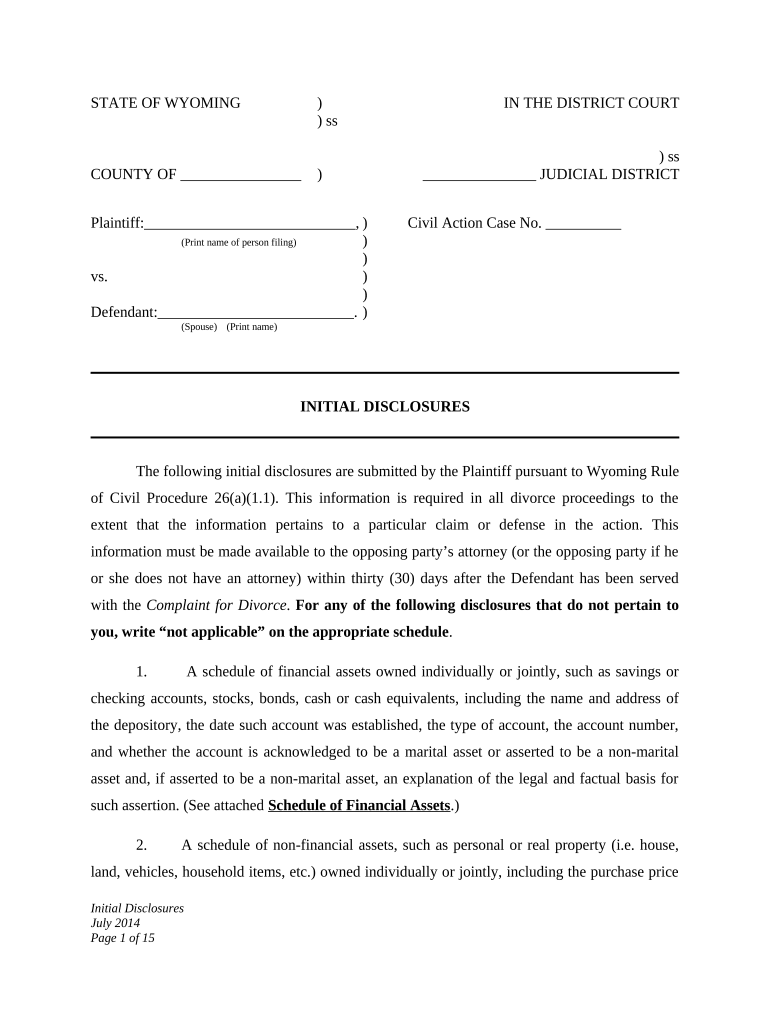
Initial Disclosures
What Initial Disclosures Are and when they apply
Why clear Initial Disclosures matter to case management
Accurate, timely Initial Disclosures reduce disputes about discovery scope, limit sanctions risk, and improve case budgeting by clarifying witnesses, documents, and damages early in the process.
Who prepares and relies on Initial Disclosures
Courts, litigants, and their counsel use Initial Disclosures to exchange foundational case information and to frame subsequent discovery tasks.
- Plaintiffs and defendants who must identify witnesses, exhibits, and damages in civil litigation.
- Defense and plaintiff counsel who coordinate preservation, collection, and production of responsive documents.
- Court clerks and magistrates who monitor compliance with Rule 26 scheduling orders and sanction provisions.
Parties should coordinate internally early, confirm responsibility for document collection, and plan for updates as facts and evidence develop.
Step-by-step sequence for preparing Initial Disclosures
-
01Collect Basics: Confirm party and counsel names, case number, and governing court.
-
02Identify Witnesses: Compile percipient witness names, addresses, and subject areas.
-
03Assemble Documents: Gather and index responsive documents with custodial notes and date ranges.
-
04Prepare Computation: Calculate damages with supporting exhibits and cite calculation method.
Configuring an online disclosure workflow
| Field | Configuration |
|---|---|
| Document Intake | Centralized upload with custodian tags and date-range metadata |
| Reviewer Assignment | Assign attorneys and paralegals with role-based access |
| Version Control | Enable automatic versioning and exportable audit trail |
| Production Format | Export to PDF or native files with load file for e-discovery platforms |
Typical electronic disclosure process from drafting to delivery
-
Draft and Tag: Populate disclosure template and tag exhibits and custodians
-
Internal Review: Legal team reviews, redacts privileged material, and approves
-
Sign and Timestamp: Authorized counsel signs and timestamped certificate is attached
-
Serve and Archive: Serve on parties per local rule and archive audit trail
Technical considerations for eSubmission and signature
Choose a platform that supports required file formats, preserves audit trails, and integrates with your document management systems.
- File Formats: PDF, DOCX, and native formats are commonly required for production and for e-discovery load files
- Integrations: Look for connectors to e-discovery and DMS platforms such as NetSuite, Google Workspace, Box, and Procore
- Authentication: Support for email verification, SMS codes, and advanced signer authentication enables stronger signer attribution
Maintain tamper-evident exports and an immutable audit trail showing signer identity, timestamp, and IP address to support the disclosure record.
Typical eSignature cost factors for preparing and sending Initial Disclosures
| signNow | DocuSign | Adobe Sign | PandaDoc | HelloSign | |
|---|---|---|---|---|---|
| Starting Price | $8/user/mo | $15/user/mo | $14/user/mo | $19/user/mo | $15/user/mo |
| Free Trial | 7-day free trial | Varies by plan | Varies by plan | Varies by plan | Varies by plan |
| Bulk Send | Yes (Business Premium) | Yes | Yes | Yes | No |
| Audit Trail | Yes | Yes | Yes | Yes | Yes |
| HIPAA Compliant | Yes (BAA) | Yes | Yes | No | No |
| Envelope Cap | No envelope cap | 100 envelopes/user/year | Varies by plan | Varies by plan | Varies by plan |
Common risks and potential sanctions for deficient Initial Disclosures
Common preparation pitfalls to avoid
- Relying on vague descriptions like 'all relevant documents' rather than itemized categories.
- Failing to run identity and contact checks for listed witnesses before filing.
- Neglecting to preserve electronic sources tied to disclosed documents and custodians.
- Using inconsistent naming conventions across exhibits and production sets.
Practical tips for accurate, defensible disclosures
Illustrative examples of Initial Disclosures in practice
Federal Civil Case
A party lists three percipient witnesses with subject summaries and attaches a spreadsheet of responsive emails
- The list clearly identifies custodians and date ranges
- The early, organized production reduced motion practice and narrowed deposition topics in subsequent discovery.
Healthcare-Related Suit
A hospital provides an indexed set of medical records and a computation of economic damages
- PHI was handled under a BAA and redactions were logged
- The disclosure minimized meet-and-confer time and clarified privilege assertions for the court.
Frequently asked questions about Initial Disclosures
-
When are Initial Disclosures due?
Under FRCP 26(a)(1), disclosures are generally due 14 days after the parties' Rule 26(f) conference unless the court orders a different schedule.
-
Must disclosures be signed?
Counsel or an authorized party should sign or certify disclosures to attest to their completeness; many courts expect a signature block or counsel certification.
-
Can I send disclosures electronically?
Yes; ESIGN (15 U.S.C. ch. 96) and UETA support electronic records and signatures for most transactions, but follow local rules for service and filing requirements.
-
How do I update disclosures?
Supplement promptly under FRCP 26(e) when new information arises and keep a log of supplementation dates and content changes.
-
What if I identify privileged documents?
Withhold privileged items and provide a privilege log describing each document's date, author, recipient, and the basis for privilege while following court rules on logging.
-
What are preservation obligations?
Implement a litigation hold upon reasonably anticipating litigation and preserve relevant ESI and paper records to avoid spoliation claims and sanctions.