Establishing secure connection…Loading editor…Preparing document…

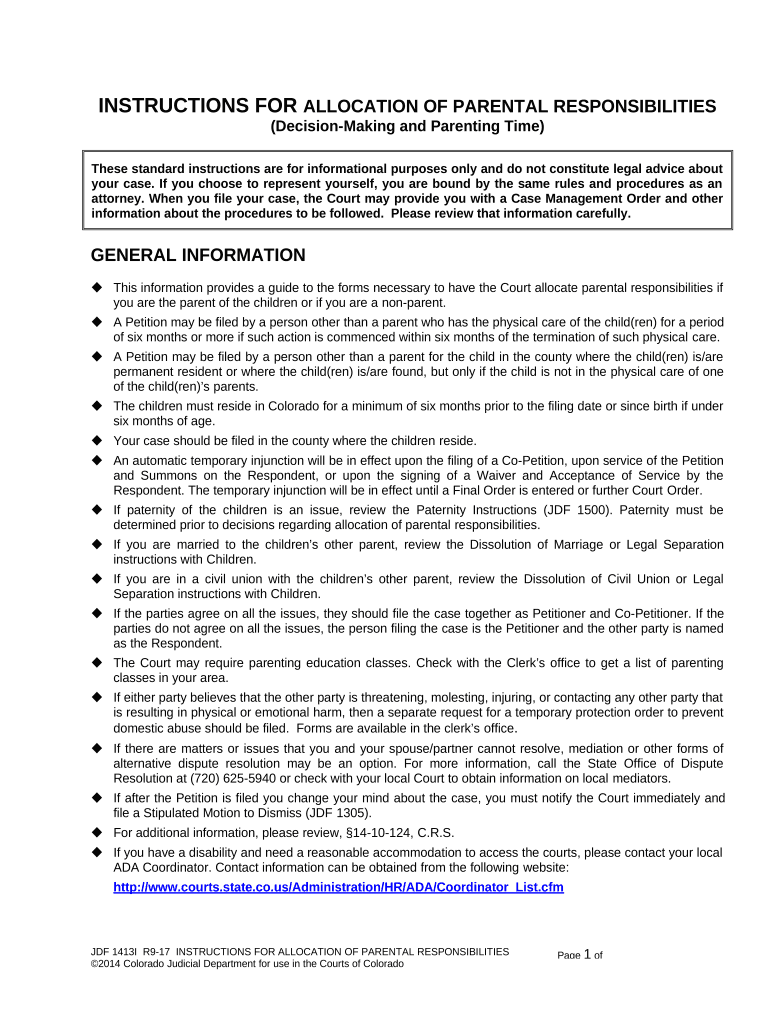
Instructions for Petition for Allocation of Parental Responsibilities

This template is fully customizable. Edit the text, fill out the fields, and send it for signature. Give it a try!
Instructions for Petition for Allocation of Parental Responsibilities

What the Instructions for Petition for Allocation of Parental Responsibilities Cover

The Instructions for Petition for Allocation of Parental Responsibilities explain how to prepare and submit a family law petition asking a court to allocate parental responsibilities, parenting time, and decision-making authority for minor children. They describe required information about the petitioner, respondent, children, proposed parenting schedule, temporary orders, service of process, and supporting exhibits. These instructions also clarify signature, notarization, and filing expectations so the court can accept and process the petition without procedural defects. Follow local court rules in addition to these general instructions.

Why Clear Instructions Matter for Allocation Petitions

Clear, consistent instructions reduce delays, lower the risk of rejection, and help ensure legal issues such as jurisdiction, service, and emergency relief are addressed. Accurate petitions support efficient scheduling of hearings and protect parental rights while limiting avoidable procedural costs.

Why Clear Instructions Matter for Allocation Petitions

Who Typically Prepares and Submits This Petition

Choose the path (self-file, attorney-file, or assisted filing) that matches your circumstances and local court requirements; if in doubt, consult counsel for jurisdiction-specific rules.

  • Self-represented parent preparing initial petition for parenting time and decision-making
  • Family law attorney filing on behalf of a client in contested or uncontested matters
  • Court staff verifying completeness before docketing and scheduling hearings

Step-by-Step: Preparing and Filing the Petition

Follow these sequential steps from completing the form to filing and serving the respondent. Observe local rules on filing fees, document formatting, and required supporting exhibits.

  • 01
    Complete Form: Fill every required field and attach exhibits such as parenting plans and financial affidavits.
  • 02
    Review Local Rules: Confirm page limits, signature/notary requirements, and electronic filing procedures with the county court clerk.
  • 03
    File with Court: File in person or via the court's e-filing portal and pay applicable fees or request a fee waiver.
  • 04
    Serve Respondent: Effect service according to state law (process server, sheriff, or certified mail) and file proof of service.

Overview of the Filing and Case-Management Flow

The petition moves through filing, service, temporary orders, hearings, and final allocation. Each step has specific documentation and timeline expectations.

  • Submission: Court clerk accepts petition, assigns a case number, and issues hearing dates if complete.
  • Service: Respondent must be served and proof filed to confirm jurisdiction and proceed.
  • Temporary Relief: Either party may request temporary orders for custody, support, or exclusive use of residence.
  • Final Hearing: Court hears evidence, considers best interests of the child, and issues final allocation orders.

Configuring an Electronic Workflow for This Petition

Set up a clear e-filing and e-signature workflow to reduce processing time and ensure complete records.

Field Configuration
Document Format PDF/A for court compatibility
Signature Method Electronic signature with audit trail
Authentication Email verification or SMS code
Storage Encrypted retention with indexed metadata

Digital Filing and Authentication Considerations

When using an eSignature provider, ensure it supports court-required evidence such as audit trails, signer authentication, and tamper-evident signed PDFs.

  • Accepted Formats: PDF, PDF/A; some courts require a single combined PDF with exhibits appended.
  • Signer Authentication: Email plus access code is commonly accepted; stronger ID verification may be required for notarized declarations.
  • Remote Notarization: Allowed in many states but subject to state notary rules and court discretion.

Key Timing Points and Deadlines to Track

Monitor filing deadlines and hearing scheduling windows. Timely service and proof of service are critical for jurisdiction and to avoid dismissal.

Filing Date:

Date you submit the petition to the court; starts the procedural timeline.

Service Deadline:

State-dependent; serve promptly to meet hearing schedules and avoid continuances.

Temporary Orders Hearing:

Often scheduled within 10–30 days after filing, depending on local rules.

Final Hearing:

Scheduled per court docket; may be months after initial petition in contested cases.

Requesting Continuances:

File a motion ahead of hearing date per local rules to avoid default outcomes.

Major Case Milestones from Filing to Final Order

These numbered milestones represent a typical sequence; timing varies by county and case complexity.

01

1. File Petition

Petitioner files the petition and pays fees or submits a fee waiver.

02

2. Serve Respondent

Respondent is served and proof of service is filed with the court.

03

3. Temporary Hearing

Court may hold a short hearing for temporary parenting time or protection orders.

04

4. Final Hearing

Court adjudicates contested issues and issues final allocation orders.

Common Pitfalls to Avoid

  • Incomplete child information or incorrect DOBs causing court to request amendments
  • Failure to serve the respondent correctly, resulting in dismissal or delay
  • Omitting required exhibits such as financial affidavits or parenting plans
  • Using improper signature or notarization methods inconsistent with local rules

Consequences of Defective or Incorrect Petitions

Case Dismissal: Petition may be dismissed for procedural defects, delaying relief.
Default Orders: Failure to serve or appear can result in a default order against a party.
Sanctions: Court may impose monetary sanctions for bad-faith filings or frivolous claims.
Enforcement Risk: Orders issued without proper notice may be unenforceable on appeal.
Custody Instability: Incomplete facts can lead to orders that don’t reflect the child’s best interests.
Privacy Exposure: Filing sensitive information without redaction can create long-term privacy issues.

Essential Data Elements and Evidence Required

Petitioner Name: Full legal name
Respondent Name: Full legal name
Child Details: Names and DOBs
Service Information: Method and proof of service
Parenting Proposal: Detailed schedule and decision rights
Supporting Exhibits: Financial affidavits, school records, or safety assessments

Common eSignature Pricing and Feature Comparison for Filing Workflows

Comparing basic pricing, trial availability, bulk-send capability, audit trail, HIPAA compliance, and envelope limits helps determine which vendor aligns with file volume and compliance needs.

signNow DocuSign Adobe Sign PandaDoc HelloSign
Starting Price $8/user/mo $15/user/mo $14/user/mo $19/user/mo $15/user/mo
Free Trial 7-day free trial Varies by vendor Varies by vendor Varies by vendor Varies by vendor
Bulk Send Yes (Business Premium) Yes Yes Yes No
Audit Trail Yes Yes Yes Yes Yes
HIPAA Compliant Yes (BAA available) Yes Yes No No

Practical Examples of How the Petition Is Used

These real-world examples show typical scenarios where allocation petitions structure parental responsibilities and schedules.

County Court Custody Case

A parent files for sole decision-making due to the other parent’s relocation

  • Court schedules temporary hearing within 14 days
  • The petitioner attached a proposed parenting plan, proof of service, and a financial affidavit; the court issued temporary orders pending final hearing with clear instructions on evidence admission.

Contested Parenting Time

Parents dispute school enrollment and medical decision authority

  • Parties attend mediation before the hearing
  • The mediator produced a draft parenting plan which was filed as an exhibit; the court considered the plan and testimony and entered a shared decision-making order with a detailed visitation schedule.

Practical Tips for Accurate and Efficient Petitions

Follow these practical tips to reduce processing time and improve the quality of your submission.

Prepare Exhibits in Order
Append exhibits in the order referenced in the petition and label them clearly for easy judicial review.
Use Consistent Formats
Use MM/DD/YYYY for dates, spell out state names, and avoid P.O. boxes for service addresses when possible.
Proofread Names
Ensure names and DOBs match IDs and school or medical records to avoid identity challenges.
Retain Copies
Keep certified copies of proof of service and all signed orders for enforcement and appeals.

Representative Roles and Responsibilities

Family Law Attorney

Drafts the petition, prepares exhibits, advises on jurisdictional issues and strategy, and represents a party at hearings. The attorney ensures compliance with local court formatting and filing rules and may negotiate temporary orders before court intervention.

Self-Represented Litigant

Completes forms, arranges proper service, and represents themselves at hearings. Self-represented litigants should use court self-help resources, verify notarization requirements, and consider limited-scope attorney review for complex issues.

Frequently Asked Questions and Troubleshooting

Answers to common procedural and technical questions about preparing, signing, and filing the petition, including e-signature and notarization concerns.


Need help? Contact support

be ready to get more
Join over 28 million airSlate SignNow users