Establishing secure connection…Loading editor…Preparing document…

Assignment of Intellectual Property and License Agreement

This template is fully customizable. Edit the text, fill out the fields, and send it for signature. Give it a try!
Assignment of Intellectual Property and License Agreement

What this Assignment of Intellectual Property and License Agreement is

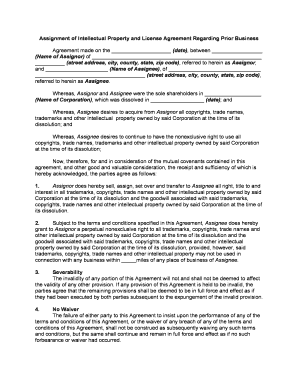
An Assignment of Intellectual Property and License Agreement transfers ownership or grants rights in intellectual property (IP) from one party to another and, where applicable, creates a license for continued use. Typical subject matter includes copyrights, patents, trademarks, trade secrets, and software code. The document defines the scope of rights transferred, any retained rights or licenses, effective date, consideration, and representations and warranties. It is commonly used in acquisitions, contractor engagements, employment-related IP transfers, and technology licensing to establish clear title and permitted uses of the IP.

Why a clear assignment and license matters

A properly drafted Assignment of Intellectual Property and License Agreement prevents ownership disputes, clarifies permitted uses, and records consideration. It reduces litigation risk, supports enforcement of rights, and enables accurate reporting for tax and corporate governance.

Why a clear assignment and license matters

Typical parties and situations for this agreement

Common users include technology companies, law firms, startups, acquirers, contractors, and in-house legal teams handling IP transfers or licensing.

  • Startups and founders transferring or vesting rights during fundraising or acquisition.
  • Employers documenting work-for-hire and assignment from employees or contractors.
  • Buyers and acquirers taking assignment of patent or copyright portfolios.

Use this agreement whenever ownership, use limits, or enforcement of IP rights must be made clear and evidentiary.

Core elements to include in a professional IP assignment and license

A complete document combines transfer language with operational terms so parties understand ownership, scope, and ongoing rights.

Assignment Clause

Clear present transfer of ownership, including identification of the specific IP being assigned and any required execution language that evidences the conveyance.
License Grant

If rights are retained, specify exclusive or non-exclusive license scope, territory, field of use, sublicensing rights, and duration with precise boundaries.

Consideration

State the monetary amount, equity, or other consideration exchanged for the assignment or license and any payment schedule or escrow terms.

Representations & Warranties

Seller assurances on title, authority to assign, no conflicting agreements, and absence of encumbrances or third-party claims.

Further Assurances

Obligation for the assignor to execute additional documents or record assignments (for patents/trademarks) to perfect title.

Confidentiality & IP Maintenance

Who bears prosecution costs, maintenance fees, and how confidential information and trade secrets are protected post-transfer.

Step-by-step: executing a valid assignment and license

Follow a consistent sequence to maintain enforceability and facilitate downstream recording or licensing.

  • 01
    Draft or Review: Prepare or have counsel review terms tailored to the IP type and commercial goals.
  • 02
    Identify Signatories: Confirm authorized officers or individuals who can legally bind each party.
  • 03
    Sign and Date: Execute with signatures and dates; include witness or notarization if required.
  • 04
    Recordation and Delivery: Deliver copies and record with appropriate registry (if applicable) to perfect rights.

How to set up a secure online workflow for this agreement

Configure your e-signature workflow to match signing order, authentication, and recordkeeping requirements.

Field Configuration
Signing Order Sequential or parallel based on negotiation and approvals.
Authentication Level Email + SMS or higher (KBA/ID) for sensitive transfers.
Attachment Requirements Include exhibits listing IP identifiers or schedules.
Audit Trail Capture timestamps, IP, signer identity, and consent record.

Where to send, record, and deliver the signed agreement

After execution, route documents to internal stakeholders and record with registries where required.

  • Internal Records: Retain originals in corporate records and finance departments.
  • Counsel and IP Counsel: Send signed copies to outside or in-house counsel for review and filing.
  • Registrar Filing: Record with USPTO or applicable trademark office when required.
  • Counterparty Delivery: Provide executed PDF copies with certificate of completion to all parties.

Digital signing considerations and platform needs

Choose a platform that supports secure signatures, audit trails, and compliance requirements for IP transfers.

  • Audit Trail: Detailed signing history and metadata.
  • Authentication: Email, SMS, or advanced verification.
  • File Formats: PDF and DOCX preservation options.

Ensure the platform retains reproducible records and allows export of signed documents and certificate data for legal and tax audits.

Practical tips to reduce disputes and ensure enforceability

Adopt consistent drafting and execution practices to support title and reduce downstream challenges.

Be specific about the assets
Identify IP clearly by registration numbers, application numbers, or exhibit schedules to avoid ambiguity about what is assigned.
Confirm signatory authority in writing
Obtain corporate resolutions or officer certificates showing the signer has power to assign IP on behalf of a legal entity.
Use further-assurance language
Include an obligation for the assignor to execute additional documents necessary to perfect title or record assignments.
Preserve audit evidence
Keep signed PDFs, audit trails, and related correspondence to demonstrate intent, consent, and attribution for ESIGN/UETA compliance.

Short risks and legal consequences to watch for

Unclear title: Ownership disputes
Incomplete execution: Assignments unenforceable
Missing recordation: Third-party claims
Tax implications: Unexpected liabilities
Confidentiality breach: Trade secret exposure
Litigation cost: High defense expense

Common drafting and execution mistakes to avoid

  • Using vague descriptions like 'all rights' without schedules which invites disputes over scope and future works.
  • Failing to secure necessary corporate approvals or officer signatures when a legal entity assigns IP rights.
  • Omitting further-assurances clauses and thereby preventing efficient recordation of assignments in registries.
  • Relying on informal email consent instead of a signed record that satisfies ESIGN/UETA intent and attribution.

Security and compliance elements to document and verify

Encryption: TLS 1.2/1.3 and AES-256
E-sign law: ESIGN (15 U.S.C. ch. 96) and UETA compliance
HIPAA readiness: BAA available if PHI involved
Audit trail: Timestamped signing events
Certifications: SOC 2 Type II, ISO 27001
Accessibility: WCAG 2.0 Level AA

Real-world examples of online execution and workflow

These examples illustrate how organizations executed IP transfers and streamlined signature capture using electronic workflows.

Optica Ventures LLC

Optica used a simple online execution process to assign rights and close deals quickly

  • "The interface is simple and easy-to-use for our team; more importantly, it is just as easy for our customers."
  • Post-execution, they retained comprehensive audit trails and reduced turnaround time for assignment filings and investor due diligence.

Xerox (NetSuite Ops)

Xerox integrated signing into enterprise systems for assignments and licenses

  • "airSlate SignNow provides us with the flexibility needed to get the right signatures on the right documents."
  • The integration ensured consistent templates, centralized storage, and reliable evidence of execution for corporate recordkeeping.

Key timing considerations when preparing and recording an assignment

Timing affects perfection of title, tax reporting, and contractual obligations; address dates clearly in the agreement.

Effective Date:

Typically the execution date or a mutually agreed date in MM/DD/YYYY format.

Recordation Timing:

Record assignments with registries promptly to protect against subsequent encumbrances; specific deadlines vary by office.

Tax Reporting:

Reflect consideration on the relevant tax period and consult counsel for reporting implications.

Maintenance Payments:

Coordinate payment dates for patent maintenance or trademark renewals post-transfer.

Contractual Notice:

If the assignment triggers notices to third parties, include deadlines for providing those notices.

eSignature platform comparison for executing IP assignments

Compare starting prices and core capabilities relevant to secure execution and recordkeeping for Assignment of Intellectual Property and License Agreement workflows.

signNow DocuSign Adobe Sign PandaDoc HelloSign
Starting Price $8/user/mo $15/user/mo $14/user/mo $19/user/mo $15/user/mo
Free Trial 7-day free trial Varies by vendor Varies by vendor Varies by vendor Varies by vendor
Bulk Send Yes Yes Yes Yes No
Audit Trail Yes Yes Yes Yes Yes
HIPAA Compliant Yes Yes Yes No No

Frequently asked questions about assignments, licensing, and e-signing

Answers to common execution and enforceability questions for Assignment of Intellectual Property and License Agreement.


Need help? Contact support

be ready to get more
Join over 28 million airSlate SignNow users