Establishing secure connection…Loading editor…Preparing document…

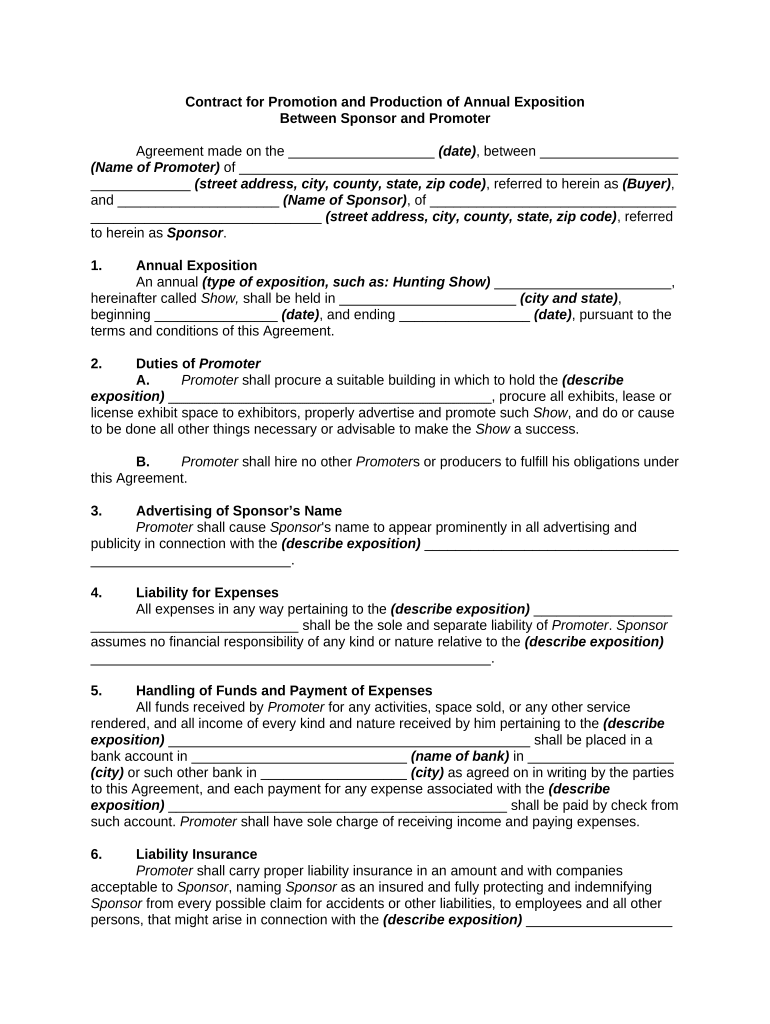
Contract for Promotion and Production of Annual Exposition

This template is fully customizable. Edit the text, fill out the fields, and send it for signature. Give it a try!
Contract for Promotion and Production of Annual Exposition

What this Contract Covers and When it’s Used

The Contract for Promotion and Production of Annual Exposition is a written agreement that sets out roles, deliverables, schedules, budgets, intellectual property rights, insurance and payment terms between an event promoter/producer and the exposition owner or sponsor. It allocates responsibilities for marketing, vendor management, site production, health and safety compliance, and revenue share or sponsorship income. Typical uses include annual trade shows, community expos, festivals and sponsored exhibitions where a promoter is engaged to manage promotion, logistics and on-site production for a defined term and scope.

Why a Formal Promotion and Production Contract Matters

A clear contract reduces ambiguity about who provides marketing, vendor coordination, exhibitor services, production labor and permitting, and it sets payment, cancellation and liability rules. It protects both parties by documenting performance milestones, insurance requirements, indemnities and IP ownership for promotional materials.

Why a Formal Promotion and Production Contract Matters

Who Typically Prepares and Signs This Agreement

Use this contract when the exposition involves paid sponsors, third-party vendors, or when attendance, revenue sharing or third-party liabilities exceed routine limits.

  • Event Promoters and Producers — Companies or individuals contracted to plan, market and operate the exposition.
  • Venue Owners and Managers — Entities providing the physical site and coordinating site services and permits.
  • Corporate Sponsors and Exhibitors — Organizations that pay for presence or marketing and require contract protections.

Primary Signatories and Their Roles

Promoter — CEO

The promoter’s authorized signatory accepts operational responsibility for marketing, vendor contracting, staffing and production delivery. The signatory must have authority to bind the promoter on payment, indemnity and insurance commitments and to approve budget line items during the event lifecycle.

Venue Owner — Director

The venue owner or sponsor signs to confirm facility access, local permits, site services, and indemnities affecting facility operations. The venue signer should be authorized to accept venue-specific insurance limits and closing procedures.

Step-by-Step: Completing the Contract

Follow these steps in order to prepare, review and execute the contract efficiently.

  • 01
    Draft Scope: Define services, deliverables and milestones clearly.
  • 02
    Allocate Costs: List fees, deposits, expense caps and payment schedule.
  • 03
    Assign Risk: Specify insurance, indemnities and limits of liability.
  • 04
    Sign and Retain: Obtain authorized signatures and store executed copies securely.

Typical Workflow from Proposal to Signed Agreement

A common transaction flow reduces missed items and aligns expectations across teams.

  • Proposal: Promoter submits detailed service proposal and budget.
  • Negotiation: Parties revise scope, schedule and payment terms.
  • Approval: Authorized signatories approve final contract text.
  • Execution: Parties sign, exchange copies and begin performance.

Online Workflow Configuration for This Contract

Configure a digital workflow that matches the contract’s approval order and required fields.

Field Configuration
Signing Order Sequential: Promoter → Venue → Sponsor
Required Fields Effective Date, Fee Items, Insurance Attachments
Authentication Email + optional SMS code for higher assurance
Attachments Vendor certificates, permits, rider documents

Delivery and Signing Options — Digital and In-Person

Ensure the chosen method meets state notarization rules and the contract’s authentication standard, and retain records in searchable format for the retention period.

  • Email + eSignature: Standard route for interstate agreements; preserves an audit trail and timestamps.
  • Remote Online Notary (RON): Use where notarization is required and state law permits permanent RON with identity proofing.
  • In-Person Notary: Use when witnesses or local notarization are mandatory under state law.

Essential Contract Clauses to Include

A professional contract should include concise, enforceable clauses covering performance, payments, and legal protections.

Scope of Work

Describe marketing, production, exhibitor management and reporting deliverables, including specific timelines and measurable outcomes.
Payment and Fees

Detail deposit amounts, milestone payments, expense reimbursement and conditions for withholding or set-off.

Cancellation Policy

State refund mechanics, force majeure treatment and rescheduling options with associated fees.

Insurance and Indemnity

Specify minimum insurance limits, naming requirements and mutual indemnification where appropriate.

Intellectual Property

Allocate ownership of promotional materials and grant any necessary licenses for images, recordings and branding use.

Governing Law

Identify the controlling state law and dispute resolution method (court or arbitration).

Key Data and Compliance Items to Record

Party Legal Names: Full legal entities
Tax ID: EIN or SSN as required
Insurance Certificates: Provider and policy numbers
Permits Attached: Local event and health permits
Payment Schedule: Deposit and balance dates
Signature Audit: Timestamp and signer identity

Common Consequences of an Incomplete or Incorrect Contract

Payment Disputes: Late or vague payment terms invite claims and delayed collections
Liability Gaps: Missing insurance clauses can expose parties to uninsured losses
Permit Violations: Absent permit responsibility can result in fines and event shutdown
IP Ownership: Unclear IP terms lead to disputes over recordings and promotional content
Tax Reporting: Incorrect payee details hamper 1099 reporting and may trigger backup withholding
Breach Remedies: Lack of liquidated damages or termination rights complicates recovery

Frequent Preparation Mistakes to Avoid

  • Vague deliverables that leave scope creep unresolved and cause cost overruns.
  • Omitting insurance limits or failing to require certificates naming the venue as additional insured.
  • Missing deadlines for permits or vendor deposits, leading to cancellations or lost deposits.
  • Failing to confirm signer authority, which can render the agreement unenforceable.

Key Dates and Deadlines to Track

Track milestones tied to marketing and logistics to avoid service gaps and penalty exposure.

Effective Date:

Date when obligations commence and timelines begin.

Deposit Due:

Date deposit is payable to secure services or venue.

Permit Application:

Deadline for filing local permits to avoid fines.

Final Payment:

Date final balance is due before event opening.

Post-Event Reports:

Deadline for delivery of attendance, revenue and reconciliation reports.

Milestone Timeline from Contract to Event Close

A sequenced timeline helps cross-functional teams manage approvals, procurement and on-site setup.

01

Contract Execution

Both parties sign and exchange fully executed copies to start obligations.

02

Permitting and Insurance

Submit permits and insurance certificates in advance of setup dates.

03

Vendor Onboarding

Confirm exhibitor contracts, booth assignments and technical requirements.

04

Event Production

On-site setup, execution of scheduled programming and immediate post-event reconciliation.

eSignature Vendor Comparison for Executing This Contract

Compare basic plan pricing and essential capabilities for electronic execution. signNow is listed first per comparison convention.

signNow DocuSign Adobe Sign PandaDoc HelloSign
Starting Price $8/user/mo $15/user/mo $14/user/mo $19/user/mo $15/user/mo
Free Trial 7-day free trial Varies by vendor Varies by vendor Varies by vendor Varies by vendor
Bulk Send Yes Yes Yes Yes No
Audit Trail Yes Yes Yes Yes Yes
HIPAA Compliant Yes Yes Yes No No

Real-World Examples of Contract Use

These examples illustrate how organizations applied standardized contracts to speed approvals and clarify responsibilities.

Optica Ventures

Optica used a standardized production agreement to centralize exhibitor obligations and deadlines, reducing scheduling conflicts.

  • Key point: simplified exhibitor onboarding.
  • Brian Fitzgibbons, COO, said the interface is simple and easy-to-use for their team and customers, enabling efficient execution and fewer follow-ups after signature.

Martin Properties

A small promoter adopted an online contract to collect deposits and insurance documents before permitting, reducing on-site hold-ups.

  • Key point: upfront verification cut setup delays.
  • Tim Martin noted he could process and execute documents online with 100% compliance and get forms back efficiently.

Frequently Asked Questions and Troubleshooting

Answers to common execution and compliance questions for this contract type.


Need help? Contact support

be ready to get more
Join over 28 million airSlate SignNow users