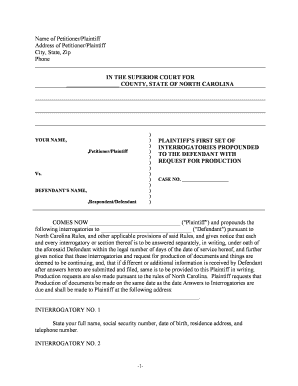
North Carolina Plaintiff's First Set of Interrogatories
What the North Carolina Plaintiff's First Set of Interrogatories Is
Why Use a Standardized First Set of Interrogatories
Using a clear, compliant first set of interrogatories helps identify key facts, narrow issues early, and build a factual record while preserving evidentiary leads for depositions or motions to compel.
Who Prepares and Responds to These Interrogatories
Typical users prepare and serve interrogatories as part of litigation discovery to obtain admissions, identify witnesses, and request supporting facts and documents.
- Plaintiff attorneys assembling factual assertions and targeted questions for the defendant to answer under oath.
- Paralegals and litigation assistants preparing exhibits, compiling documents, and tracking service and response deadlines.
- Discovery vendors or litigation support teams organizing searchable responses and producing documents in native or PDF formats.
Responses are usually prepared by counsel for the responding party; if electronic signing and secure transmission are used, retain authentication and audit records to support admissibility.
Step-by-Step: How to Draft and Serve the First Set
-
01Draft questions: Create clear, numbered interrogatories tied to your theory of the case.
-
02Attach exhibits: Label and attach any documents referenced in the questions.
-
03Serve parties: Serve the defendant according to local rules and proof of service requirements.
-
04Track deadline: Calendar the response due date and follow up on late or deficient answers.
How Discovery Flow Typically Proceeds After Service
-
Service: Interrogatories are served on counsel or the party per rules.
-
Response Period: Respondent prepares answers or objections within the allowed time.
-
Supplementation: Parties must supplement responses if new information arises.
-
Enforcement: Motion to compel or meet-and-confer if answers are evasive.
Digital Setup: Recommended Workflow Settings for Online Completion
| Field | Configuration |
|---|---|
| Signer Authentication | Email + SMS code or stronger depending on sensitivity |
| Document Format | Use PDF/A for retention and compatibility |
| Audit Trail | Enable IP, timestamp, and action logs |
| Access Control | Restrict downloads to named parties only |
Technical Requirements for Electronic Signing and Submission
Choose a platform that captures a robust audit trail, supports common document formats, and meets your jurisdiction's e-signature standards.
- File Types: PDF, DOCX supported
- Integrations: Works with Google Workspace and Microsoft 365
- Security: TLS and AES encryption
Ensure the chosen provider supports export of certificate-of-completion records, preserves timestamps, and offers administrative controls for legal hold and audit requests.
Key Deadlines and Timing Expectations
Standard Response Time:
Typically 30 days after service under Rule 33 (Fed. R. Civ. P.)
Extended Deadlines:
Court orders or stipulations may change response timeframes
Supplementation Window:
Supplement prior answers as new information arises
Motion Practice:
Meet-and-confer required before filing a motion to compel in many jurisdictions
Service Proof:
Retain proof of service and delivery receipts
Milestones: From Service to Resolution
Serve Interrogatories
Plaintiff serves the first set on defense counsel or party.
Acknowledgement of Service
Confirm receipt and method of service in writing.
Responses Due
Respondent must answer or object by the deadline.
Enforce or Supplement
Meet-and-confer, then motion to compel if necessary.
Common Pitfalls to Avoid When Preparing Interrogatories
- Overbroad or compound questions that invite boilerplate objections and motions to strike.
- Failing to attach or label exhibits referenced in a question, causing confusion in responses.
- Not calendaring deadlines or assuming electronic delivery equals legal service without rule verification.
- Using ambiguous definitions or undefined terms that create avoidable disputes at meet-and-confer.
Risks and Court Remedies for Deficient Answers
Comparison: eSignature Pricing and Compliance for Discovery Workflows
| signNow | DocuSign | Adobe Sign | PandaDoc | HelloSign | |
|---|---|---|---|---|---|
| Starting Price | $8/user/mo | $15/user/mo | $14/user/mo | $19/user/mo | $15/user/mo |
| Free Trial | 7-day free trial, no card | Trial available | Trial available | Free limited plan | Free limited plan |
| Bulk Send | Yes | Yes | Yes | Yes | No |
| Audit Trail | Yes | Yes | Yes | Yes | Yes |
| HIPAA Compliant | Yes | Yes | Yes | No | No |
Real-World Examples: How Plaintiffs Use Interrogatories
Commercial Contract Dispute
A plaintiff used targeted questions to identify invoice discrepancies and accounting witnesses.
- The defendant produced underlying ledgers.
- Answers and documents supported a focused deposition that resolved key damages issues pretrial through summary judgment briefing.
Personal Injury Claim
Interrogatories sought prior medical history and witness contact details.
- Defendant objected to overbreadth.
- Meet-and-confer narrowed scope, produced records, and enabled the plaintiff to prepare for a substantive medical deposition and settlement negotiations.
Best Practices for Drafting and Managing Interrogatories
Frequently Asked Questions About North Carolina Plaintiff's First Set of Interrogatories
-
When must answers be served?
Answers are generally due within the time specified by the governing rule (often 30 days from service). Check the Federal Rules (Rule 33) or the North Carolina Rules of Civil Procedure for any case-specific order altering the deadline.
-
Can you object to an interrogatory?
Yes. State specific, not boilerplate, objections and state the grounds. If an objection is asserted, the responding party should still answer as to any non-privileged portion and preserve objections for meet-and-confer or court resolution.
-
Are electronically signed responses valid?
Electronic signatures are permissible under ESIGN and UETA when intent and attribution are clear; preserve audit trails and authentication records to support admissibility.
-
What if responses are incomplete?
Meet-and-confer first. If unresolved, file a motion to compel and seek costs and fees for the deficiency under applicable discovery rules.
-
Do interrogatories require notarization?
Interrogatory answers typically require verification by the responding party rather than notary acknowledgement; follow local rule verification language and signature requirements.
-
How to amend answers after service?
Supplemental answers should be served promptly upon discovery of new information; label supplements clearly and preserve prior versions.