Establishing secure connection…Loading editor…Preparing document…

Mississippi Motion for Continuance

This template is fully customizable. Edit the text, fill out the fields, and send it for signature. Give it a try!
Mississippi Motion for Continuance

What the Mississippi Motion for Continuance Is and when it’s used

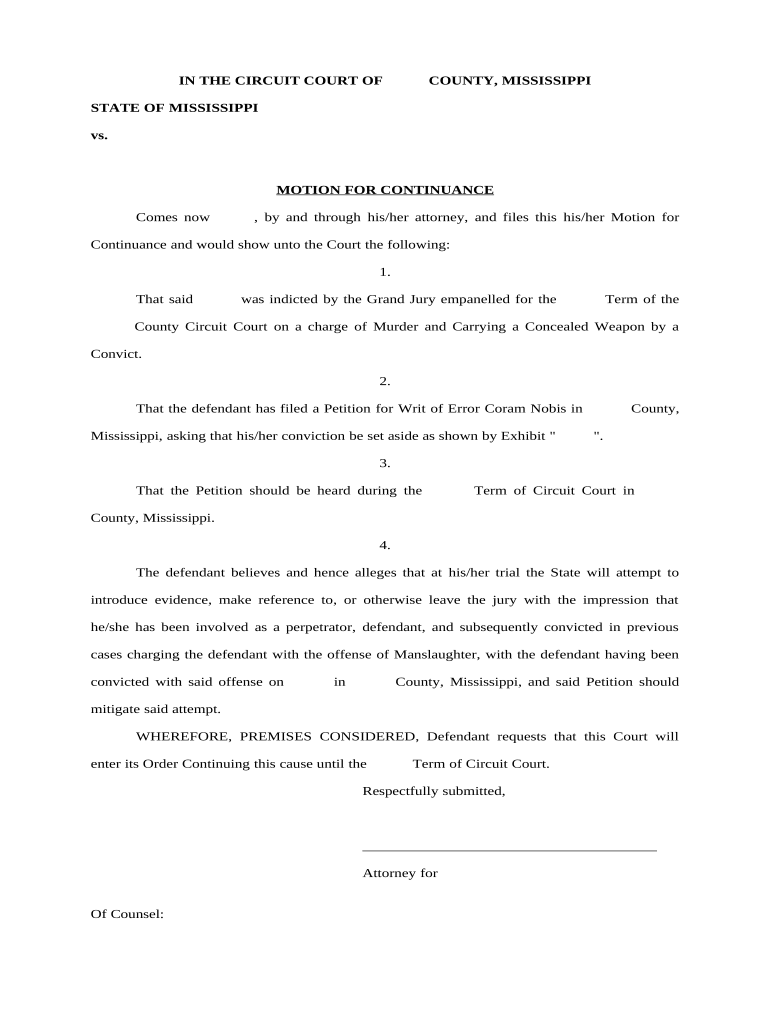
A Mississippi Motion for Continuance is a formal written request filed with a Mississippi court asking for a postponement of a scheduled hearing, trial, or other court appearance. It explains why the moving party cannot reasonably proceed on the current date and requests a new date. Motions for continuance are governed by local court rules and the Mississippi Rules of Civil Procedure; they typically require a statement of facts, any supporting exhibits, and proof of service on other parties. Courts assess prejudice, diligence, and scheduling impact when ruling on continuance requests.

Why filing a properly prepared Motion for Continuance matters

A clear, compliant motion preserves a party’s right to preparation and ensures the court can consider scheduling fairness and prejudice before proceeding.

Why filing a properly prepared Motion for Continuance matters

Who typically prepares and files this motion

The court and opposing counsel evaluate diligence, prejudice, and alternative scheduling options when deciding the motion.

  • Trial attorneys requesting additional discovery or expert preparation.
  • Pro se litigants seeking extra time to obtain counsel or documents.
  • Government counsel or prosecutors coordinating witness availability.

Primary signers and submitters

Attorney — Movant

Lead counsel drafts the motion, attaches supporting affidavits or exhibits, certifies service on adverse parties, and signs under penalty of perjury when required by Mississippi procedure.

Pro Se Litigant

An unrepresented party may prepare and sign the motion personally; courts expect clarity, local rule compliance, and proper proof of service even when the filer lacks counsel.

Step-by-step: preparing and filing a Mississippi Motion for Continuance

Follow these sequential steps to prepare a motion that a Mississippi court can evaluate efficiently.

  • 01
    Draft Motion: State the case caption, hearing date, facts, and specific continuance requested.
  • 02
    Attach Support: Include affidavits, scheduling conflicts, or medical documentation as appropriate.
  • 03
    Certificate of Service: Add a certificate showing how and when opposing parties were served.
  • 04
    File with Clerk: File per local court procedure and obtain a stamped copy for records.

Configuring an online workflow for the motion

Set up electronic routing and required fields to streamline completion, signing, and filing.

Document Template Create a reusable motion template with locked caption and common paragraphs.
Required Fields Mark hearing date, requested date, and grounds as mandatory entries.
Signer Order Route to counsel first, then to pro se parties or co-counsel as needed.
Authentication Use email verification or multi-factor for signer attribution.
Retention Setting Enable audit trail and archival for court compliance.

Technology considerations for e-completion and e-filing

Choose a platform that supports PDF and Word uploads, audit trails, and secure signer authentication for legal filings.

  • File Formats: PDF and DOCX accepted.
  • Signer Authentication: Email, SMS, or advanced MFA.
  • Integrations: Connect to court e-filing or case management.

Confirm the court’s electronic filing requirements before submitting; not all Mississippi courts accept identical e-filing formats or e-signature methods.

How e-signing and e-submission typically flows

A simple online process can collect signatures, preserve an audit trail, and produce a certified PDF for filing.

  • Upload Document: Start with your motion template or a draft filed document.
  • Place Fields: Add signature, date, and text fields for required entries.
  • Authenticate Signers: Select email code or stronger verification for each signer.
  • Export for Filing: Download signed PDF with an audit certificate for the court clerk.

Key elements to include in a professional Motion for Continuance

Include these components to make the motion clear, procedurally complete, and persuasive to the court.

Case Caption

Full court name, docket number, and party names must match prior filings exactly so the clerk and judge can identify the matter without ambiguity.
Statement of Facts

Concise factual recitation describing the conflict or reason for the continuance, demonstrating diligence and tying facts to the requested relief.

Specific Request

State the exact continuance sought (length or new date) and explain why a particular timeframe is necessary or reasonable.

Supporting Evidence

Attach affidavits, medical notes, scheduling emails, or other exhibits that substantiate the grounds for the requested postponement.

Certificate of Service

A clear service statement identifies recipients, method, and date — essential to preserve notice and comply with local rules.

Proposed Order

Include a proposed order the judge can sign to expedite relief and reduce clerical work for the court.

Downloads, exports, and supporting documents to attach

Prepare file-ready attachments and choose export formats that courts accept when e-filing or delivering paper copies.

Signed PDF

Produce a flattened PDF with an embedded audit trail or certificate for submission to the clerk.

Proposed Order

Provide a separate proposed order in editable format so the court can modify and sign if appropriate.

Affidavits / Exhibits

Combine supporting affidavits and documentary evidence into a single exhibit file with clear labels and exhibit tabs.

Certificate of Service

Attach a signed certificate showing service details for every opposing party and interested entity.

Essential information to include on the motion

Case Caption: Court name and docket
Movant Name: Full legal name
Hearing Date: Original hearing date
Requested Date: Proposed new date
Grounds Stated: Concise explanation
Service Statement: Method and date served

Common errors that delay or defeat a continuance request

  • Failing to attach supporting evidence or affidavit explaining the basis for the continuance can lead to a swift denial by the judge.
  • Omitting a certificate of service or serving parties late undermines notice and can result in refusal to consider the motion.
  • Requesting an unspecified continuance without proposing alternative dates or showing diligence often appears speculative and is frequently denied.
  • Using inconsistent captions, incorrect docket numbers, or unsigned motions causes clerks to reject filings or return them for correction.

Consequences of filing an inadequate or untimely motion

Denial of Motion: Court may refuse the requested postponement
Proceeding Anyway: Hearing or trial may proceed without the movant
Sanctions: Judge can impose sanctions for bad-faith filing
Evidence Exclusion: Important evidence may be excluded if deadlines missed
Default Risk: Default judgment risk in extreme cases
Cost Awards: Court may award fees to opposing party

Timing considerations and typical deadlines

Local rules set filing and service deadlines for motions; check county or circuit rules for exact lead times.

Advance Filing:

File as soon as conflict arises; many courts expect notice days before hearing.

Service Deadline:

Serve opposing parties promptly; some courts require same-day or within specified local rule periods.

Response Time:

Opposing parties may respond; time to respond follows local motion practice rules.

Hearing Scheduling:

Judge may set a hearing; provide calendar availability when requesting continuance.

Emergency Motions:

For urgent matters, request expedited consideration and explain urgency in the motion.

Key milestones from filing to court decision

Track these milestones so you can meet service, response, and hearing obligations without last-minute surprises.

01

Prepare Motion

Draft and attach evidence supporting the continuance.

02

Serve Parties

Deliver the motion and certificate of service to all required recipients.

03

Court Review

Judge or clerk reviews motion and may schedule a hearing.

04

Ruling Issued

Court grants, denies, or modifies the requested continuance.

eSignature vendor snapshot for court documents and legal filings

Compare common plan features and starting prices; select a vendor based on required compliance (HIPAA, court acceptance) and bulk-volume needs.

signNow DocuSign Adobe Sign PandaDoc HelloSign
Starting Price $8/user/mo $15/user/mo $14/user/mo $19/user/mo $15/user/mo
Free Trial Yes, 7-day trial No No Yes, limited Yes, limited
Bulk Send Yes Yes Yes Yes No
Audit Trail Yes Yes Yes Yes Yes
HIPAA Compliant Yes Yes Yes No No

Practical examples: when a continuance may be granted

Two common contexts show how motions for continuance are used and evaluated in practice.

Civil Trial Scheduling

A party discovers a key expert cannot attend on the scheduled trial date and files promptly

  • Expert availability is documented and alternative dates proposed
  • The court favors motions showing diligence and minimal prejudice to other parties, frequently rescheduling when discovery or expert testimony is essential.

Family Law Hearing

One party becomes suddenly hospitalized and the movant files with medical documentation

  • Certificate of service provided to opposing counsel
  • Family courts often grant short continuances for health emergencies when notice is timely and the movant proposes reasonable alternatives.

Practical tips for accurate and efficient motion preparation

Follow these practices to reduce the likelihood of denial and speed court processing.

Check Local Rules First
Before drafting, verify county or circuit court motion practices, required lead times, and preferred filing formats to prevent clerical rejection.
Be Specific and Concise
State precise dates and reasons; avoid vague language. Courts prefer motions that explain what was done to avoid delay and show minimal prejudice.
Attach Proof
Provide affidavits, emails, or medical statements that corroborate the request. Documentary proof materially improves the chance of success.
Propose Solutions
Offer concrete alternative dates and explain how counsel will avoid future conflicts to demonstrate good faith and cooperation.

Frequently asked questions about the Mississippi Motion for Continuance

Answers to common procedural and practical questions when preparing and filing a continuance motion in Mississippi courts.


Need help? Contact support

be ready to get more
Join over 28 million airSlate SignNow users