Establishing secure connection…Loading editor…Preparing document…

Tennessee Plaintiff's First Set of Interrogatories

This template is fully customizable. Edit the text, fill out the fields, and send it for signature. Give it a try!
Tennessee Plaintiff's First Set of Interrogatories

What the Tennessee Plaintiff's First Set of Interrogatories Is

The Tennessee Plaintiff's First Set of Interrogatories is a formal discovery document served by a plaintiff in a civil case to obtain written answers from a defendant. It typically follows the complaint and initial disclosures and requests specific factual information, identification of witnesses, and documents relevant to claims. Answers must be provided within the time allowed by court rules or local practice; objections must be stated with particularity. Interrogatories are governed by the applicable rules of civil procedure and are often used to narrow issues, preserve testimony, and prepare for depositions or motions.

Why a Well‑Prepared Set of Interrogatories Matters

A precise first set of interrogatories focuses discovery, reduces surprises, and creates a written record of an opponent's positions and factual responses. Clear, properly numbered questions limit objections and speed case preparation while preserving issues for motion practice or settlement discussions.

Why a Well‑Prepared Set of Interrogatories Matters

Who Prepares and Responds to Interrogatories

Plaintiffs' counsel prepares the first set; defendants and their counsel must respond or object within deadlines.

  • Plaintiff's attorney or paralegal prepares targeted questions to support claims and frame issues for trial.
  • Defense counsel reviews each interrogatory, asserts appropriate objections, and provides full or partial answers when required.
  • Pro se litigants must follow the same procedural rules; courts generally apply identical timing and form requirements.

Accurate drafting and timely responses reduce procedural disputes and conserve court time and client expense.

Essential Parts of a Professional First Set of Interrogatories

A professional first set of interrogatories is organized, numbered, and anchored to claims or defenses so each question is clear, limited in scope, and relevant.

Caption

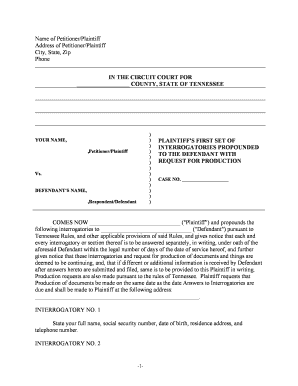
Case caption and court identification must appear at the top so the document is properly filed and linked to the pending case and docket number.
Definitions

Concise definitions and instructions (e.g., 'document', 'communication', date ranges) reduce ambiguity and prevent broad fishing objections.

Interrogatory Text

Each interrogatory should be numbered, single‑questioned where possible, and narrowly tailored to relevant facts, witnesses, dates, or transactions.

Requests for Identification

Common interrogatories ask for identities of persons with knowledge, custodians of documents, and insurance coverage information.

Document Cross‑references

Where documents are requested, identify documents by Bates range or production category and request custodial or transactional detail.

Signature Block

Include counsel signature, contact information, and date; certify the good‑faith nature of requests consistent with professional rules.

Required Data Elements and Short Form Fields

Case Caption: Court, party names
Docket Number: Case identifier
Serve Date: Date served
Definitions Section: Scope language
Interrogatory Numbers: Sequential IDs
Signature: Counsel contact

Step-by-Step: Drafting and Serving the First Set

Follow these sequential steps to draft, finalize, and serve interrogatories consistent with Tennessee practice and federal or local rules.

  • 01
    Prepare Draft: Identify issues, limit scope to relevant facts.
  • 02
    Define Terms: Include clear definitions and date ranges.
  • 03
    Number Questions: Use consecutive numbering and avoid compound questions.
  • 04
    Serve Properly: Serve per local rules and note the service date.

Customizing an Online Interrogatory Workflow

Set up a repeatable online workflow to draft, review, sign, and store interrogatories while preserving a clear audit trail and version history.

Field Configuration
Document Template Create a reusable template with fixed caption and placeholders.
Collaborative Reviews Enable tracked comments and role-based editing before finalizing.
eSignature & Certificate Require counsel signatures and capture timestamped audit trail.
Archival Storage Save executed versions to a secure repository with retention tags.

Where to File or Send Interrogatories in Practice

Interrogatories are typically served directly on opposing counsel; some courts also require a courtesy filing or docket entry. Follow local procedure.

  • Service to Opponent: Deliver via mail, email, or e‑service as allowed by rules.
  • Certificate of Service: Attach or include service certification with date and method.
  • Court Filings: File only when required by local rules or to resolve disputes.
  • E‑Service Portals: Use court e‑filing where mandatory in the jurisdiction.

Distribution and eSubmission Options

Interrogatories may be shared by traditional service or via approved electronic channels; ensure compliance with local court rules and opposing counsel preferences.

  • Email / E‑service: Acceptable where authorized
  • Court e‑filing: Required in many counties
  • Secure Portal: Use for large document sets

Maintain copies of all transmissions and an audit trail showing delivery, date, and recipient to support any future disputes about service.

Typical Timing and Deadlines to Track

Be aware of the typical response windows and related timing for objections, verification, and supplemental answers in civil discovery.

Service Date:

Day interrogatories are served triggers response clock.

Response Deadline:

Usually 30 days unless court or local rule provides otherwise.

Supplemental Duty:

Parties must supplement answers if new info arises.

Motion to Compel:

File promptly after meet-and-confer attempts fail.

Discovery Cutoff:

Complete discovery by the court's scheduled cutoff date.

Common Drafting and Response Pitfalls

  • Overbroad questions that combine multiple issues invite boilerplate objections and preservation disputes, delaying substantive responses and increasing motion risk.
  • Compound or ambiguous wording can produce incomplete answers; single‑issue interrogatories reduce the likelihood of evasive replies or later supplementation.
  • Failure to define terms and date ranges leads to inconsistent or narrowed interpretations that opponents can exploit during deposition or briefing.
  • Missing a proper verification or certificate of service may render responses procedurally defective and expose the responding party to sanctions.

Consequences of Improper Interrogatory Practice

Sanctions: Court may impose fees or other sanctions
Adverse Inference: Judge may allow adverse evidentiary inferences
Motion Costs: Loser may pay motion to compel expenses
Waiver Risk: Late or incomplete answers can waive issues
Delay: Procedural defects prolong pretrial schedule
Reputational: Repeated abuses affect credibility

Practical Tips to Improve Accuracy and Efficiency

Follow these best practices to reduce disputes, speed responses, and protect privileged material during discovery.

Narrow Questions
Draft focused interrogatories tied to specific elements of the claim; targeted questions reduce objections and streamline responses.
Use Clear Definitions
Define key terms and date ranges at the outset so parties interpret questions consistently and avoid ambiguous answers.
Preserve Audit Trails
When using electronic tools, record timestamps, delivery receipts, and signer identity to verify service and response timing.
Privilege Logs
When withholding documents, prepare a privilege log with enough detail to justify redaction without revealing privileged substance.

Realistic Use Cases for a Plaintiff's First Interrogatories

Two typical scenarios show how interrogatories support fact development, witness identification, and document preservation.

Employment Dispute

A plaintiff seeks personnel records and witness names

  • requests identification of decision‑makers and dates of key events
  • completed interrogatories revealed central communications used to frame a deposition strategy and narrow liability theories.

Personal Injury

A plaintiff requests medical providers and incident details

  • asks for contemporaneous statements and photographs
  • responses produced insurance contacts and treatment timelines that directly informed settlement valuation and expert retention.

eSignature Vendor Comparison for Discovery Documents

Short vendor comparison showing starting price and common features relevant for signing and managing discovery documents. signNow is listed first per platform rules.

signNow DocuSign Adobe Sign PandaDoc HelloSign
Starting Price $8/user/mo $15/user/mo $14/user/mo $19/user/mo $15/user/mo
Free Trial Yes, 7-day trial Yes Yes Yes Yes
Bulk Send Yes Yes Yes Yes No
Audit Trail Yes Yes Yes Yes Yes
HIPAA Compliant Yes Yes Yes No No

Frequently Asked Questions About Plaintiff Interrogatories

Answers to common procedural and drafting questions to reduce confusion and avoid procedural defects.


Need help? Contact support

be ready to get more
Join over 28 million airSlate SignNow users