Establishing secure connection…Loading editor…Preparing document…

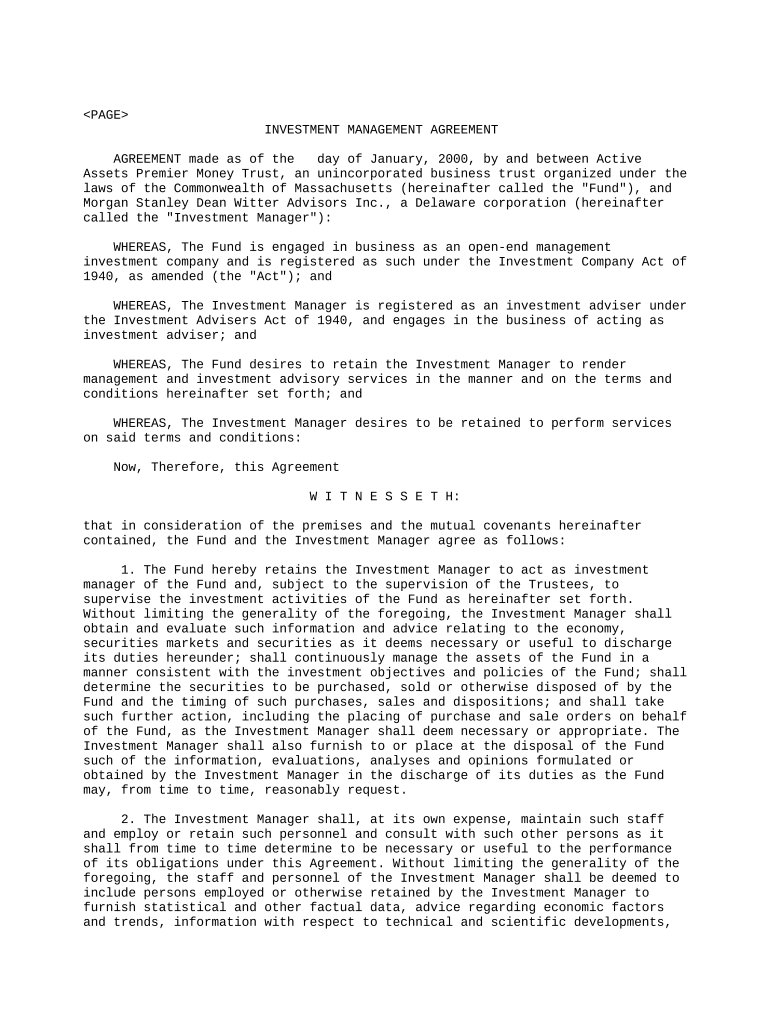
Investment Management Agreement

This template is fully customizable. Edit the text, fill out the fields, and send it for signature. Give it a try!
Investment Management Agreement

What an Investment Management Agreement Is and when it applies

An Investment Management Agreement (IMA) is a private contract that appoints an investment manager or adviser to manage specified assets on behalf of a client. The IMA sets scope, authority, fees, reporting obligations, custody instructions, and termination rights. It defines investment mandate, risk tolerance, permitted transactions, delegated powers (e.g., discretionary trading), and required disclosures. In the United States IMAs are enforceable when signed consistent with ESIGN and applicable state electronic transaction law, and the document often pairs with custody and brokerage agreements to implement investment instructions.

Why a clear Investment Management Agreement matters

A well-drafted IMA clarifies authority, reduces operational disputes, and documents fee and reporting expectations. Clear terms protect both client and manager by limiting ambiguity, allocating liability, and ensuring compliance with applicable securities, fiduciary, and privacy rules.

Why a clear Investment Management Agreement matters

Typical users and participants for an Investment Management Agreement

The IMA is used by institutional and individual investors, registered advisers, family offices, and third‑party managers to formalize investment authority.

  • Registered investment advisers and asset managers who accept discretionary mandates and need documented authority and compliance controls.
  • High‑net‑worth individuals, family offices, and trusts seeking a written mandate, risk profile, and reporting cadence from a manager.
  • Custodians, broker-dealers, and plan administrators who require a signed IMA to accept trading instructions and establish account access.

Representative signer roles and responsibilities

Chief Investment Officer

The CIO or portfolio manager signs for the manager entity, accepting discretionary authority within the IMA and confirming compliance with investment mandate and internal controls. The role should be named, with title and capacity shown to bind the manager.

Client Authorized Signer

An authorized representative of the client (trustee, corporate officer, or individual) signs to accept manager authority, fee schedules, and termination notice requirements. The signer should be authorized in corporate records or trust documents to avoid later disputes.

Core sections to include in a professional Investment Management Agreement

A complete IMA organizes legal authority, fees, reporting, risk limits, compliance, and termination. Below are six essential sections to draft carefully to reduce ambiguity and operational friction.

Parties

Identify full legal names, entity types, jurisdiction of organization, and authorized signers for both client and manager.
Authority and Scope

Describe discretionary powers, permitted instruments, prohibited investments, and trading limits, including delegation authority.

Fees and Expenses

Specify management fees, performance fees, expense reimbursements, calculation method, payment schedule, and clawback terms.

Reporting and Valuation

Set reporting frequency, valuation methodology, custody reporting, and delivery method for statements and performance reports.

Compliance and Representations

Include manager representations, client suitability statements, conflict disclosure, AML obligations, and regulatory compliance clauses.

Termination and Succession

Define termination for cause/without cause, notice periods, wind‑down instructions, and successor manager procedures.

Step-by-step: how to prepare and execute an Investment Management Agreement

Follow a consistent sequence to reduce errors during drafting, review, signing, and onboarding.

  • 01
    Draft: Populate parties, scope, fees, and reporting clauses.
  • 02
    Review: Have compliance, legal, and client review the draft.
  • 03
    Execute: Collect signatures and notarization if required.
  • 04
    Onboard: Deliver signed IMA to custodian and set account permissions.

How to set up an online signing workflow for the IMA

Configure a repeatable digital workflow that enforces signer order, authentication, and archival requirements for each IMA.

Field Configuration
Signing Order Manager then client; enable sequential routing for approvals.
Authentication Use email plus SMS or ID verification for higher assurance.
Template Fields Lock mandate, fee, and signature blocks as required fields.
Storage Archive final PDF and audit trail in secure document store.

Where to send the completed Investment Management Agreement

Route the executed agreement to every party and to operational counterparties that need it to act on instructions.

  • Client Copy: Deliver a signed PDF to the client for their records and internal compliance.
  • Manager Files: Store a signed version in the manager's compliance repository.
  • Custodian / Broker: Send to custodian to enable trading and establish account permissions.
  • Compliance Team: Provide final IMA and audit trail to legal and compliance for review and retention.

Technical and format requirements for digital completion

Choose a signing platform that supports PDF/DOCX, audit trails, and appropriate signer authentication.

  • File Formats: PDF and DOCX accepted; preserve original formatting.
  • Authentication: Email, SMS, and optional ID verification supported.
  • Integrations: Connect to CRM, NetSuite, or cloud storage for archiving.

Common dates and deadlines to include or monitor

Track effective, funding, reporting, and termination notice dates to avoid disputes and operational delays.

Effective Date:

MM/DD/YYYY — when authority and fees begin.

Funding Deadline:

Date by which assets must be transferred to custodian.

Reporting Frequency:

Specify monthly, quarterly, or annual reporting cadence.

Termination Notice:

Notice window (e.g., 30–90 days) for ending the agreement.

Tax Reporting:

Coordinate year‑end statements and 1099 schedules with custodian.

Common mistakes to avoid when preparing an Investment Management Agreement

  • Using imprecise investment mandates that do not specify permitted instruments or concentration limits creates execution risk and later disputes.
  • Failing to name authorized signers and their capacity often delays account opening with custodians and broker‑dealers.
  • Omitting clear fee calculation examples or timing can cause billing disputes and possible client complaints to regulators.
  • Neglecting to align the IMA with custody and brokerage agreements leads to operational conflicts over trading authority and settlements.

Key risks and potential consequences of an incorrect agreement

Unauthorized Trading: Potential client claim and regulatory complaint.
Fee Disputes: Repayment or arbitration costs.
Operational Delays: Custodian may refuse instructions without proper execution.
Privacy Violations: HIPAA or privacy breach risk if health data is mishandled.
Regulatory Exposure: SEC or state enforcement for deficient disclosures.
Contract Invalidity: Execution defects may render agreement unenforceable.

Comparing eSignature provider pricing and enterprise features

Below is a concise comparison of starting price and key features across major eSignature providers. signNow is listed first per platform conventions.

signNow DocuSign Adobe Sign PandaDoc HelloSign
Starting Price $8/user/mo $15/user/mo $14/user/mo $19/user/mo $15/user/mo
Free Trial 7-day free trial Varies by plan Varies by plan Varies by plan Varies by plan
Bulk Send Yes (Premium tier) Yes Yes Yes Yes
Audit Trail Yes Yes Yes Yes Yes
HIPAA Compliant Yes Yes Yes No No
Envelope Cap No envelope cap 100 envelopes/user/year Varies by plan Varies by plan Varies by plan

Real examples of how organizations use digital IMAs

These customer examples show typical operational benefits from standardized, digitally executed Investment Management Agreements.

Optica Ventures (COO)

We standardized our IMA process to reduce onboarding variability and speed account setup.

  • The streamlined workflow cut manual follow‑ups.
  • As a result, Optica reduced time to trade initiation and improved client transparency by storing agreements, fee schedules, and custody instructions in a central, auditable repository.

Martin Properties (Founder)

Switching to digital signing allowed remote principals to approve mandates quickly.

  • Execution became mobile and auditable.
  • This change enabled Martin Properties to finalize management appointments without physical meetings, shortened closing cycles, and ensured every signed IMA included a timestamped audit trail for compliance.

Practical tips to complete IMAs accurately and efficiently

Adopt consistent templates, require identity verification for signers, and maintain a single authoritative archive to reduce disputes and regulatory exposure.

Use standardized templates
Reduce negotiation time by starting from a preferred, legally reviewed template that covers fees, scope, and termination consistently.
Verify signer authority
Confirm corporate resolutions, trust instruments, or power of attorney documentation before accepting signatures to avoid invalid execution.
Preserve audit trails
Ensure the platform records IP, timestamps, and authentication events to demonstrate intent and attribution if challenged.
Align companion documents
Attach custody agreements, fee schedules, and KYC records to the IMA to prevent operational mismatches during onboarding.

Key milestones from negotiation to operational onboarding

Monitor these sequential stages to ensure the IMA is executed and operationalized without delay.

01

Drafting Complete

Agreement terms finalized and approved by legal.

02

Execution

All parties sign and dates are recorded.

03

Custodian Onboarding

Signed IMA delivered to custodian; account permissions set.

04

Live Management

Assets funded and trading authority activated.

Frequently asked questions about Investment Management Agreements

Answers to common questions about signing, validity, and operational steps when using electronic workflows to execute IMAs.


Need help? Contact support

be ready to get more
Join over 28 million airSlate SignNow users