Parties & Recitals
Identify all parties with precise legal names, addresses, and formation jurisdiction, and summarize the transaction background and purpose to frame interpretive context.
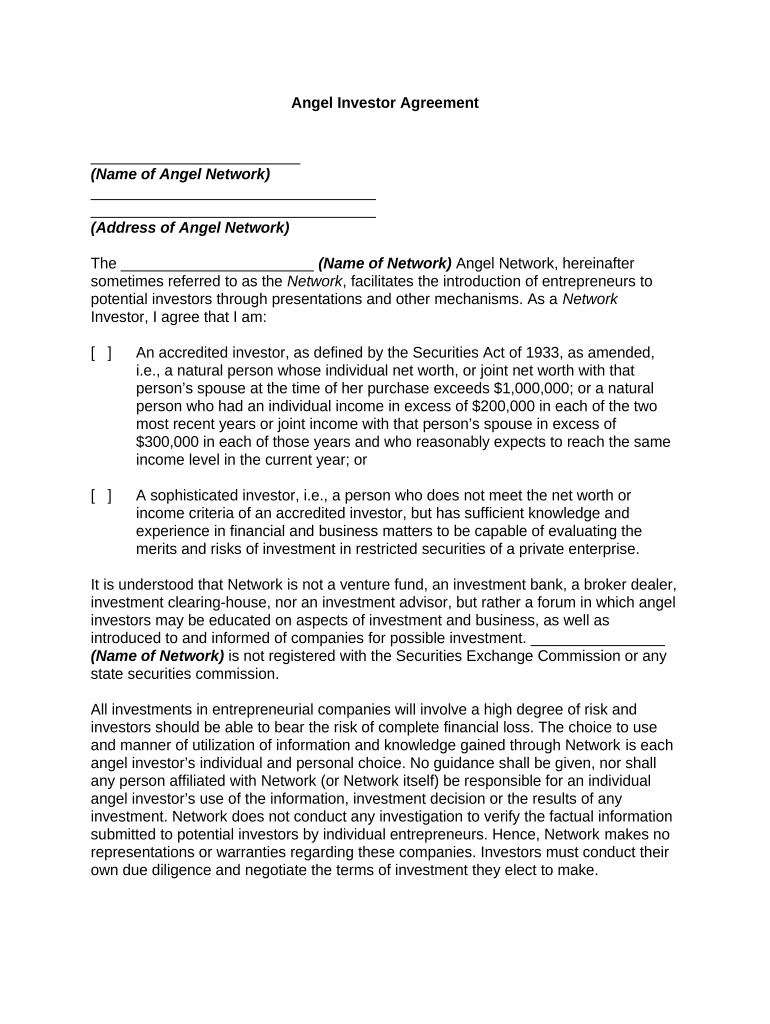
A well-drafted Investor Agreement defines economic and governance terms, reduces misunderstandings, and creates an enforceable record of the investment relationship. Clear terms limit future disputes, support regulatory compliance, and simplify downstream transactions such as transfers, follow-on financings, or exits.

Various parties are involved in preparing and executing Investor Agreements; understanding roles helps ensure correct completion and signature authority.
A named officer (CEO, CFO, or other corporate officer) signs on the company’s behalf after corporate approvals, board resolutions, or delegated authority are confirmed. The document should specify the officer’s title and cite the board resolution when required.
An individual with signature authority for the investor entity (e.g., managing partner or authorized signatory) must sign and provide evidence of authority such as a corporate resolution, power of attorney, or entity formation documents.
Identify all parties with precise legal names, addresses, and formation jurisdiction, and summarize the transaction background and purpose to frame interpretive context.
Specify the exact monetary amount, accepted currency, payment timing, escrow instructions, closing mechanics, and any conditions precedent to funding.
Describe security type, number of shares or percentage ownership, capitalization after issuance, and any conversion or anti-dilution mechanics.
Allocate risk by listing factual statements each party makes about authority, corporate status, financials, and absence of undisclosed liabilities.
Set ongoing obligations (e.g., reporting, use of proceeds) and closing conditions such as regulatory approvals, board resolutions, or third-party consents.
Include transfer restrictions, right of first refusal, tag/drag provisions, buyback mechanics, and dispute-resolution processes including governing law and jurisdiction.
| Field | Configuration |
|---|---|
| Authentication Level | Email, SMS code, or KBA |
| Signing Order | Sequential or parallel |
| Conditional Fields | Show/hide fields by role |
| Reminders & Timeouts | Auto-reminders and expiration |
Ensure the chosen platform supports evidence of intent, retains records per ESIGN/UETA, and can integrate with counsel and escrow providers for seamless filing and distribution.
| Criteria | Investor Agreement | Stock Purchase Agreement |
|---|---|---|
| Purpose | broad investment terms | share sale specifics |
| Consideration Type | equity or note | equity only |
| Typical Investors | multiple or single parties | buyer-specific |
| Closing Formalities | flexible | formal share transfer |
Date the agreement becomes operative
Date funds are wired and securities issued
File Form D within 15 days after first sale (Reg D Rule 503)
Provide tax info for K-1 or 1099 as required annually
Preserve executed documents per legal retention rules
| signNow | DocuSign | Adobe Sign | PandaDoc | HelloSign | |
|---|---|---|---|---|---|
| Starting Price | $8/user/mo | $15/user/mo | $14/user/mo | $19/user/mo | $15/user/mo |
| Free Trial | 7-day trial | Varies by plan | Varies by plan | Varies by plan | Varies by plan |
| Bulk Send | Yes | Yes | Yes | Yes | Yes |
| Audit Trail | Yes | Yes | Yes | Yes | Yes |
| HIPAA Compliant | Yes | Yes | Yes | No | No |
| Envelope Cap | No cap | 100 envelopes/user/year | Plan-dependent | Plan-dependent | Plan-dependent |
A startup uses a convertible note to bridge to Series A
A founder sells 15% to an angel group