Establishing secure connection…Loading editor…Preparing document…

Letter Requesting Subpoena for Workers' Compensation Hearing

This template is fully customizable. Edit the text, fill out the fields, and send it for signature. Give it a try!
Letter Requesting Subpoena for Workers' Compensation Hearing

What the Letter Requesting Subpoena for Workers' Compensation Hearing Is

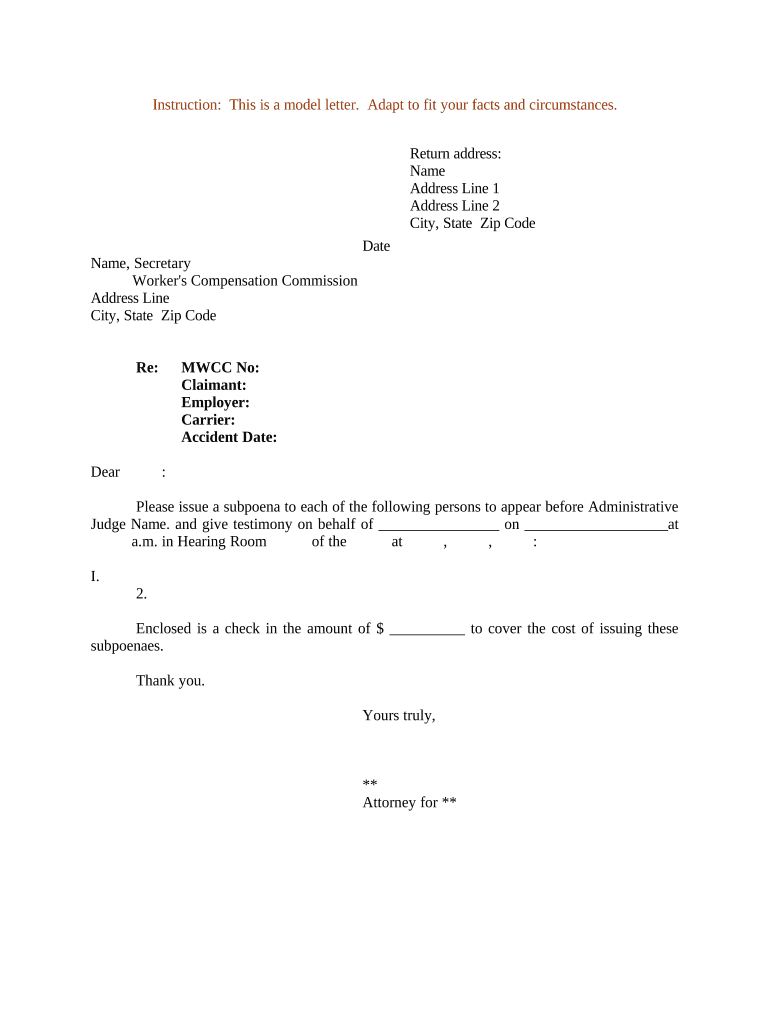
A Letter Requesting Subpoena for Workers' Compensation Hearing is a formal written request submitted to a workers' compensation judge, clerk, or administrative office asking the tribunal to issue a subpoena compelling a witness or a custodian to produce testimony, documents, medical records, or other evidence at a scheduled hearing. The letter identifies the parties, case number, the specific items or witnesses requested, the hearing date, and the legal basis for the request. It often accompanies a proposed subpoena form or draft and must follow local board or commission procedural rules for format, service, and timing.

Why a Clear, Compliant Request Matters

A precise letter reduces the risk of delay, ensures the tribunal can evaluate the need for a subpoena, and helps the issuing officer draft enforceable process. Clear requests protect privacy interests and shorten litigation timelines when properly served and timed.

Why a Clear, Compliant Request Matters

Who Typically Prepares and Uses This Letter

Common preparers include claimant attorneys, employer representatives, claims examiners, and pro se claimants seeking documentary evidence or witness testimony for a scheduled workers' compensation hearing.

  • Claimant attorney preparing evidence requests and witness subpoenas for medical or vocational testimony.
  • Employer or insurer representative seeking medical records, employment files, or surveillance documentation.
  • Unrepresented claimant or small employer who must assemble and serve proof-of-evidence before the hearing.

Tailoring the letter to the tribunal's formatting and service rules increases the chance the judge will issue the subpoena without additional briefing.

Who Signs and Submits the Letter

Claims Attorney

An attorney of record signs when acting for a claimant or respondent; signature establishes authority to request compulsory process and should include bar number and firm contact information.

Employer Representative

A designated claims manager or in-house counsel may sign on behalf of an employer or insurer; include title and authority statement to show standing to request the subpoena.

Core Components to Include in the Letter

A professional letter requesting a subpoena should be concise and structured so the adjudicator can quickly verify relevance, necessity, and proper service instructions.

Case Identification

Include the workers' compensation board name, docket or claim number, claimant and employer names, and assigned judge or hearing officer so the request is attached to the correct file.
Specific Request

List each witness name and each document or category of records sought, with precise date ranges and locations to avoid vague or overbroad subpoenas.

Purpose Statement

Explain briefly why the evidence or testimony is material to the hearing issues—causation, extent of injury, compensability, or credibility—so the tribunal may assess proportionality.

Service Instructions

Provide how and when the subpoena should be served, including physical address or custodian contact, and whether electronic delivery or process server use is acceptable under local rules.

Suggested Subpoena

Attach a draft subpoena form and certificate of service to speed approval and ensure the court issues process in the requester’s preferred format.

Signature Block

Signer name, title, firm, contact phone and email, and date; include authorization if filing on behalf of another party or insurer.

Essential Information and Fields to Provide

Board and Docket: Case number and tribunal
Party Names: Claimant and employer
Hearing Date: MM/DD/YYYY
Target Custodian: Name and organization
Records Sought: Specific documents or date ranges
Service Address: Physical or electronic address

Step-by-Step: How to Draft and Submit the Letter

Follow these sequential steps to prepare a compliant request and increase the likelihood the tribunal will issue the subpoena without delay.

  • 01
    Draft Letter: State case ID, hearing date, and precise request.
  • 02
    Attach Draft Subpoena: Include form with service instructions and production dates.
  • 03
    Check Local Rules: Confirm filing method, timing, and signature requirements.
  • 04
    File and Serve: Submit to board and serve opposing parties per rules.

How to Prepare the Letter Online and Configure Delivery

Set up the document workflow to capture required fields, routing, and authentication before sending for issuance or signature.

Field Configuration
Case Number Field Single-line required field, MM/DD/YYYY if date-like
Hearing Date Field Date picker, enforce MM/DD/YYYY format
Signature Block Signer name and title with date field
Delivery Method Choose email, certified mail, or process server

Where to File or Send the Letter Requesting Subpoena

Different tribunals accept letter requests via electronic filing systems, email to the clerk, or physical delivery—confirm the workers' compensation board's accepted channels before submission.

  • Workers' Comp Board: File with the board clerk or online portal
  • Assigned Judge: Submit to the hearing officer if permitted
  • Opposing Counsel: Serve counsel copies per local service rules
  • Records Custodian: Send draft subpoena and production deadline

Digital Submission and eSignature Considerations

Use secure eSubmission and eSignature workflows when permitted by the tribunal; ensure the method satisfies authentication and record-retention requirements.

  • File Formats: PDF or PDF/A preferred for reproducibility
  • Signer Authentication: Use email or SMS codes for attribution
  • Integrations: Supports common systems like Microsoft 365

Confirm the tribunal accepts electronic filings and whether original signed copies, notarization, or additional service proof are required before relying solely on electronic evidence.

Typical Timing and Deadlines to Watch

Track procedural deadlines so subpoenas are issued and served with enough time for production and witness preparation.

Request Before Hearing:

Submit request early—ideally 14–30 days before the hearing for processing

Service Lead Time:

Allow sufficient service time per local rules, often 7–14 days

Production Deadlines:

Set a production date that gives parties time to review documents

Objection Window:

Parties may have a short timeframe to move to quash or limit the subpoena

Motion To Compel:

If not complied with, prepare to file a motion before hearing

Key Milestones from Request to Production

A sequential milestone view helps track issuance, service, production, and enforcement steps for an effective subpoena process.

01

Draft and Attach Subpoena

Prepare complete materials to submit with the request for issuance

02

Clerk or Judge Review

Tribunal reviews and decides whether to issue process

03

Service of Subpoena

Process server or authorized person completes service document

04

Document Production

Custodian produces records or objects by the required date

Common Mistakes to Avoid When Preparing a Request

  • Being vague about records requested, which can lead to quashing or delay and require a follow-up motion to clarify scope.
  • Missing or incorrect case identification, causing the clerk to misfile the request and delaying issuance of the subpoena.
  • Failing to check local service rules for the tribunal, resulting in ineffective service or rejected filings.
  • Neglecting privacy protections for medical records, creating HIPAA compliance issues and possible refusal to produce without authorization.

Consequences of an Incorrect or Improper Letter

Delay or Denial: Judge may deny issuance
Quash Risk: Subpoena may be quashed for overbreadth
Sanctions: Court may impose sanctions or costs
Privacy Violation: HIPAA exposure if PHI mishandled
Evidence Exclusion: Untimely production can be excluded
Repeat Filings: Additional motions increase expense

Use Cases: How Request Letters Work in Practice

Two concise examples illustrate typical letters for medical records and live witness testimony.

Medical Records Request

A claimant's attorney requested all orthopedic clinic records from 01/01/2020–12/31/2021 to document ongoing treatment

  • the point: narrow date range and provider names reduce objections
  • the outcome: tribunal issued subpoena with a two-week production deadline, avoiding a contested motion and preserving hearing schedule by providing time-limited, specific discovery.

Witness Testimony Request

An employer sought witness testimony from a former supervisor to corroborate work duties and attendance records

  • the point: include exact employment dates and contact details
  • the outcome: judge issued subpoena, the witness attended and testimony shortened hearing time while supporting cross-examination on disputed issues of credibility and work scope.

Tips for Accurate, Efficient Letter Preparation

Adopt these practical habits to reduce objections and expedite issuance.

Be Specific and Proportionate
Describe records and witnesses precisely and limit requests to what is material to avoid burdensome or overly broad subpoenas that invite motions to quash.
Confirm Jurisdictional Requirements
Review local board rules for filing format, signature requirements, acceptable service methods, and any form templates to avoid procedural rejection.
Protect Privacy
When medical or sensitive records are sought, request protective measures, limited disclosure, redaction, or in-camera review to comply with HIPAA and privacy expectations.
Document Service
Keep certificates of service, process server affidavits, and proof of delivery to demonstrate compliance and to support enforcement if production is resisted.

eSignature Vendor Comparison for Preparing and Delivering Subpoena Letters

Platforms differ on price, bulk sending, audit capabilities, HIPAA support, and envelope limits; signNow is listed first for direct feature comparison.

signNow DocuSign Adobe Sign PandaDoc HelloSign
Starting Price $8/user/mo $15/user/mo $14/user/mo $19/user/mo $15/user/mo
Free Trial 7-day trial Varies by plan Varies by plan Varies by plan Varies by plan
Bulk Send Yes Yes Yes Yes No
Audit Trail Yes Yes Yes Yes Yes
HIPAA Compliant Yes Yes Yes No No
Envelope Cap No cap 100 envelopes/user/year Varies by plan Varies by plan Varies by plan

Frequently Asked Questions About Subpoena Request Letters

Answers to common practical and legal questions when preparing a Letter Requesting Subpoena for a workers' compensation hearing.


Need help? Contact support

be ready to get more
Join over 28 million airSlate SignNow users