Establishing secure connection…Loading editor…Preparing document…

Kentucky Lien

This template is fully customizable. Edit the text, fill out the fields, and send it for signature. Give it a try!
Kentucky Lien

What the Kentucky Lien Is and when it applies

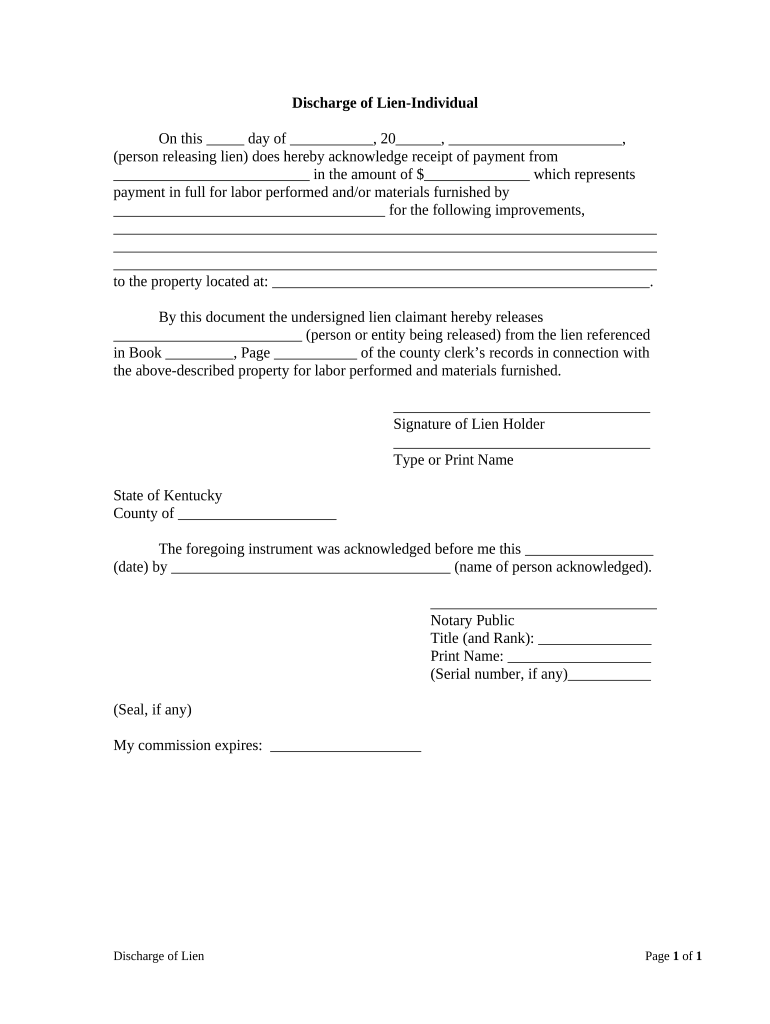
A Kentucky Lien is a formal claim filed against real property or project funds to secure payment for labor, materials, services, or a judgment. Commonly used in construction contracting (mechanic’s liens) and to record court judgments affecting title, it notifies owners and third parties of the claimant’s legal interest and potential enforcement remedies if unpaid.

Why a properly prepared Kentucky Lien matters

A correctly completed lien preserves statutory rights to payment and enforcement while reducing the risk of invalidation, extra legal fees, and missed recovery windows. Proper form, accurate property description, and timely filing are essential to preserve remedies under state law.

Why a properly prepared Kentucky Lien matters

Who commonly prepares and relies on a Kentucky Lien

Professionals involved in construction, property management, and commercial lending frequently complete or respond to liens.

  • General contractors, subcontractors, and material suppliers who need to secure payment for work or materials supplied to a project.
  • Property owners, title companies, and lenders who review liens during closings or when evaluating encumbrances on real property.
  • Attorneys and claim agents who file liens, negotiate releases, or litigate priority disputes on behalf of clients.

Accurate completion and timely processing protect both claimants pursuing payment and owners seeking clear title.

Step-by-step: Completing a Kentucky Lien form

Follow this basic sequence to prepare and preserve a lien claim in Kentucky. Local practice and county recording rules vary—confirm county clerk requirements before submission.

  • 01
    1. Identify claimant: Enter the claimant’s full legal name and business entity exactly as on ID or registration.
  • 02
    2. Describe property: Provide the legal description or parcel number used by the county recorder.
  • 03
    3. State amount: List the precise unpaid amount and break out retainage, extras, and interest if applicable.
  • 04
    4. Notarize and file: Sign before a notary if required, then record with the county clerk and serve required parties.

How to configure an online Kentucky Lien workflow

When filing electronically, set up a workflow that enforces required fields, captures signer identity, and produces a record suitable for county recording and service.

Field Configuration
Required Fields Make claimant, property description, amount, and date mandatory
Signer Authentication Use email + SMS code or stronger KBA where available
Notary Integration Enable remote online notary or schedule in-person notarization
Output Format Generate ISO/PDF-A compatible PDF for recording

Digital signing and eSubmission essentials

Ensure the eSignature platform supports required authentication, notarization workflows, and produces a tamper-evident audit trail suitable for legal records.

  • Integrations: Salesforce, NetSuite, Google Workspace supported
  • Formats: PDF, DOCX accepted for upload
  • Authentication: Email, SMS, KBA and multi-factor options

Capture an audit trail with timestamps, IP addresses, and signer attribution; if notary is required, include notarization evidence and any audio-video recording per state rules.

Where to file, record, and serve a Kentucky Lien

Kentucky liens are typically recorded at the county level and may require serving the property owner or contracting entity after recording. Follow local county clerk procedures for recording and service.

  • Prepare the Lien: Complete form and gather supporting invoices
  • Notarize if needed: Sign before an in-person or RON notary where allowed
  • Record with county: Submit to the county clerk for indexation
  • Serve parties: Deliver notice to owner, general contractor, or lender as required

Security and compliance considerations for electronic lien records

Encryption: TLS 1.2/1.3 in transit
At-Rest: AES-256 encryption
Certifications: SOC 2 Type II available
HIPAA: BAA required for PHI workflows
ESIGN / UETA: Meets ESIGN and UETA standards
21 CFR Part 11: Compliant options for regulated records

Consequences of incorrect or late filings

Lien Invalid: May be unenforceable
Monetary Loss: Loss of recovery rights
Statute Limit: Missed filing window
Additional Costs: Attorney and court fees
Priority Risk: Other liens may take precedence
Criminal Risk: False claims may trigger penalties

Common mistakes to avoid when preparing a Kentucky Lien

  • Using an incorrect legal description or parcel number that prevents proper indexing and weakens enforceability.
  • Failing to confirm the last date of work or supply, which can cause you to miss statutory filing deadlines.
  • Not serving the required parties after recording, leaving the claim subject to procedural challenges or dismissal.
  • Omitting supporting invoices or failing to document contractual entitlement, which invites owner disputes and delay.

Critical elements every professional Kentucky Lien should include

A professional lien lists specific, verifiable information so recorders, owners, and courts can determine priority and scope of the claim.

Claimant Details

Full legal name, business entity, mailing address, and contact information for service of process or notices.
Property Identification

County, parcel or lot number, and full legal description used in public records to ensure correct indexing.

Amount Owed

Clear dollar amount, breakdown of labor/materials, retained amounts, and any contract interest terms.

Timeline

Dates for contract start, last work performed, and delivery of materials to establish filing deadlines.

Verification

Signature, printed name, and notarization or verification clause when required by statute or county rule.

Recording Instructions

Preferred recording county, number of certified copies required, and any county clerk fee details to include.

Real-world scenarios showing how a Kentucky Lien is used

Below are two anonymized real-user examples showing typical outcomes and process highlights when filing liens on property-related claims.

Martin Properties — Field Use

A local developer used an online lien template to preserve payment rights after a subcontractor defaulted on site work.

  • Short timeline required urgent recording and service.
  • Tim Martin (Founder, Martin Properties) notes: "I can process and execute all of these documents online with 100% compliance and built-in security. Whether on mobile or working offline, I can get forms back to their necessary parties efficiently."

Optica Ventures — Portfolio

A property manager placed a lien to protect remediation costs across multiple lots.

  • Needed consistent documentation across files.
  • Brian Fitzgibbons (COO, Optica Ventures LLC) reports the interface was simple for internal teams and customers while preserving legal traceability during enforcement.

Who is authorized to sign a Kentucky Lien

Property Owner

Owners or their authorized corporate officers may sign releases or acknowledgements. When an owner files a lien release, include proof of authority such as a board resolution or power of attorney.

Contractor / Claimant

The claimant or an agent with written power of attorney may sign the lien statement; attach supporting evidence of authorization to avoid challenges to validity.

Notarization and witness flow for recording and service

Follow these steps to authenticate a lien: many counties require notarization and some require prior service or notice before filing.

01

Prepare Lien Statement

Complete all required fields and attach supporting invoices

02

Confirm Notary Needs

Check county rules for physical or RON notarization

03

Sign Before Notary

Signer provides ID and signs in notary presence or RON session

04

Obtain Notarial Certificate

Notary completes acknowledgment or jurat as required

05

Record with County

Submit signed, notarized instrument to clerk for indexing

06

Serve Required Parties

Deliver recorded notice to owner and other interested parties

07

File Proof of Service

Record service affidavits where statute requires

08

Monitor Priority

Track other filings that may affect lien priority

How a Kentucky mechanics’ lien compares to a judgment lien

Compare core attributes to choose the right remedy and understand filing, priority, and enforcement distinctions.

Criteria Mechanics' Lien Judgment Lien
Created by work/materials supplied court judgment
Filing deadline statutory months after last work upon entry of judgment
Requires notarization often yes not typically
Primary remedy foreclosure on property writ of execution or levy

eSignature vendor comparison for managing Kentucky Liens

Comparison of common eSignature features and price points for platforms used to prepare, notarize, and deliver lien documents. signNow is listed first per platform ordering rules.

signNow DocuSign Adobe Sign PandaDoc HelloSign
Starting Price $8/user/mo $15/user/mo $14/user/mo $19/user/mo $15/user/mo
Free Trial Yes, 7-day trial Trial available Trial available Trial available Trial available
Bulk Send Yes Yes Yes Yes No
Audit Trail Yes Yes Yes Yes Yes
HIPAA Compliant Yes Yes Yes No No

Frequently asked questions about Kentucky Liens

Answers to common questions about enforceability, eSigning, deadlines, and what to do when a lien is challenged.


Need help? Contact support

be ready to get more
Join over 28 million airSlate SignNow users