Establishing secure connection…Loading editor…Preparing document…

Joint Tenancy Minnesota

This template is fully customizable. Edit the text, fill out the fields, and send it for signature. Give it a try!
Joint Tenancy Minnesota

What a Joint Tenancy Deed in Minnesota Is

A Joint Tenancy in Minnesota is created by a deed that conveys real property to two or more persons with an express right of survivorship. When one joint tenant dies, ownership passes automatically to the surviving joint tenant(s) without probate. The deed must be properly drafted, signed, notarized, and recorded in the county where the property sits to be effective against third parties and for title search purposes.

Why Joint Tenancy Is Used and How It Functions Legally

Joint tenancy simplifies transfer on death by creating a right of survivorship and avoiding probate. For electronic workflows, ESIGN (15 U.S.C. ch. 96) and UETA (1999) support electronic signatures generally, but deeds still require physical or remote notarization and county recording to perfect title.

Why Joint Tenancy Is Used and How It Functions Legally

Who Typically Prepares and Uses a Joint Tenancy Deed

Several groups commonly prepare or execute a Joint Tenancy deed in Minnesota, each with distinct priorities.

  • Real estate attorneys preparing clear vesting language and advising on tax and mortgage consequences.
  • Title and escrow officers ensuring the legal description, recording block, and liens are correctly handled.
  • Individual property owners or co-owners who want survivorship transfer and to avoid probate.

Choose the appropriate professional support based on complexity: simple transfers may be handled through title/escrow, while contested or tax-sensitive transfers benefit from attorney review.

Representative Professionals Involved

Real Estate Attorney

An attorney drafts and reviews vesting language, analyzes mortgage or tax implications, and advises on alternatives to joint tenancy such as tenancy in common or transfer-on-death deeds.

Title Officer

A title or escrow officer prepares the deed for recording, verifies liens and encumbrances, confirms the legal description, and forwards the document to the county recorder for indexing.

Essential Parts of a Minnesota Joint Tenancy Deed

A professional joint tenancy deed contains specific elements that ensure enforceability and clear title transfer at death.

Vesting Language

Explicit phrase stating 'joint tenants with right of survivorship' or equivalent; this clause governs survivorship and supersedes ambiguous tenure terms.
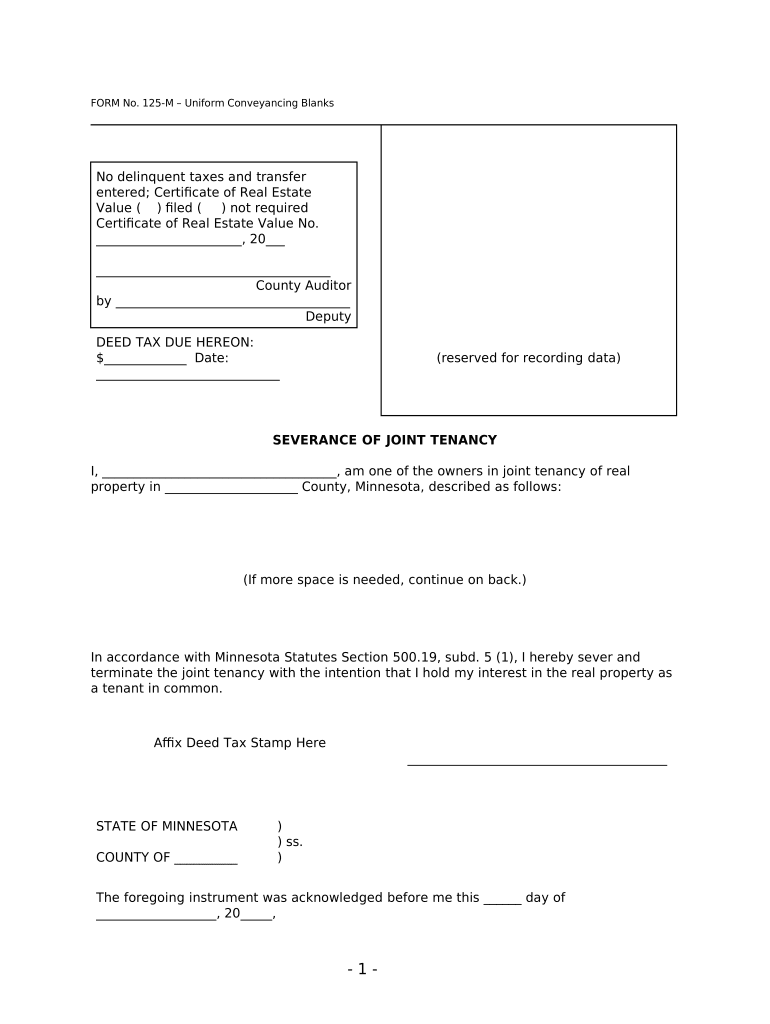
Legal Description

Full parcel legal description (not just street address), matching county records and the recorded plat or metes-and-bounds language.

Grantor/Grantee Names

Full legal names exactly as they appear on government ID or prior title documents to avoid title defects and mismatched records.

Consideration Recital

A short statement of consideration (e.g., nominal or specific dollar amount) as required by local recording practice and tax reporting.

Notary Acknowledgement

Notary block meeting Minnesota requirements; for remote notarization, follow state RON rules and retain required records.

Recording Block

Space for county recorder use, including return-to address and instrument number to enable proper indexing and title chain continuity.

Step-by-Step: From Draft to Recorded Joint Tenancy

Follow these core steps to create and record a valid joint tenancy deed in Minnesota.

  • 01
    Prepare Deed: Draft deed with accurate legal description and joint tenancy wording.
  • 02
    Review Title: Confirm there are no unaddressed liens or title exceptions.
  • 03
    Sign & Notarize: All grantors sign before a notary or RON-compliant notary where permitted.
  • 04
    Record Document: File with the county recorder and pay required fees to perfect transfer.

How Recording and Title Transfer Work After Signing

Understanding post-signature steps helps ensure the deed becomes effective against third parties.

  • County Recording: Recorder indexes and assigns instrument number for public notice.
  • Title Chain Updated: Title exam reflects the new ownership and any remaining encumbrances.
  • Survivorship Effect: At a joint tenant’s death, surviving tenant(s) receive title automatically.
  • Tax Reporting: Recording may trigger transfer tax or change in property tax assessment.

Digital Workflow Settings for Preparing a Deed

Configure a secure workflow that supports signature, notarization, and delivery while documenting chain of custody.

Field Configuration
Signer Roles Define grantor signature and notary as separate roles.
Authentication Use email + SMS or stronger KBA for signer identity verification.
Notary Option Select in-person or RON compliant process as available.
Record After Signing Enable automatic package export for county recording submission.

Technical Requirements and Integrations for e-Workflow

Choose a platform that supports secure signatures, notarization records, and common integrations used by title professionals.

  • Supported Integrations: Salesforce, NetSuite, Microsoft 365, Google Workspace
  • File Formats: PDF and Word DOCX supported for recording packages
  • Security Stack: TLS and AES encryption in transit and at rest

Ensure the chosen provider meets your county’s file-format and evidence requirements, and preserves audit logs and notarization recordings where applicable.

Timing Considerations and Typical Processing

Timing affects priority, tax reporting, and mortgage obligations; record promptly to protect ownership rights.

Record Promptly:

Record as soon as possible after notarization to establish priority against later claims.

Mortgage Notification:

Inform mortgage lender prior to transfer if mortgage exists; lender consent may be required.

County Processing:

County recorder processing times and fees vary by county and may affect indexed availability.

RON Records:

If remote notarization used, retain audio‑visual and identity proofing per state rules.

Tax Reporting:

Recording may trigger local transfer tax or change in assessment; consult county assessor for timing.

Key Milestones from Drafting to Full Title Update

Track these sequential milestones to ensure a smooth transfer and minimize title issues.

01

Draft and Review

Finalize legal description and vesting language; resolve liens or encumbrances.

02

Execution

Grantor signs in presence of notary or under RON procedures where lawful.

03

Recording Submission

Submit the executed deed with payment to the county recorder for indexing.

04

Title Update

Recorder indexes; title companies update records and deliver confirmation.

eSignature Pricing Snapshot for Deed Workflows (signNow First)

Cost and feature comparisons help teams choose an eSignature provider for notarization, audit trails, and volume needs. Prices reflect common per-user annual rates and plan summaries.

signNow DocuSign Adobe Sign PandaDoc HelloSign
Starting Price $8/user/mo $15/user/mo $14/user/mo $19/user/mo $15/user/mo
Free Trial 7-day free trial Varies Varies Varies Varies
Bulk Send Yes Yes Yes Yes No
Audit Trail Yes Yes Yes Yes Yes
HIPAA Compliant Yes Yes Yes No No
Envelope Cap No cap 100 envelopes/user/year Varies Varies Varies

Security and Compliance Essentials for Deed Workflows

Transport Encryption: TLS 1.2/1.3
Data at Rest: AES‑256 encryption
Certifications: SOC 2 Type II; ISO 27001 available
Regulatory Compliance: ESIGN and UETA compliance
Healthcare BAA: HIPAA available with BAA
Audit Trail: Comprehensive signer activity log

Consequences of Errors or Omitted Steps

Recording Failure: Title disputes; later bona fide purchasers may take priority
Incorrect Vesting: May create tenancy-in-common instead of survivorship
Missing Notary: Recorder may reject the deed
Mortgage Breach: Potential lender default or acceleration
Tax Consequences: Transfer taxes or reassessment risk
Fraud Exposure: Unverified signatures can lead to legal challenges

Common Preparation Errors to Avoid

  • Using a street address instead of the recorded legal description triggers title exceptions and recording rejection.
  • Failing to have all required grantors sign in front of a notary causes the county to refuse recording.
  • Ambiguous vesting language converts intended joint tenancy into tenancy in common upon review.
  • Not checking for outstanding liens or mortgages may violate lender terms and complicate title insurance.

Frequently Asked Questions About Joint Tenancy in Minnesota

Answers to common procedural and legal questions to help you avoid recording issues and unintended ownership results.


Need help? Contact support

be ready to get more
Join over 28 million airSlate SignNow users