Establishing secure connection…Loading editor…Preparing document…

Jury Instructions on Evidence and Deliberation

This template is fully customizable. Edit the text, fill out the fields, and send it for signature. Give it a try!
Jury Instructions on Evidence and Deliberation

What Jury Instructions on Evidence and Deliberation Cover

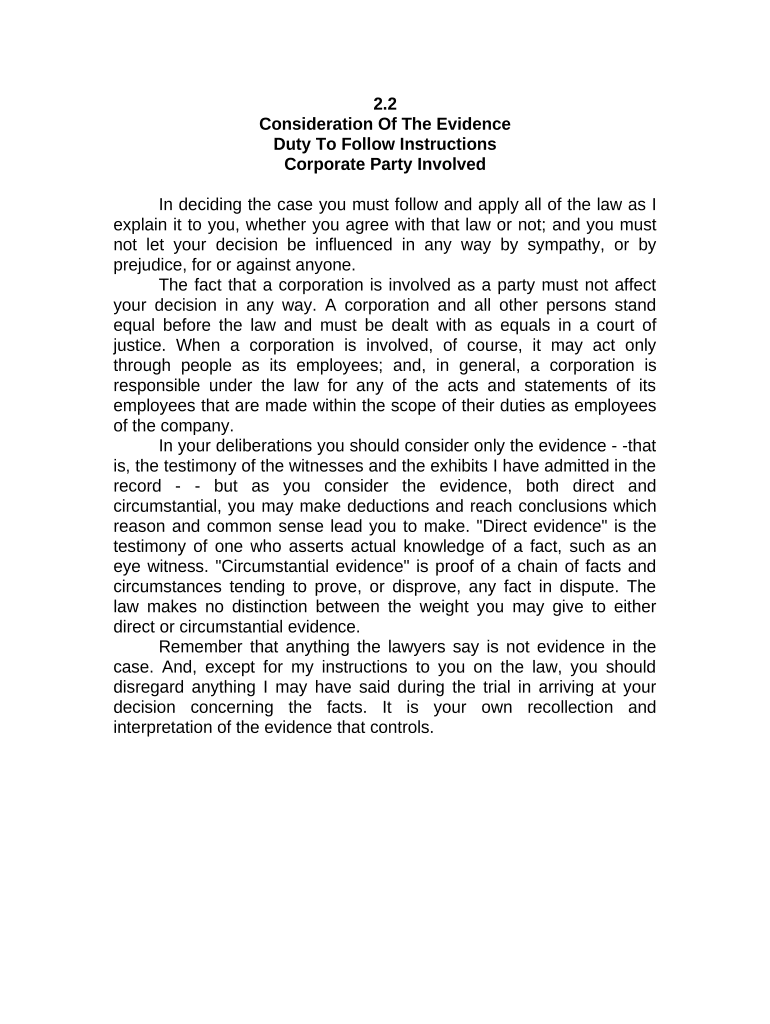
Jury Instructions on Evidence and Deliberation are the judge's formal directions that explain the law, how jurors should evaluate evidence, and the procedures to follow during deliberations. They identify the elements a party must prove, outline permissible inferences, and set standards for assessing witness credibility and exhibits. These instructions also state how the jury should reach a verdict and the burden of proof. Well-crafted instructions reduce confusion, limit reversible error on appeal, and guide deliberations toward a lawful and reasoned outcome.

Why Accurate Jury Instructions Matter

Clear, legally accurate instructions protect a party's right to a fair trial, reduce grounds for appeal, and help jurors apply the law to facts consistently.

Why Accurate Jury Instructions Matter

Who Prepares and Uses These Instructions

Courtroom stakeholders prepare, review, and apply jury instructions at trial and during charge conferences.

  • Trial judges and their clerks who draft, edit, and read instructions aloud to the jury prior to deliberations.
  • Plaintiffs' and defendants' counsel who propose, object to, and argue for specific instruction language at the charge conference.
  • Court reporters and appellate counsel who record the given instructions and may later cite them on appeal.

Representative Users and Their Roles

Trial Judge

The judge selects, adapts, and reads jury instructions, rules on objections, and ensures the charge conforms to governing law. Accurate instructions help the court limit reversible error and provide jurors with a lawful framework for deliberation and verdict formation.

Defense Counsel

Defense counsel proposes alternative language, objects to improper legal formulations, and preserves issues for appeal. Thorough review and timely objections to the charge can be essential to protect client rights and support post-trial motions.

Core Elements of Professional Jury Instructions

Most effective instructions combine statutory text, model instructions, case law citations, plain-language explanations, and clear verdict forms to guide jurors through legal standards and deliberative steps.

Legal Elements

Precise statement of each element of the claim or defense that the party must prove or disprove.
Burden & Standard

Clear description of burden of proof (e.g., beyond a reasonable doubt, preponderance) and which party bears it.

Evidence Evaluation

Instructions on assessing witness credibility, exhibits, hearsay exceptions, and weighing circumstantial evidence.

Deliberation Procedure

Guidance on foreperson selection, open deliberation, unanimity requirements, and how to report questions to the court.

Verdict Forms

Structured forms or interrogatories aligned with the instructions to capture the jury's findings clearly.

Ancillary Directions

Statements on notes, taking breaks, communications with the court, and handling juror questions.

Step-by-Step: Preparing and Submitting Jury Instructions

Follow these steps to draft, file, and resolve disputes over jury instructions efficiently during trial preparation.

  • 01
    Draft Proposals: Prepare proposed instructions with citations and verdict forms before the charge conference.
  • 02
    Exchange Proposals: Serve proposed instructions to opposing counsel per local rules or pretrial order.
  • 03
    Charge Conference: Argue contentious language at the conference and lodge formal objections on the record.
  • 04
    Final Charge: Judge issues the final jury charge and places the decision on the record for appeal preservation.

Typical Workflow for Courtroom Review and Delivery

This sequence shows how proposed jury instructions move from counsel to the bench and ultimately to jurors during trial.

  • Prepare Document: Counsel drafts instructions and compiles supporting authorities for the court.
  • Exchange and Confer: Parties exchange proposals and attempt to narrow disputes before the conference.
  • Submit to Court: File or deliver proposals per local court e-filing and briefing rules.
  • Judge's Charge: Judge finalizes instructions and reads them to the jury prior to deliberation.

Setting Up an Electronic Submission Workflow for Instructions

Configure e-submission steps to meet local court e-filing requirements and to preserve a clear audit trail for the charge conference.

Field Configuration
File Format PDF/A or DOCX as required by court e-filing portals
Authentication Use judge/court clerk-approved signer authentication where needed
Retention Ensure archival retention and searchable audit logs
Distribution Auto-notify opposing counsel and court staff on submission

Technical Considerations for eSubmission and Sharing

Choose a platform that supports required file types, produces tamper-evident PDFs, and captures an audit trail for each submission.

  • File Types: PDF, PDF/A, DOCX supported
  • Authentication: Email, SMS, or advanced methods
  • Integrations: Connects to court e-filing and document repositories

Timing: When to Propose and Object to Instructions

Observe local rules and the judge's pretrial schedule to ensure proposed instructions are considered and objections preserved on the record.

Proposal Deadline:

Submit proposed instructions according to the court's pretrial order or local rule.

Exchange Timing:

Exchange drafts with opposing counsel by the ordered date to facilitate conferencing.

Objection Deadline:

Raise objections at the charge conference or when the court sets the deadline.

Final Charge Time:

Judge provides the final charge to the jury before deliberations begin.

Record Preservation:

Ensure objections and the final charge are on the official transcript for appeal purposes.

Key Milestones in the Jury Instruction Process

A sequential milestone view from proposal to verdict helps track timing and preserve issues for appeal.

01

Drafting Complete

Proposed instructions finalized and internally reviewed before filing.

02

Exchange with Opposing Counsel

Drafts exchanged to identify and narrow disputes.

03

Charge Conference

Court hears arguments and rules on contested language.

04

Charge to Jury

Judge reads final instructions aloud prior to deliberations.

Common Mistakes When Preparing Jury Instructions

  • Failing to tie proposed language to a controlling statute or binding case law, which weakens objections and risks reversal on appeal.
  • Using technical or argumentative language that confuses jurors rather than stating neutral legal standards and elements.
  • Submitting inconsistent verdict forms and instructions, causing ambiguity in jury findings and potential post-verdict disputes.
  • Not preserving objections on the record at the charge conference, which can forfeit appellate review of instruction errors.

Consequences of Deficient Instructions

Reversal Risk: Possible reversal on appeal
Mistrial: Court may declare mistrial
Remand: Case remanded for new trial
Jury Confusion: Increased deliberation errors
Sanctions: Rare sanctions for bad-faith filings
Appeal Cost: Higher litigation expenses

Electronic vs Paper Jury Instructions: Key Differences

Compare the primary characteristics and operational implications of electronic submission versus traditional paper delivery.

Criteria Electronic Paper
Enforceability yes (if accepted)
Audit Trail digital timestamps and logs paper file stamp only
Modification After Filing trackable amendments harder to trace
Distribution instant electronic service manual service required

Security and Compliance Features to Expect

In-Transit Encryption: TLS 1.2/1.3
At-Rest Encryption: AES-256
HIPAA Support: BAA required
Audit Controls: Comprehensive audit trail
Certifications: SOC 2 Type II
Regulatory Standards: 21 CFR Part 11 compliance available

eSignature Pricing Comparison for Submitting Legal Documents

Compare typical vendor starting prices and feature availability relevant to legal teams handling jury instructions and court filings; signNow is listed first for consistent comparison.

signNow DocuSign Adobe Sign PandaDoc HelloSign
Starting Price $8/user/mo $15/user/mo $14/user/mo $19/user/mo $15/user/mo
Free Trial 7-day free trial Varies by plan Varies by plan Varies by plan Varies by plan
Bulk Send Yes Yes Yes Yes No
Audit Trail Yes Yes Yes Yes Yes
HIPAA Compliant Yes Yes Yes No No

Frequently Asked Questions About Jury Instructions and eSubmission

Answers to common procedural, technical, and legal questions regarding preparation, submission, and preservation of jury instructions.


Need help? Contact support

be ready to get more
Join over 28 million airSlate SignNow users