Establishing secure connection…Loading editor…Preparing document…

Notice of Federal Crime Regarding Damage to Reproductive Health Services Facility

This template is fully customizable. Edit the text, fill out the fields, and send it for signature. Give it a try!
Notice of Federal Crime Regarding Damage to Reproductive Health Services Facility

What this notice is and when it applies

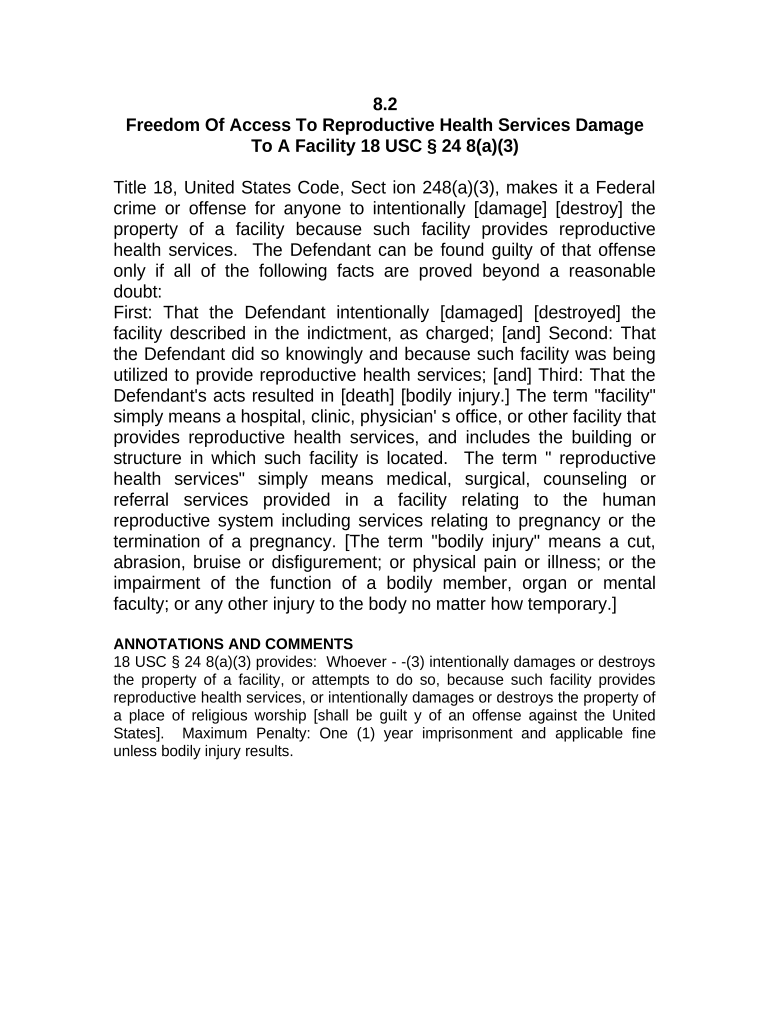
The Notice of Federal Crime Regarding Damage to Reproductive Health Services Facility is a formal, written disclosure used to report vandalism, arson, or other destruction affecting clinics or facilities that provide reproductive health services to federal authorities or federal prosecutors. The notice records incident details—date, time, location, extent of damage, and any known suspects or witnesses—and identifies the reporting party and facility owner. Completed notices support law enforcement investigations, insurance claims, and preservation of evidence. This document can be retained electronically and executed with compliant electronic signatures where allowed under ESIGN and state law.

Why a standardized federal notice matters

Using a standardized Notice of Federal Crime Regarding Damage to Reproductive Health Services Facility helps preserve factual details, creates an audit trail for investigators and insurers, and can be executed electronically consistent with the ESIGN Act (15 U.S.C. §7001) and applicable state UETA rules.

Why a standardized federal notice matters

Who typically completes and relies on this notice

This notice is used by facility managers, legal counsel, and law enforcement contacts when reporting damage to reproductive health services facilities.

  • Clinic administrators and on-site security report incidents and provide initial incident summaries to federal contacts.
  • Legal counsel completes notices for evidentiary preservation and to advise on civil remedies and insurance claims.
  • Local law enforcement and federal prosecutors use notices to document potential federal crimes and coordinate investigations.

Primary signer roles and responsibilities

Facility Director

A Facility Director or clinic manager typically documents the incident, secures the site to preserve evidence, notifies law enforcement and insurers, and coordinates internal communications. Their timely, accurate account is critical for criminal investigations and subsequent claims or regulatory reporting.

Legal Counsel

Legal Counsel prepares the formal notice to ensure information meets evidentiary standards, advises on disclosure obligations, and coordinates with prosecutors. Counsel evaluates potential civil claims, preservation letters, and helps manage communications to minimize legal risk while protecting patient privacy under HIPAA.

Essential sections to include in a professional notice

Core sections include incident summary, property and victim details, witness statements, evidence inventory, reporting party information, and signature blocks for verification and chain-of-custody records.

Incident Details

Document date, time, precise address, description of damage, and immediate actions taken. Include photographic references and any entry or exit points observed. This section establishes initial factual baseline for investigators.
Facility Information

Provide facility name, owner or operator name, license numbers if applicable, and operational hours. Clarify whether reproductive health services were active during the incident and whether patients or staff were present.

Witnesses

List witness names, contact information, and concise statements describing what they observed. Note when statements were collected, by whom, and whether witnesses consent to follow-up interviews by law enforcement.

Evidence Inventory

Catalog physical evidence, photos, video files, timestamps, and chain-of-custody notes. Identify where evidence is stored and any evidence preservation steps taken to prevent contamination or loss.

Reporting Party

Identify the person submitting the notice, their role, contact information, and relationship to the facility. Include authorization to act on behalf of the owner if applicable.

Signature & Verification

Provide printed name, title, date, signature, and contact method for verification. Note whether the document is signed electronically and include the audit trail or notarization details.

Step-by-step: completing and submitting the notice

Follow these sequential steps to complete and submit the federal crime notice accurately and promptly.

  • 01
    Collect Evidence: Secure scene and gather photos, video, and documents.
  • 02
    Record Details: Enter incident date, time, location, and damage description.
  • 03
    Notify Authorities: Contact local law enforcement and federal tips line as appropriate.
  • 04
    File Notice: Complete notice, sign, and submit to designated federal office.

Configure an electronic workflow for submission

Configure an electronic workflow to collect, authenticate, and route the notice to designated recipients with audit trail capture.

Field Configuration
Signer Authentication Email verification plus single-use SMS code
Routing Order Facility then local PD then federal office
Attachments Photos, video, insurance forms, and witness statements
Retention Policy Store signed notice with audit trail for minimum six years

Typical routing from reporting to investigation

Typical routing moves from facility to local law enforcement, then to federal prosecutors and investigators for case assessment and potential prosecution.

  • Facility Log: Initial incident report entered into facility records.
  • Local PD: Officer documents the scene and collects statements.
  • Federal Referral: Case referred when federal offenses or interstate elements present.
  • Investigation: Federal agents gather evidence and interview witnesses.

Technical and platform considerations for eSubmission

Electronic submission requires PDF/A or searchable Word DOCX formats and secure TLS transmission to preserve integrity and metadata.

  • File Formats: PDF, PDF/A, DOCX supported
  • Authentication: Email, SMS code, or stronger
  • Integrations: Works with Salesforce and NetSuite

Key timelines and prompt actions to observe

Key deadlines relate to evidence preservation, insurance notice, and any statutory reporting windows; act promptly to avoid penalties or lost claims.

Preserve Evidence Immediately:

Within hours if possible; photograph and secure scene.

Notify Local Law Enforcement:

Report at once; obtain incident report number.

Notify Insurer Promptly:

File claim per policy timelines to preserve coverage.

Submit Federal Notice:

Deliver notice to designated federal office as soon as practical.

Retain Records:

Keep originals and copies according to retention rules.

Milestone timeline from incident to archive

Sequential milestones show the end-to-end process from incident to federal case disposition and record retention.

01

Immediate Preservation

Secure scene, take photos, and collect witness contacts.

02

Initial Reporting

Notify local police and document the incident number.

03

Federal Referral Review

Prosecutors determine federal nexus and pursue charges if present.

04

Case Closure and Archive

Record outcomes, close file, and archive with retention notes.

Security and compliance controls to protect notices

Encryption In Transit: Uses TLS 1.2/1.3 protected connections
Encryption At Rest: AES-256 encrypted storage by default
Audit Trail: Immutable timestamps, IP, and event log
Certifications: SOC 2 Type II, ISO 27001 compliance
HIPAA Support: BAA available for protected health information
Access Controls: Role-based access and two-factor options

Consequences of incorrect or incomplete notices

Evidence Loss: Case weakening; claim denial
Privacy Violations: HIPAA penalties possible
Late Reporting: Insurance coverage risk
Incorrect Signer: Invalid notice
Criminal Exposure: Civil and criminal liability
Evidence Contamination: Forensic exclusion risk

Common preparation pitfalls to avoid

  • Missing or vague incident times and locations make evidence correlation difficult and can delay prosecution or benefits from insurance claims.
  • Failing to secure or document physical evidence risks contamination; do not allow cleanup before photographs, chain-of-custody, or official release from investigators.
  • Using informal language or speculative statements reduces notice credibility; stick to observable facts and separate opinion from description.
  • Incorrect signer authority or unsigned notices can invalidate filings and slow enforcement; confirm signatory authorization and, if required, include a notarized acknowledgment.

Real-world examples of notice usage

Example scenarios show how facilities and counsel use the notice to preserve evidence and pursue legal avenues.

Clinic Response

After a nighttime break-in, clinic staff documented damage, collected photos, and secured witness statements immediately.

  • Local police took initial report.
  • The completed federal notice allowed the prosecutor to assess interstate elements quickly, supported an insurance claim, and preserved key timestamps for forensic analysis and potential civil relief, and helped coordinate victim services and community communication.

Legal Action

Legal counsel prepared the notice after multiple vandalism incidents to document patterns and notify federal authorities of possible coordinated attacks.

  • Pattern documentation supported federal review.
  • The notice, paired with security footage and witness statements, helped prosecutors establish elements of federal offenses and informed requests for enhanced enforcement resources and protective orders and aided civil litigation strategy by documenting repeated conduct.

Pricing and feature snapshot for common eSignature vendors

Compare common plan features and starting prices for eSignature vendors; signNow is listed first per vendor comparison guidance.

signNow DocuSign Adobe Sign PandaDoc HelloSign
Starting Price $8/user/mo $15/user/mo $14/user/mo $19/user/mo $15/user/mo
Free Trial 7-day trial Varies Varies Varies Varies
Bulk Send Yes Yes Yes Yes No
Audit Trail Yes Yes Yes Yes Yes
HIPAA Compliant Yes Yes Yes No No

Practical steps to improve accuracy and defensibility

Practical tips reduce errors, preserve evidence, and maintain legal and privacy compliance when completing the notice.

Record Observable Facts Only
Write only what was seen, heard, or photographed. Avoid attributing motive or guessing identities. Clear, objective language strengthens admissibility and aids investigators who will supplement the record with forensic analysis.
Preserve Originals and Metadata
Keep original digital files with timestamps and file metadata. Export photos and video at highest resolution and maintain copies of system logs. Loss of metadata can reduce evidentiary value in court or insurance proceedings.
Coordinate with Counsel Early
Engage legal counsel promptly to assess reporting obligations, civil remedies, and interactions with law enforcement. Counsel can prepare preservation letters and ensure notices comply with privacy laws like HIPAA while protecting client interests.
Use Secure eSubmission Channels
When submitting electronically, use platforms that record signer authentication, IP addresses, and timestamps. Ensure the platform supports ESIGN and UETA rules and enables retention for audit and possible subpoena.

Frequently asked questions about preparing and submitting the notice

Answers to common questions about preparing, signing, and submitting the Notice of Federal Crime Regarding Damage to Reproductive Health Services Facility.


Need help? Contact support

be ready to get more
Join over 28 million airSlate SignNow users