Establishing secure connection…Loading editor…Preparing document…

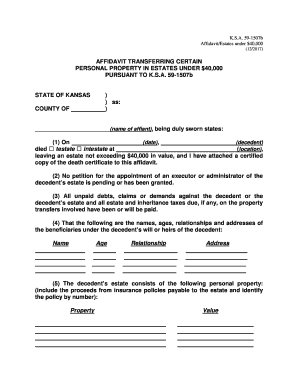
Kansas Affidavit Transferring Personal Property in Estates Under $40,000

This template is fully customizable. Edit the text, fill out the fields, and send it for signature. Give it a try!
Kansas Affidavit Transferring Personal Property in Estates Under $40,000

What this Kansas small-estate affidavit is and when it applies

The Kansas Affidavit Transferring Personal Property in Estates Under $40,000 is a statutory affidavit used by heirs or designated successors to collect and transfer personal property from a decedent’s estate when the total personal personal property is valued at or below forty thousand dollars. It creates a simplified, non-probate path for small estates, requiring identification of the decedent, a description of items, claimant relationship, and a sworn statement of value and entitlement under Kansas procedures.

Why this affidavit matters for small estates

Used when an estate’s personal property does not exceed $40,000, this affidavit reduces time and cost by avoiding formal probate procedures. It streamlines transfer of household goods, small bank accounts, and titled property when custodians accept the affidavit and required supporting documents.

Why this affidavit matters for small estates

Who typically prepares and submits this Kansas affidavit

Typical filers include heirs, small estate personal representatives, and family members seeking to transfer personal property without formal probate in low-value estates.

  • Heirs and next of kin claiming household items and personal effects.
  • Named beneficiaries seeking bank account or vehicle transfer under simplified procedure.
  • Small estate administrators frequently avoiding formal probate costs and delays.

Step-by-step: completing and executing the Kansas affidavit

Follow these steps to complete and execute the Kansas affidavit, from gathering documents through notarization and submission to custodians or county officials.

  • 01
    Gather Documents: Collect death certificate, titles, account statements, and ID.
  • 02
    Estimate Value: Total personal property value; include itemized estimates.
  • 03
    Complete Affidavit: Fill fields accurately, date, and sign where required.
  • 04
    Notarize & Submit: Have signature notarized; deliver affidavit to holders or county.

How to configure an online affidavit workflow

Configure an online workflow for e-signing, conditional fields, and document routing so the affidavit can be completed securely and tracked end-to-end.

Field Configuration
Authentication Email link with optional SMS code
Conditional Fields Show asset fields only if checkbox selected
Attachments Allow PDF uploads for supporting documents
Audit Trail Capture IP, timestamp, and action log

Typical routing and acceptance steps

Typical routing for the affidavit involves preparation, signer authentication, notarization (in person or RON), and final delivery to property holders or county offices.

  • Prepare: Populate form and attach death certificate.
  • Authenticate: Verify signer identity via ID or RON methods.
  • Notarize: Obtain notarization in-person or via approved RON vendor.
  • Distribute: Submit originals or certified copies to custodians.

Digital signing, file formats, and platform considerations

Digital completion options depend on platform support for notarization, file types, and multi-signer workflows and audit trail capture.

  • File Types: PDF and DOCX accepted
  • Integrations: Works with Google Workspace and NetSuite
  • Security: TLS in transit; AES-256 at rest

Timing and submission considerations

Timing matters for filing, creditor notice, and property transfer; follow Kansas rules to avoid claims and to meet any county acceptance windows.

Affidavit Execution:

No statutory deadline; execute promptly after death

Notarization Timing:

Notarize at signing to validate oath

Creditor Notice:

Provide notice period per Kansas probate procedures if required

Custodian Acceptance:

Custodians may impose their own submission windows

Record Retention:

Retain copies as evidence of transfer permanently

Key legal risks and consequences to avoid

False Statement: Perjury and civil liability risk
Creditor Claims: Creditors may challenge transfers
Title Defects: Transfer refusal without documentation
Tax Consequences: Potential reporting and withholding
Notary Errors: Return or rejection by institutions
Estate Litigation: Disputes increase legal costs

Essential data elements required on the affidavit

Decedent Name: Full legal name as on death certificate
Date of Death: Enter date as MM/DD/YYYY
Claimant Identity: Full name, address, contact phone
Relationship: State legal relationship to decedent
Property List: Itemized list with values
Notary Block: Notary signature, seal, and date

Practical tips to reduce rejection and speed acceptance

Follow these practical tips to minimize rejection, speed processing, and reduce disputes when using the Kansas small-estate affidavit.

Verify beneficiary names and ID documents
Before submitting, compare claimant names to government-issued IDs and the death certificate; correct spelling and consistent naming prevent custodians, banks, or title companies from refusing transfers and reduce the risk of later litigation or creditor challenges.
Provide clear itemized property descriptions
Include serial numbers, account numbers, VINs, and precise descriptions with estimated values; vague or aggregated listings invite disputes and may lead banks or agencies to require formal probate or additional affidavits before releasing assets.
Attach supporting documentation for each claim
Attach certified death certificate, title documents, statements, and proof of relationship such as marriage or birth certificates; clear evidence expedites acceptance and creates a stronger record in case of creditor claims or competing heirs.
Consider legal review for complex estates
If the estate includes contested assets, tax liabilities, or federally regulated accounts, consult an attorney to confirm eligibility and document sufficiency; professional review can prevent costly reversals or allegations of improper transfer.

Concrete examples of how the affidavit is used in practice

Realistic scenarios show typical custodial requirements and processing outcomes for bank, DMV, and title transfers using the Kansas small-estate affidavit.

Local Bank Release

A surviving spouse prepared the Kansas small estate affidavit to claim joint and sole bank accounts after the decedent’s uncomplicated death.

  • Bank required certified death certificate and ID verification.
  • With a notarized affidavit, certified death certificate, and matching IDs attached, the bank released funds within two weeks, avoiding probate and saving months of delay and additional legal fees.

Vehicle Title Transfer

An heir transferred a vehicle title using the affidavit when the estate value remained below the statutory threshold and the title had no liens.

  • DMV accepted affidavit with notarized title and proof of relationship.
  • After notarization and submission of the signed affidavit plus vehicle title and proof of relationship, the motor vehicle office issued a new title in the claimant’s name without formal probate proceedings.

Comparison: signNow and common eSignature vendors for affidavit workflows

Key plan and feature comparisons to consider when choosing an eSignature provider for affidavit completion, notarization support, and secure recordkeeping.

signNow DocuSign Adobe Sign PandaDoc HelloSign
Starting Price $8/user/mo $15/user/mo $14/user/mo $19/user/mo $15/user/mo
Free Trial 7-day free trial Varies by plan Varies by plan Varies by plan Varies by plan
Bulk Send Yes Yes Yes Yes Varies by plan
Audit Trail Yes Yes Yes Yes Yes
HIPAA Compliant Yes Yes Yes No No

Frequently asked questions and answers about the Kansas affidavit

Common questions about eligibility, required fields, notarization, and submission process for the Kansas Affidavit Transferring Personal Property in Estates Under $40,000 are addressed below.


Need help? Contact support

be ready to get more
Join over 28 million airSlate SignNow users